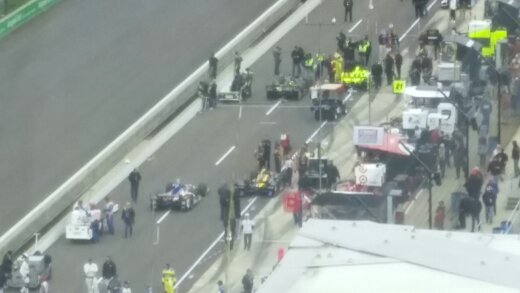
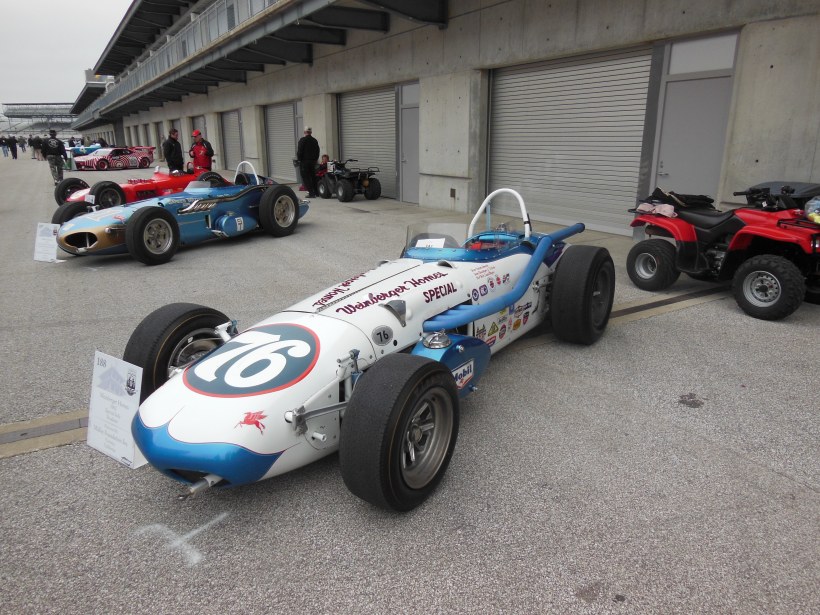
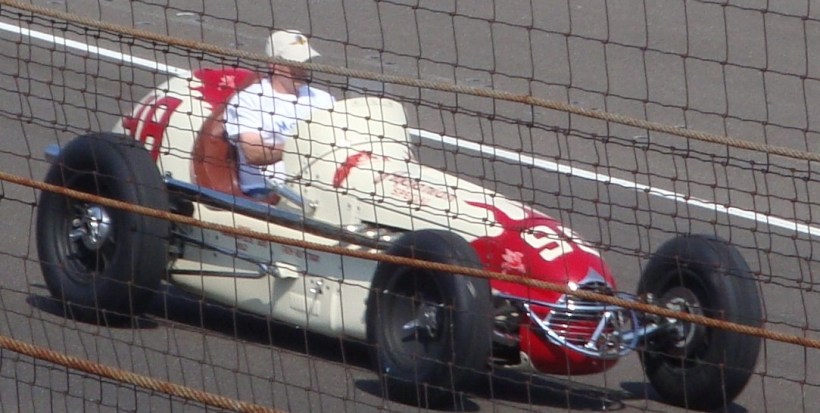
In Six Decades…..

I have seen:

The Track…

Front stretch bricks turn asphalt,

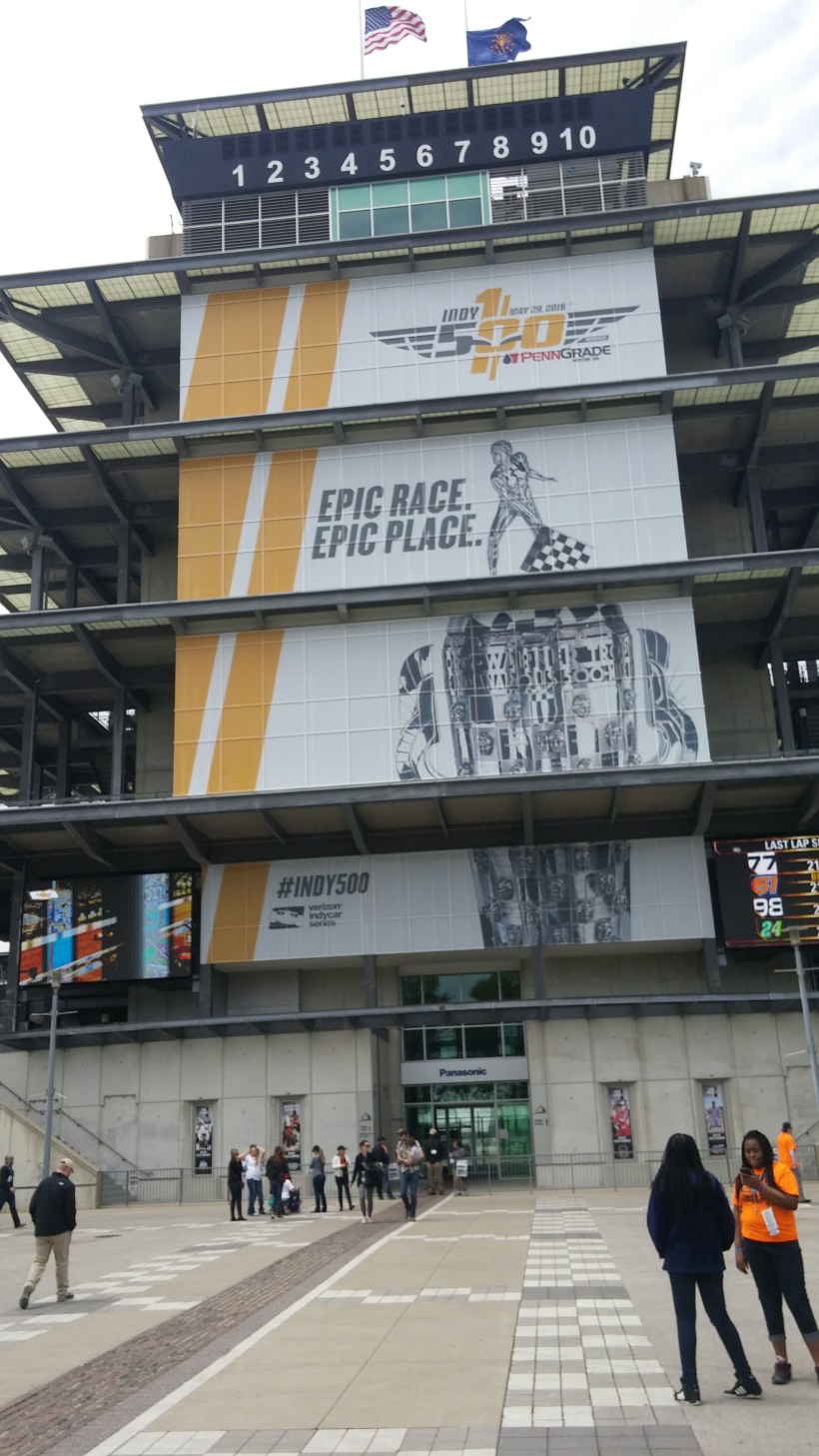
Master Control Tower become new Pagoda,

Parking lot made Plaza,

Pit sign boards fade to radios,

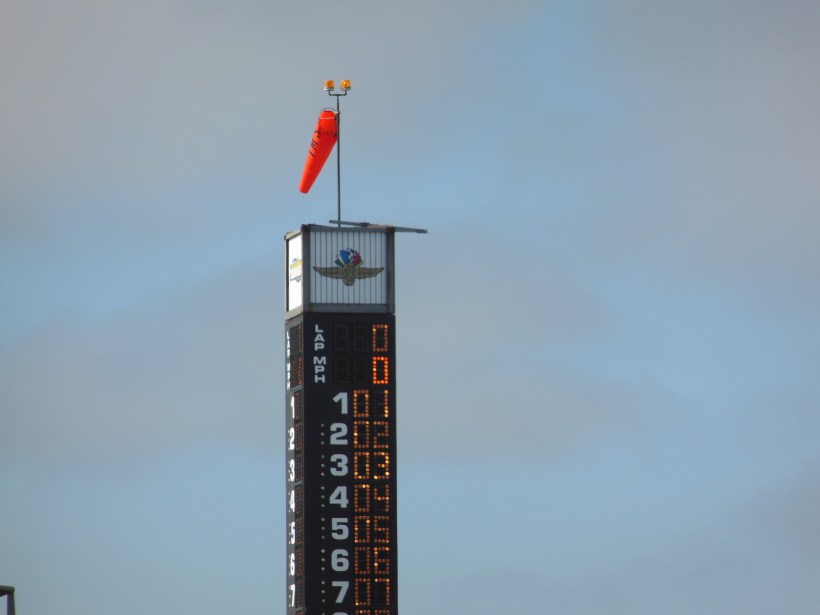
Three scoring pylons,

Frame garages set in stone,

Grandstands rise and fall,

Scoreboards show action around the track.

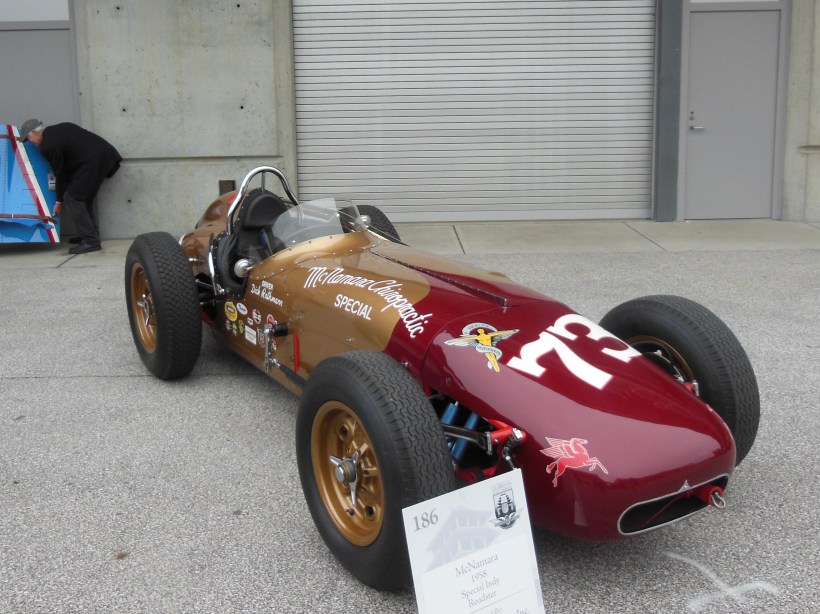
The Cars..

Engines march to the rear,

Tires lose their treads,

Wings replace sleek tubes,

150 mph, 200 mph,

210 mph, 220 mph,

230 mph.

The Race…

Four time winners,

Close finishes,

Great races,

Dull races,

Qualifying silliness,

Qualifying drama.

The Speedway changes,

Yet my emotions stay the same.

The second century of racing is about to begin.


Qualifying at Indy- Let’s Start Over

The final hours of qualifying yesterday and today produced some great drama.  The top spot changed hands several times, and one of the smaller teams ended up with the fastest speed.  The hours before that were as dull as the last hour was thrilling. The current qualifying procedure is the problem. First, with only thirty -three cars there is no intrigue as to who will make the field.  Second, having to qualify on two days to set a position is redundant and meaningless.  Third, too many points are available for qualifying. I have a proposal to change qualifying and add some life to both days.

The problem of car count is most likely going to be the biggest issue for a while. Until a third engine manufacturer comes on board, I don’t see an increase in car on the grid. Even then, we could just see a redistribution of the current field split among three engines rather than two. My proposal assumes just thirty-three entries.

For my new procedure, I’m looking no further than the street/road course qualification process. Yes, knockout qualifying with an Indy twist. Keep the four lap runs. Qualify in groups. Keep the Fast Nine. Here is how my plan works.

Based on Fast Friday speeds,  divide the field into three groups of eleven. the three groups by speed rank:

Group 1: 1,4,7,10,13, 16, 19, 22,25,28, 31

Group 2: 2,5,8,11,14,1,7,20, 23, 26, 29, 32

Group 3: 3,6,9,12,15, 18,21,24,27,30,33.

Group 3 goes first, then group 2 and finally group 1.

Each group has two hours. Each car may make more than one run after everyone has had a turn. The fastest six advance to the next round. The rest of the group is assigned grid positions accordingly. First qualifying group 29-33, second group 24-28, third group 19-23.

That is the Saturday program.  As yesterday showed, six o’clock is not necessarily when qualifying needs to stop.

Sunday’s schedule , after practice sessions for cars still eligible for the pole and for those eliminated Saturday, is a three hour session to determine the fastest nine qualifiers. The slowest nine get grid spots 10-18. After a one hour break, the Fast Nine compete using the current format.

Points are still awarded, but not in great numbers. The fastest in each first round group gets one point. The fastest in the round of eighteen gets one point. The pole winner gets two points.  While it’s easy for me to spend others people’s money,  substantial cash rewards need to be paid out for each round as well.

Qualifying procedures have changed several times over the years.  It seems many changes have come rapidly in the last decade or so. I believe my proposal offers a bit more excitement to the current format. I’m very interested in hearing t your thoughts about this idea and if you have other plans you’d like to share.

I plan several posts this week. Tomorrow, changes I’ve seen at the speedway over 6 decades, a post about my favorite speedway cars, and of course my fearless and probably very  inaccurate race predictions.


Watching a Race in Style

My first stop at the Speedway was the new Hulman Club Suites above Grandstand C.  The track opened it to everyone today, even though it is sold out for this year and there is a waiting list for next year. My first thoughts: Impressive. Luxurious. Outstanding track views. Refuge from the elements. Hot food. This is an amazing space.

Outside the clubhouse on the south end  is a full bar. You can enjoy your beverage there or take it back to your seat or table inside.  Inside hot meals are available for purchase.  Three screens keep fans up to date on track activity. In addition to a video screen, another one shows the on track location of each car, and the third screen displays a timing report.

The views from the seating area outside allow viewing of a lot of the track and the pits. The north end offers a view of turns 3 and 4 plus a look down the front stretch into turn 1. I wouldn’t mind having seats here for the race, club or no club.

I hope the photos below give you a sense of  this space. Next week, a posting on changes I’ve seen at the track and one on my favorite race cars.


Angie’s List Grand Prix of Indianapolis Rix-View

Sunday morning I thought I woke up on Memorial Day weekend 1992.  It was a race day at IMS. The weather app on my phone read 45 degrees with a wind chill of 39.  It would be another bone chilling day at the track as the Autumn of 2016 continues this month of May.

I joined other brave souls at the track. Race fans are a loyal, hardy bunch. We will endure almost anything to watch a race. Cold, rain, snow, tornadoes, whatever can be thrown at us. If a race is scheduled, we will be there.  Given the conditions, and the durability of the dedicated race fan, I thought the turnout was surprisingly good. The viewing mounds looked quite full, although the grandstands did not. Considering this race was not the focus of the month, I felt the crowd would be significantly down from the first two years of this race, and it was.

The race itself was better than last year’s. I rate it good, not great. There was passing. There were interesting pit strategies.  The driving stars of the day were Conor Daly for taking the lead on a restart and stretching it;  Graham Rahal coming from 24th to 4th; Alexander Rossi finishing 10th with a steady drive;  and Helio Castroneves overcoming brake issues from qualifying and driving to a solid 2nd place.  It was nice to have a race where the dreaded two words Race Control were not mentioned. We had a smooth race decided by the drivers. The younger drivers in the series provided many of the highlights.

My viewing plans for the race changed Thursday night. I was planning to watch from the Turn 1 viewing mounds with some friends. Thanks to my friend Shay Hazen, owner of Live Full Throttle, and her partnership with Verizon, I was offered a Pagoda suite pass. Of course I accepted. Besides having a warm place to watch the race, there was another benefit: I could see the race play out in front of me. I still feel I have a lot to learn, and viewing from the Pagoda helped a lot.

I learned a lot about how a race flows, how pit stops work, and how cars approach for a pass. Watching cars take slightly different lines through the corners is something that can’t be seen from ground level.  Seeing most of the way around the track rather than the usual limited view from a seat location gave me a completely new perspective of a race.  I’ve watched pit stops from across the track, but from above the choreography is exciting to observe. Below, Jack Hawksworth pits.

ALGP16 167

So now the real Fortnight of May begins. I will be at the track daily through Race Day and probably a day or two past that. Thursday, a story about the changes I’ve seen since I began going to the track.

The Day the Grandstand Disappeared


Tension began May 1, 1964, and persisted throughout the month at the Speedway.  Rear engine cars were poised to have a strong month. The traditional roadsters still held favor with many drivers and fans. This month could be a turning point for the car of the future.  Who would prevail?

There was talk that a rear engine car could complete the race without a pit stop.  Could cars making stops overcome that by pure speed?  It seemed as if they would have to have quite a gap to complete their stop and come out of the pits still ahead. Would the extra fuel load be an early disadvantage?  I sensed it was dangerous to have that much f fuel on a race car.

During Race Week, the newspapers had full page ads about going the entire race without a pit stop. The ad mentioned the driver was surrounded by 75 gallons of fuel. I was not impressed, I was concerned.

Race morning was cooler than usual. Our routine was the same: up early, pack the cooler, head to the track to sit in traffic. I told my brother during a long delay about the dream I had the night before.  I dreamt of a multi-car crash coming out of turn 4. A car caught fire and stopped against the pit wall. Several other cars spun and hit the outside wall.

We finally parked in the infield and went to our seats in the Tower Terrace. We were about halfway between the Start/Finish line and Turn 4.  I had purchased these seats the previous year. They were great. We could see the cars come out of Turn 4, the start of the race, and pit stops.

The prerace ceremonies built to their always stirring conclusion, and the command to start engines echoed over the PA.  The combination of rear engine and front engine cars made an interesting looking grid.  The pace car pulled into the pits and the race was on. It was a furious start.

Out of the fourth turn to complete the second lap, I watched Dan Gurney pull to the inside to pass A. J. Foyt., rear engine vs. roadster. I followed the two cars down the front stretch. My brother tapped me on the shoulder and pointed to the fourth turn. I turned to see a four-wheeled fireball sliding across the track. As it came to rest against the outside wall,  we heard a loud thump. I knew the result immediately.  Then the vision in my dream  appeared. A burning  car rested against the pit wall while the first inferno continued behind it. Cars sat helpless everywhere.

The smoke became so thick, black, and tall that the grandstand on the outside of the track disappeared for what seemed to be several minutes. A burning tire flew over the fence between two stands.  A quarter of a million people, cheering just moments before, stood mostly silent, with some low murmuring. The red flag stopped the race.

There was no shock that Tom Carnegie began to announce a death. The shock was which driver. Eddie Sachs? No. It can’t be. I had figured out that the fiery car was Dave MacDonald. How was he still alive? The silence became complete.

Nearly two hours later, the race restarted. There was no question that it would not. Death was accepted as a possibility in that era. The spectre of a fatality hung over every track every race. A race where no one died was considered a relief. The restart began with a subdued crowd watching.

Jim Clark dominated until his suspension broke. A battle between A J Foyt and Parnelli Jones developed. Jones came in to the pits while leading. He never left. A spark blew the fuel cap off and he left his pit with the car on fire.  He leaped out, and the fire was extuinguished. Shortly afterwards, we learned that Dave MacDonald had also died.  Foyt led the rest of the race.

1964 was the last victory for  the front engine car at Indianapolis. Good things to come of the disaster were the introduction of a fuel bladder cell in the fuel tank and the banning of gasoline. Mandatory pit stops became part of the rules. When something bad happens in racing, it accelerates the search for safety measures.  It would be nice if some ideas could become rule before something happens.

I never entertained the thought of not going to another race. For me, it was simply a difficult part of the sport. I don’t like it; I get upset when a driver dies. Racing is dangerous. Things will happen.   I really wish these incidents didn’t occur, but I realize it is a possibility.

I don’t have many dreams the night before the race anymore. Fortunately, the ones I have had did not happen the next day.  I have seen other scary crashes during the race but nothing that involved a grandstand blotted out by a smoky cloud.


My First Turn Terrace Family

This is my second episode of my adventures in racing.  Posted on Facebook last week.  A new story will be here on Thursday.  Enjoy.

First Turn Terrace Family

Marco Andretti and Sam Hornish , Jr. barreled out of the fourth turn heading for the checkered flag. They appeared to be one 8 wheeled car instead of two.  Hornish edged past Marco just before the finish line.  Those of us in the First Turn Terrace watched on the video board, then turned to salute the winner as he drove by.

Everyone gradually packed up their coolers and other belongings . We shook hands, and as always, said, “See ya next year.” Sadly, there was no next year. Later in 2006 the speedway would tear down the First Turn Terrace over the winter to make room for the new motorcycle course.

***********************************

I had missed the 1984 race. I decided to get a reserved seat instead of general admission for my return in 1985. The First Turn Terrace was my first choice. It looked like a great view,  all of turn 1 and the short chute. I was not disappointed.  From the top row I could also see a bit of turn 2. My next concern was who else sat here. Were they just casual fans who would change every year, or were they diehards like myself?

Per tradition (mine) , I was one of the first to arrive at the track. Since this seat was new for me, I decided to check it out first before walking around.  The track view was great. I said hi to the other three people in the stand at the time. They were several rows down and to my left.

After a stroll through the infamous snakepit (a story for when the kids are asleep), I saw people settling in near my place. I returned to my place, said hello, and we talked about how we thought the day would go. Others soon filled in the empty spaces. These newcomers were the regulars I would spend the next twenty race days with.

The man next to me was an older gentleman who always had a cigar stub in his mouth. It could very well have been the same cigar all twenty years since I never saw it lit. He was obviously a veteran race attendee, although he never said for how many years. We discussed our favorites drivers and favorite races.

The row immediately in front of me included a young couple from Southport, and a family from Wisconsin. They were very nice people. One of the men from Wisconsin also was steeped in race history.  I really loved talking to him every year. On my other side two seats were part of a large group from Canada. They could not get seats all together, so they rotated their scattered sections each year. I think it took five years before I met them all.

Each year, I could look at my watch and know who would be the next to appear. The cigar man was usually one of the last. The Canadians’ timetable varied depending on who was sitting there.   The Wisconsin group was always there at 10 o’clock, pretty much on the dot.

The reunions made Race Day official.  We shared food and drink.  Someone began a driver pool . We talked about how the rest of the previous year had gone. I looked forward to seeing these people again as they had become part of my race day family.

Our best bonding experience was in 1992.  Indiana has had milder winters than that race day.  Some people brought blankets. They were kind enough to share them with those of us who thought just wearing warm clothes was enough. We took turns using the blankets.  If the stands had been made of wood, we probably would have burned them. This was also the worst 500 I have ever been to. The great finish only slightly helped.

When the Speedway called in the fall of 2006 to inform me that my grandstand was being torn down, my naive hope was that surely some of the group would be relocated near my new seat in G Stand.  I knew it was a long shot, but I searched both sections of G to see if any of them were there, then walked around just hoping to find some of my family.  It was a fruitless search. I have not seen any of them at the track since the end of the 2006 race. The family had officially dispersed.

I now attend the race with my best friend from college and her family and friends.  Somehow they ended up with seats in G Stand by random luck. We plan to find a new location together should G Stand ever become a part of Speedway history.  I’ve lost one family there. I don’t intend to lose another.


My First 500

Welcome to my blog. I will be writing about my experiences and adventures as a race fan. To begin, my first post is about my first 500. Some of you may have read it on Facebook, as well as the second one which will be here Wednesday.  A new post will be up Thursday. Please enjoy, and thanks for reading.


My dream was only minutes from coming true.  The 1962 Indianapolis 500 pace lap just started. I stood weak-kneed, my heart pounding, anticipating the start.  The cars slowly rolled by three abreast, a roaring giant multi-colored centipede.  They went into turn 3, then disappeared.  When I saw them again, they would be racing.

********************************

Seven years earlier I first listened to the race on the radio. I had wanted to go ever since. There were obstacles. I could not yet drive. My parents had no interest in attending.

The usual kid arguments met stony denial.  “Bob goes every year”; “I’ll mow lawns to pay for my ticket.” “You could just drop me off and pick me up”. I found out later that was a naïve suggestion given the race day traffic. Nothing worked.

Then a miracle happened.  Bill began working for my dad. He also happened to be a race official.  Transportation issue solved.  Tickets were now the biggest concern.  They were not readily available then as they are now.  Enter Grandfather.  A client gave him two tickets. All I had to do was mow his lawn and the tickets were mine.

I was insufferable to others the following week.  I had tickets that I had earned, and everyone heard about it. They heard about it more than once. My friends and family were looking forward to Race Day more than I was, albeit for a different reason.

Now Race Day arrived.  Bill picked up my brother and me early. His credentials allowed us quick entry and easy parking in a preferred lot behind the control tower. I thought ”This is great!” Then, for the first time, I looked at the tickets to see where our seats were.

I asked Bill where we need to go to get to our seats.  He grinned, surely to keep from laughing, and said, “Go to the other side of the track, through the tunnel, then left.” Fortunately the race didn’t start for three and a half hours.  The safari began immediately.

The intrepid hikers eventually completed their quest, slogging through thickets of cars, seas of campers, and mountains of beer cans and trash. We then ascended the final summit to our seats, and basked in our victory.

*************************************

The race began.  The centipede had turned into a snake as the cars chased each other single file around the track.  It ended all too soon for me.  Rodger Ward drove a great race and had very quick pit stops to take the win. Jim Hurtubise and Len Sutton, finished the race for the first time in their careers. They acted as joyful as Ward as they came by on their cool down lap.

After another hike over taller mountains of trash, angry rolling seas of cars, and hordes of campers eager to leave, we returned to the parking lot. We waited a couple of hours  until traffic eased.

While we waited, many people connected to the teams walked through the area. I noticed a man introducing himself to everyone as he walked through. He extended his hand and said, “Lou Meyer.” I introduced myself and he started to walk away.  Then it hit me.  He won the 500 three times!  I called after him, using all of my 15 year old sophistication, “Didn’t you win ..?”  The question never finished as he just said, “Yeah,” and kept walking.  It was a lesson in humility I’ve never forgotten.

**********************************


My 50th race is just 28 days away. Much has changed in my life  since Memorial Day 1962. Much has also changed in racing yet the 500 endures.  Much has not changed though. I still sleep very little the night before the race. I must bring specific food and drink to the track.  My knees still get weak and my heart still pounds as the command to start engines is given.

Each year when I arrive at the track on race morning, I fondly remember my first race, all the scheming to get there, the spectacle,  and the lesson in humility from a former winner