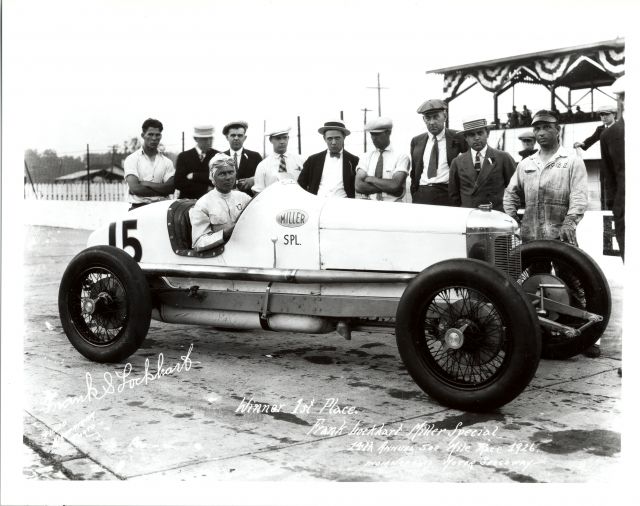
He was like a comet, a brilliant star who raced across the racing heavens and burned out in an instant. Frank Lockhart came to the 1926 race to drive in relief of Bennett Hill, but when owner-driver Pete Kreis became ill with pneumonia, Lockhart got the ride.
(For more about Pete Kreis, I recommend The Last Lap by William Walker, available at Octane Press.)
It took the rookie three attempts to qualify the car, and he started the race from the middle of row seven in the 28 car field. Lockhart quickly moved through the field at the start of the race; He had assumed the lead the lead when the race was halted by after 71 laps.
Pole sitter Earl Cooper did not lead a lap and retired after 74 laps with transmission problems. The first sixty laps saw a battle for the lead between Phil Shafer and Dave Lewis. Shafer finished 10th, while Lewis retired after 92 laps.
Lockhart took the lead on lap 50 and led all but six laps the rest of the way.
It took an hour for the track to dry. Lockhart led through lap 100, then Harry Hartz led six laps. Lockhart regained the lead on lap 107 and was never caught.
Rain began again on lap 152 and intensified eight laps later. The race was stopped and declared official. Lockhart won by nearly two laps over Hartz, who had an issue on his final pit stop.
In 1926, 350 miles needed to be run for the race to be official. It was the first time the Indianapolis 500 had been stopped and called complete because of rain. There would not be another rain shortened race until 1973.
In 1927 Lockhart qualified on the pole but dropped out after 120 laps with a broken connecting rod. He had led 110 laps.
Unfortunately, 1927 was to be Lockhart’s final 500. He was killed in Daytona Beach, Florida, the following April attempting to set a land speed record. A tire blew out on his second pass sending the car into a barrel roll. Lockhart was thrown from the Stutz Blackhawk Special Streamliner and died instantly.
In his two Memorial Day starts, Lockhart led 205 of 280 laps run.
Frank Lockhart finished second in the season points in both 1926 and 1927, winning nine races. His tragic demise cut short what would have been stellar career.
Notes
For the 1926 race, riding mechanics were optional, but none were used.
The race was the first race in which no starter from the inaugural event in 1911 drove.
All starters received prize money. Lockhart won $35,600, and last place finisher Albert Guyot took home $500.
It appears a pattern is beginning to develop in years that end in the number six. The 1916 race was scheduled for a shorter distance. The 1926 race was shortened by rain. As we go through this series, we’ll find more oddities about the races each mid-decade.
1926 began a string of three consecutive races won by rookies.
,
 The Pit Window by Mike Silver