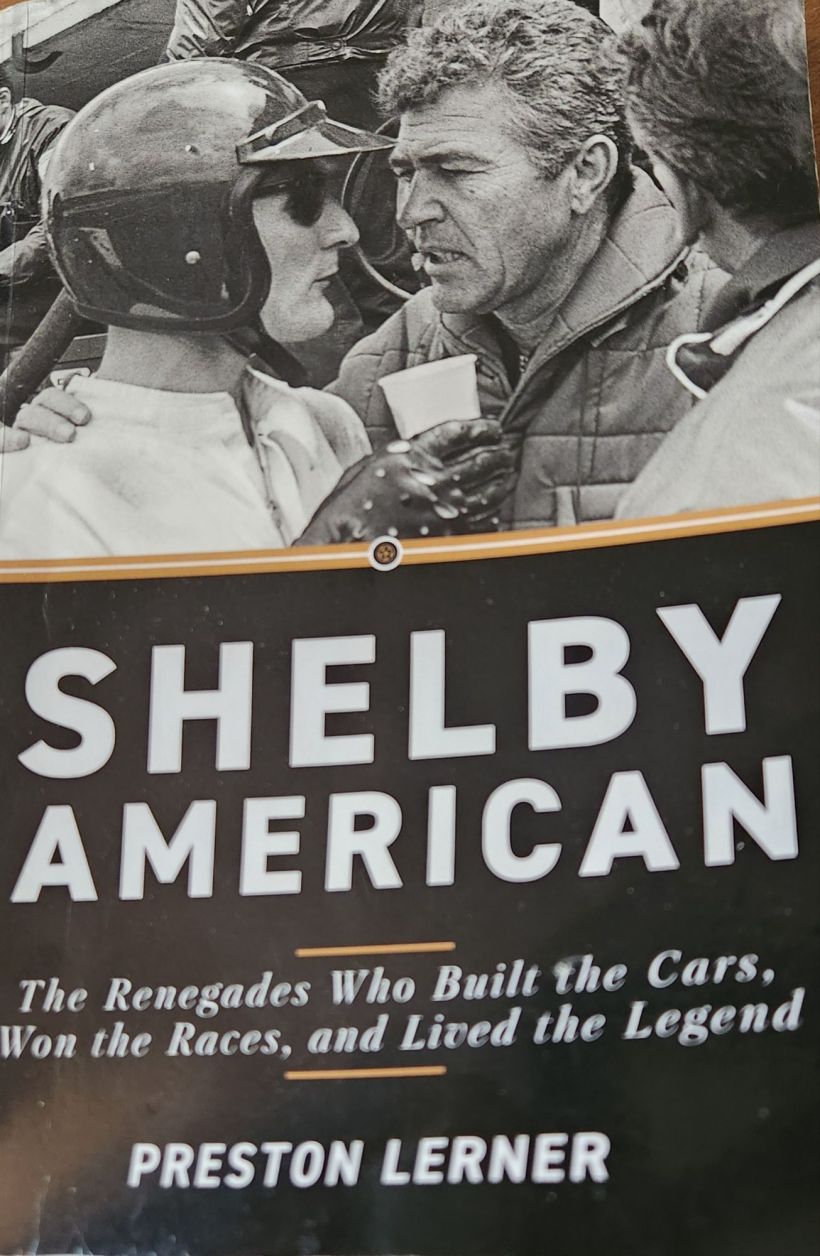
Shelby American- Book Review

Carroll Shelby did things his way. Even his association with Ford didn’t hinder his independent thinking or methods. Sometimes his ideas worked, other times they failed. Much of the time Shelby was his own worst enemy.

I have always been fascinated by the Cobra and Shelby, and I learned a lot reading this biography.

Shelby American by Preston Lerner chronicles Shelby’s and Shelby American’s time as one of the dominant race cars of the mid 60s. It wasn’t all easy. Parts failures while leading races. engine failures (six in one weekend) were interspersed with podium sweeps and runaway victories.

Shelby was an outstanding sports car driver in the 50s, highlighted by his Le Mans win in 1959. He had a heart condition which he treated by gulping nitro pills while racing, but by the end of 1960, he had to retire. Shelby went out in style, finishing second in his final race at Laguna Seca in a birdcage Maserati and clinching the USAC Road Racing Championship.

Throughout its brief history many top drivers drove for Shelby- among them Dan Gurney, Ken Miles, Dave MacDonald, Lloyd Ruby, Parnelli Jones, and Bob Holbert.

Fourteen months later he tested an AC Ace at Silverstone. The car would become the basis for the Cobra. Shelby had a chassis shipped to Los Angeles and put a 260 cubic inch Ford V8 under the hood, modified the body styling, and the Cobra prototype was born.

Shelby American and the Cobra cars would have years of triumph and years of famine. 1966 was the best year, as the Cobras and the GT cars he helped Ford develop won almost every race they entered. Ford’s victory at Le Mans was vindication for Henry Ford II, who had a feud with Enzo Ferrari.

Winning Le Mans in 1966 came at a cost. In a test at Le Mans Walt Hansgen died in a crash. Ford’s 1-2-3 finish was badly handled by Ford executives, and Ken Miles was denied a win he deserved. Miles died in August while testing the car.

Shelby entered the Indianapolis 500 in 1968 with a turbine powered car. USAC had changed the rules for turbines for the new season, severely cutting their power. Bruce McLaren and Dennis Hulme drove the cars, which were slow in practice. One of Shelby’s mechanics did an illegal modification to boost the output of the engines, but it was discovered, and the cars were quickly withdrawn.

I wonder what the 500 would have been like with Andy Granatelli and Carroll Shelby together on pit lane, two colorful characters grabbing most of the attention .

In 1969 Shelby American closed its doors. Ford did not renew their deal with Shelby and took this part of their program back to Michigan.

The biography is well written, but the author gets into a lot of jargon and technical details at times. His best writing is when he is describing the races, especially Le Mans.

For those interested in racing history, it is a fascinating look at United States sports car racing in the 1960s. Shelby American is available frrom Octane Press

Movie Review : Ford vs. Ferrari

I’m not sure Ford vs. Ferrari is the appropriate title for this film. Shelby vs. Ford, Miles vs. Beebe, or The Ken Miles Story might have more aptly described the content. Ferrari plays just a small part in the overall plot. The good news is this is a very entertaining film, well acted by Matt Damon and Christian Bale. It features some decent racing sequences of LeMans, including some shots at night. I found those especially good.

The first two thirds of the film focuses on Henry Ford II’s plan to pull his company out of its sales slump. In the early sixties, sales had dropped as the baby boomers sought sleeker, faster cars. He decides on the quick fix of buying financially strapped Ferrari. On the verge of the sale, Enzo Ferrari rejects the offer because  he would lose of the control of the racing program. Ferrari then accepts an offer from Fiat for the same price.

Ford soon introduces the Mustang under Lee Iacocca’s direction and plans to build a LeMans car to beat Ferrari. They reach an agreement with Carroll Shelby to build what became the Ford GT40.  Shelby and his friend and test driver Ken Miles don’t exactly see eye to eye with the Ford executives. Miles and Leo Beebe in particular don’t care for each other. Shelby and Miles are abrasive characters who have issues following the company line.  However, when they win the 1966 24 Hours of Daytona and the 12 Hours of Sebring, Ford grudgingly gives them some respect.

After Ford’s disastrous showing in the 1965 24 Hours of LeMans, Shelby’s team continues to develop the car with the aid of a larger 427 engine. Miles, who was not allowed to drive in the 1965 race, starts the 1966 event and charges from a lap down at the start to a commanding lead. The controversial finish of that year’s race, dictated by Leo Beebe, is still contentious.

If you go expecting lots of racing, you will be disappointed. Almost all the racing footage takes place in the last third of the movie. I was expecting more racing. There are lots of shots of the speedometer(?) and the tachometer hitting 7,000 rpm. And of course some crash scenes, a few of which seemed gratuitous.

A subplot involves Miles, his supportive wife, and his son Peter, who adores his father. Theses scenes help round out Miles’ character and give him a sympathetic touch. Shelby races vicariously through Miles after Shelby’s career was cut short by a heart condition.

As a film Ford vs Ferrari is entertaining. I liked the depictions of the characters, especially since last week I read Go Like Hell. I found their screen portrayal true to the book. I was a bit disappointed that most of the other stars of the era were not depicted, even in a cameo. Several were mentioned, but not portrayed.

My book review: https://wordpress.com/read/feeds/90591962/posts/2484338576

If you want to see a racing movie with lots of racing, I recommend Rush or Grand Prix. I recommend Ford vs Ferrari as a study of the era when the business model of racing began to change as Ferrari’s dominance begins to fade from the sports car scene.