Quick Thoughts- Indycar Grand Prix Qualifying

Nice to see so many different drivers in the second round.

Even nicer to see new faces in the Fast Six.

Scott Dixon and Will Power have a big chance to move up in the point standings tomorrow.

I can’t remember the last Ganassi front row lockout. It might have been when Dario Franchitti and Dixon were together.

Jack Harvey was having an under the radar good season. It’s not under the radar now. When you remember Harvey is not full time, this makes a Fast Six appearance even more impressive.

The Fast Six had two rookies, three drivers making their first appearance in the final round, and two drivers who make regular appearances.  The changing of the guard is getting closer.

Weather could play a huge role in tomorrow’s race.

Full qualifying story up later tonight. Thanks for following along today.


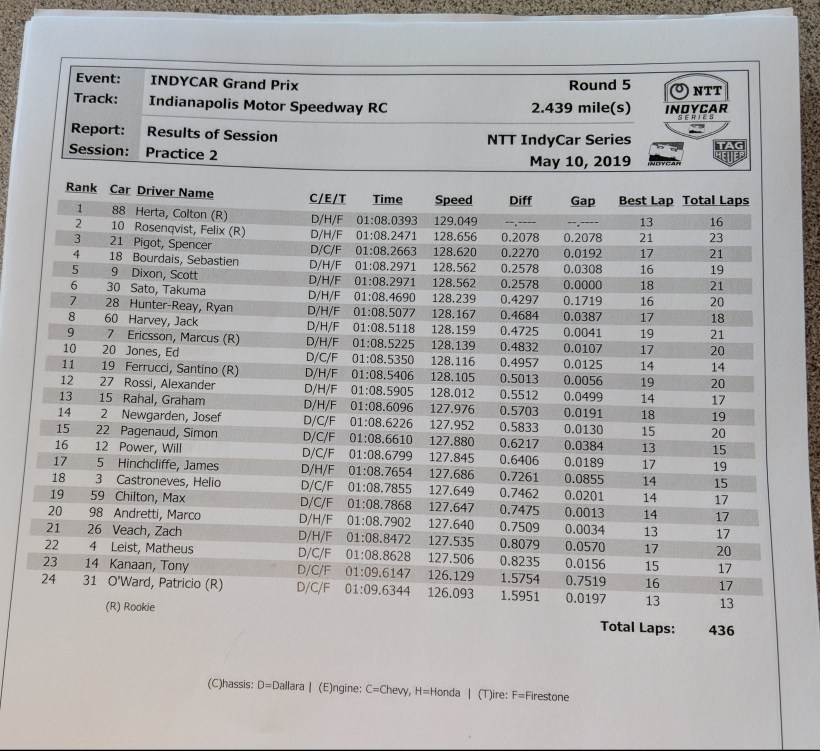
Power Leads Practice One

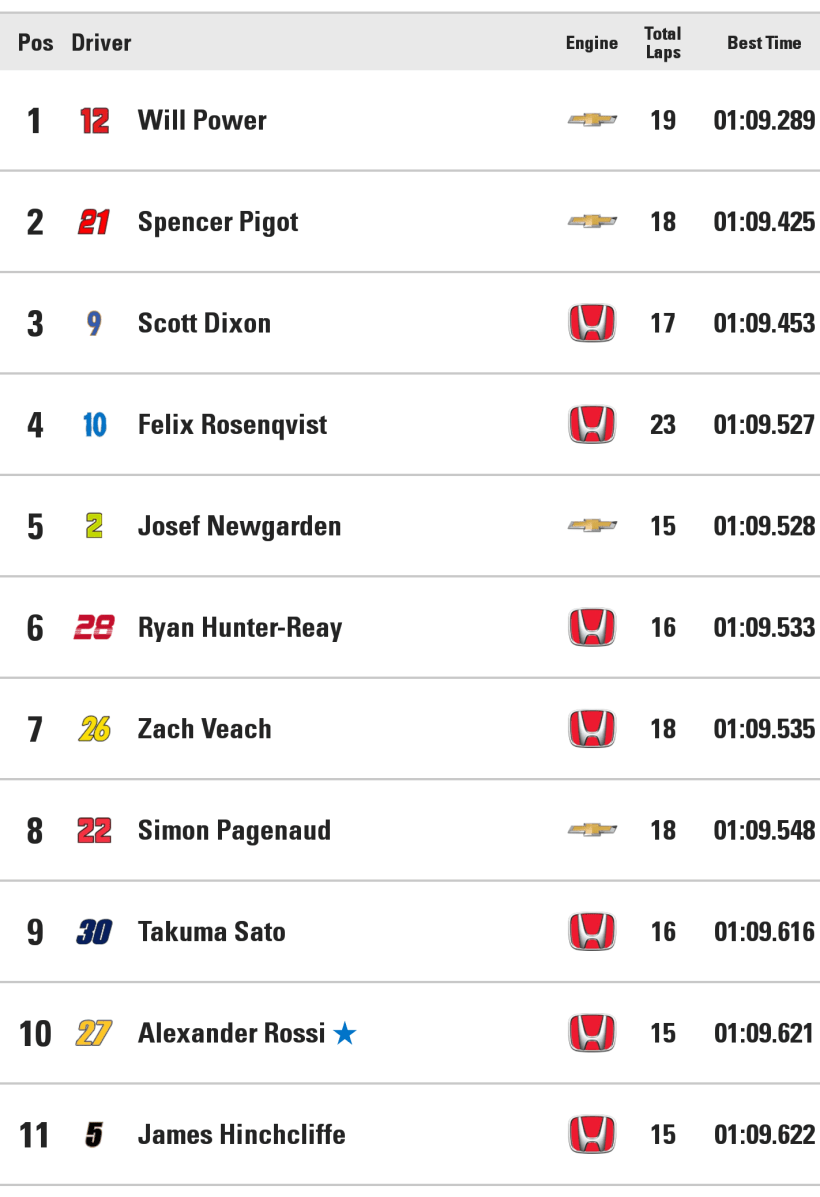
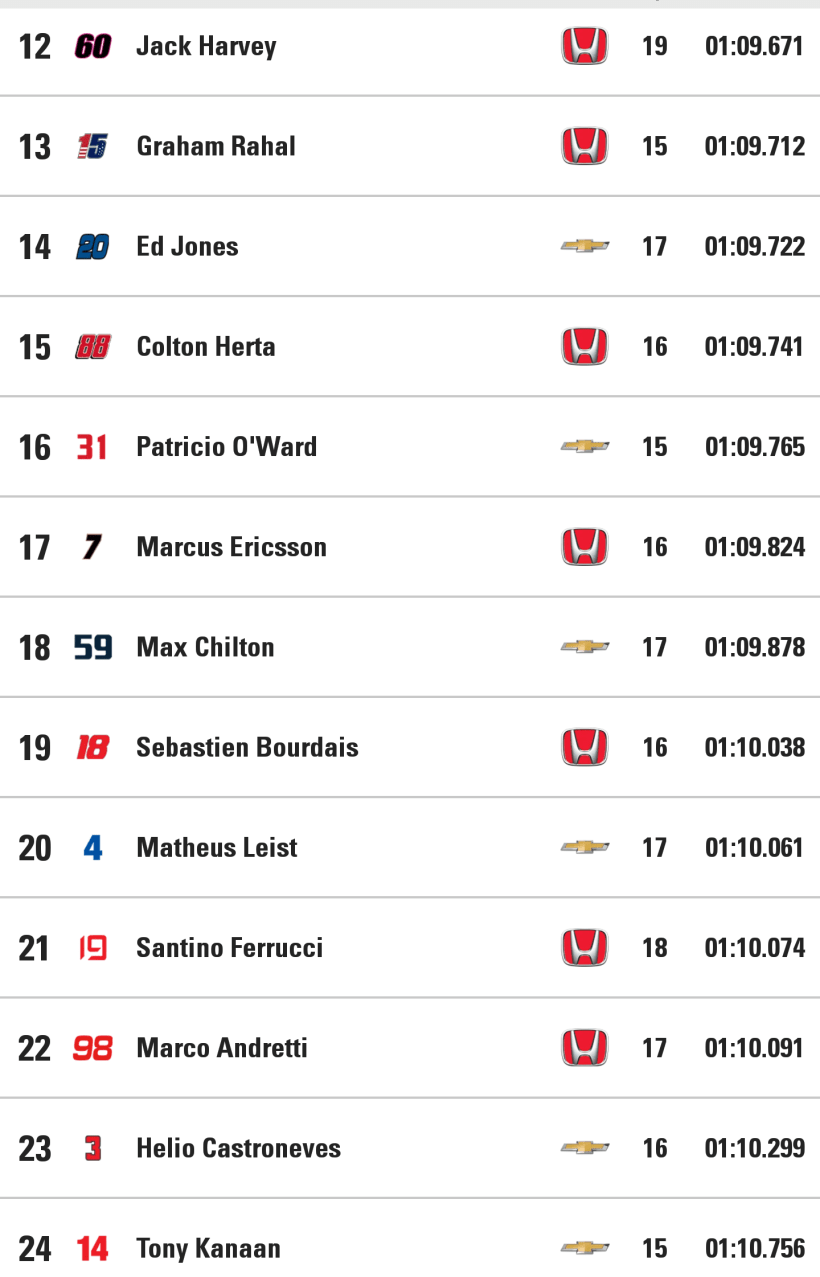
Will Power led the just completed first practice with a lap of 1:09.2 seconds.  He edged Spencer Pigot who led the session until a red flag for Helio Castroneves halted the session with just over two minutes left.  Castroneves’ car stopped in turn 10.  After his car was cleared, the field was allowed to take one more hot lap. Power once again showed who owns this road course.

Results:

wp-15574982609424693229832504344234-e1557498399100.png

wp-15574982317447599909807295520613-e1557498628996.png

It’s Opening Day at IMS!

At last the Indianapolis Motor Speedway is open for racing. Today is practice and qualifying for the Indycar Grand Prix. The sixth running of this race begins the NBC network television era. Fans are looking forward to how the network will cover this race and the 500.

While some fans don’t care for this event, it has served its stated purpose, which is to attract a bigger crowd than the opening day of practice or even qualifying would have. Four days of qualifying is no longer necessary, which leaves an open weekend that needed to be filled.

It is cool and cloudy as Indycar’s first practice begins in 15 minutes. It will be interesting to see how much running happens in this session.  Back after practice with results.


Bump Tales- 1957: Busy Bump Day Knocks Out Parsons; 1950 Winner Still Starts the Race

Indianapolis Motor Speedway has made many necessary changes over the years for various reasons. The track usually doesn’t handle the changes well at first.

Two personal notes:

First, The Pit Window turns 3 today. I want to thank all the readers who were with me May 9, 2016, when this all started. i also want to thank all who have come on board since then.  I have had tremendous growth the last 16 months. It has been very humbling to do something I love and hear how much others enjoy it. 

Second, I chose this Bump Day because it was the first day I ever went to IMS.  I was 10 and I’ve never forgotten it. The cars were loud and seemed very fast.  I still remember the sound of the cars driving over the quarter mile stretch of bricks on the front stretch. It’s a part of Speedway history gone forever. i am glad I got to see it. Okay, enough about me.

Indianapolis Motor Speedway has made many necessary changes over the years for various reasons. The track usually doesn’t handle the changes well at first. There is confusion which sometimes leads to chaos. 1957 was no exception. Wild qualifying led to a crazy race start and a post race protest.

The second year of United States Auto Club sanction was the first year for for the pit wall and the Master Control Tower, which replaced the old Pagoda erected in 1926. With the pits separated from the track,  officials decided to begin the race with a parade lap and a pace lap, perhaps to help the drivers orient themselves to the new setting on race day. There would be two years of chaotic starts with confused drivers with the new configuration.

Bump Day 1957 was one of the busiest Bump Days ever. Twenty- one cars qualified and nine were bumped. The field was filled by 2:30 pm, leaving lots of time for bumping.. As always, the drama didn’t end until the gun went off.

1950 winner Johnnie Parsons went out first despite the high winds.  His Agajanian team figured the winds would continue all day. His average of 138.975 put him in the field. They thought that time would be hard to beat with the high winds. Of course, around four o’clock the winds died down. As usual, it was the sign for cars to line up to attempt to get in the field.

Rookie Bill Cheesbourg had just been bumped. He lined up another ride with help from Jimmy Bryan.  Cheesbourg bumped Parsons from the field.  Later in his career Cheesbourgh became adept at putting cars in the field at the last minute or hanging on to the last spot.

In an attempt to get back in the race, Parsons turned some practice laps in the Jones and Maley Special. He pulled into the pits and said he wasn’t comfortable in the car. Parsons suggested Bob Christie try to qualify it. Christie had been bumped by Chuck Weyant.

He went out with just a little time left and made the field as the gun sounded. Christie had bumped Billy Garrett by 0.43 seconds. Garrett was driving one of three federal engineering Special cars. The team, managed by former driver Russ Snowberger had both cars bumped on this Sunday. they would be the first and second alternates. The third car had been badly damaged earlier in the week and was not repaired.

Sunday ended with a former winner on the sidelines in a wild day of action. But there were more strange happenings to come before the race the following Thursday.  It was almost as wild as Bump Day.

Race Week Drama Begins

On Sunday night the Speedway ruled that with the new pit configuration, the alternates would not be allowed to be on pit lane Race Day morning unless something happened to one of the starters before Thursday. If the 33 qualifiers presented themselves to their pit stalls on race morning, the alternates would not be allowed to start.

Monday night Dick Rathmann, who qualified 17th, was attacked by a group of teen agers who threw rocks at him. He was examined by track doctors Thursday morning and not cleared to race.  Johnnie Parsons got the ride. In a strange ruling the car stayed in its original grid spot. I’m not sure why. I will have to research that more. Parsons finished the race in 16th place, three laps behind the leader.

Race Day

The command was given and the cars started rolling on what was not the first of two laps before the green flag.  Elmer George hit the tail of Eddie Russo’s car, ending the day for both before the green flag. George had qualified 9th and Russo 26th. Why they were near each other on the parade lap is curious.

The race finally started. Sam Hanks got to the lead on lap 36 from his 13th starting position. He led 136 laps en route to a then record  average at 135.601 mph. In an emotional Victory Lane interview, Hanks retired from racing. Some thought he might become Speedway president.  Tony Hulman had done a decent job after Wilbur Shaw’s death,  but some believed a former driver would be better suited for the task.  Hanks became Director of Competition for USAC instead.

End of story? No. The Federal Engineering team filed a protest stating that because of the George/Russo incident their cars should have been allowed to start the race. The protest was denied. The Speedway had made clear in their Sunday ruling that the alternates would not run if the qualifiers presented their cars race morning.

Another note about 1957: Wednesday, the night before the race, the first 500 Festival Parade was held in downtown Indianapolis.

Look for my Grand Prix Preview on Wildfire Sports tomorrow. I’ll be back later today with some developments that made me say “Hmmmm.”
 

When Cars Were Special

Of course there is nothing special about the current Indycar. They are all the same except for the engines.

It had to happen. This may seem like a “get off my lawn” post. I have been thinking the last couple of days about the names of cars and how I miss the term “Special” in the name.  A Special added the air of romance to the race. The car name gave a hint of its personality. The Bardahl Special sounds like a mean machine. Travelon Trailer Special?  It had to be a sleek cruiser.The Bowes Seal Fast Special just rolls off the tongue.

Of course there is nothing special about the current Indycar. They are all the same except for the engines.

Cars in the 500 weren’t always called specials. From 1911-1919 the car was just the manufacturer’s name. There were no company sponsors.  The first instance of the term special I found was in 1920, when John Boling drove the Richards Special to an 11th place finish. In 1923 all top 10 finishers’ cars carried Special in the cars names.

In 1924 all cars in the field were Specials. While not every car in following years was a special, the majority of cars were. In the era in which I grew up, which was the 50’s and 60’s, it seemed as if every car was a “Special.”  The term made sense as each car was individually built by people who had their own ideas of how a winning Indianapolis car should look.

In 1959 Roger Ward won the 500 in the Leader Card 500 Roadster. This smal drip away from Special was barely noticed. In 1961 jack brabham brought his rear engine Cooper-Climax to the race. We were back to just the car maker as the name. In 1963 Jim Clark entered the race with the Lotus powered by Ford. Dan Gurney entered his Eagles and then McLaren joined, all with thesponsor and car manufacturer name instead of Special.

Mark Donohue won in 1972 in the Sunoco McLaren. The term Special was still on some cars up until around 1990. Now the name has completely disappeared.

It’s understandable, since the cars are spec. When Special first began disappearing, however, cars were still produced from several sources. Somke manufacturers like Swift, March, P,enske, Foyt, March, and Lola began making cars.

What I mostly miss are the great sponsor names that Special just seemed to fit at the end of. My all time favorite car names-  Bowes Seal Fast Special, Travelon Trailer Special,  Thermo-King Special, Dean Van Lines Special, and Wynn’s Friction Proofing Special.

I’d like to hear what your favorites from the “special” era are. Send them to me in the3 comments section and I’ll do a follow up column next Wednesday. I know I’m forgetting some.

Reminder- The mildly popular Bump Tales returns tomorrow.

Kaiser Confirmed in Juncos Ride for Indianapolis 500

In a surprise to no one, Kyle Kaiser today was confirmed as driver of Juncos Racing car 32 for the 103rd running of the Indianapolis 500. Kaiser drove for Juncos this season at the Indycar Classic at Circuit of the Americas. The 500 will be just the second race in the NTT Indycar series this year for Juncos. More races are not confirmed at this time.

Kaiser won the 2017 Indy Lights championship driving for Juncos and it was assumed he and the team would move to Indycar full time.  Kaiser shared he car last year with Rene Binder and Alfonso Celis, Jr. This season, Juncos began a DPi program in IMSA. Kaiser has been one of the drivers for the sports car program.

In 2018, Kaiser qualified for the 500 in 17th, but did not finish due to mechanical issues.

Kaiser is the 35th confirmed driver for the May 26 race.  The 77 entry of Arrow Schmidt Peterson has yet to confirm who will drive what should be the final driver slot.


ICON : Mario at the IMS Museum

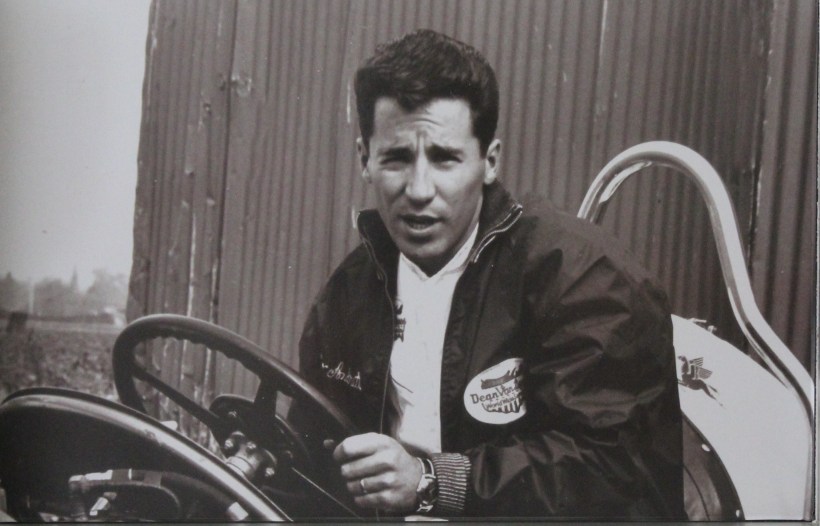
The photos of a very young Mario Andretti like the one above jolted me back to 1965 when this rookie showed up for the Indianapolis 500. He was fast and became an instant fan favorite. Andretti earned Rookie of the Year honors and won his first Indycar race later that summer.

In honor of the 50th anniversary of his 1969 Indianapolis 500 win, the Mario Andretti ICON exhibit now on display at the Indianapolis Motor Speedway takes visitors on a tour of Mario’s racing career from sprint cars to his final race. His many stops include Formula 1 and the 1978 World Championship and a victory in the Daytona 500 in 1967.

I really like the special exhibits the IMS Museum has done- A. J. Foyt, the Unsers, and now Mario. One thing that does disturb is how many of the cars on display I saw race.  You’d think I was old or something.

The car that fascinated me the most was the Ted Horn Offenhauser sprint car which Andretti drove in four United Racing Club events in 1961. These races were the beginning of his sprint career. The car’s new owner put a Cadillac engine in it. Andretti had three top 10s in the four races in this car.  The car as seen in the museum is as it was when Horn drove it in the post war forties.

The exhibit recalls what to many was the Golden Age of Racing. Drivers drove any type of car any time. It goes beyond the cold statistics of Andretti’s career and presents us a versatile driver who could win no matter what series he drove in.  I think that is something sorely lacking today.

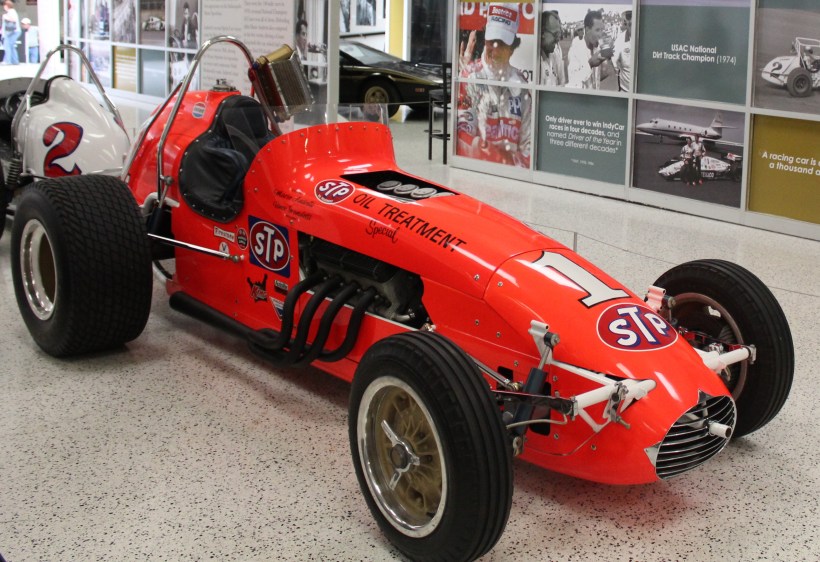
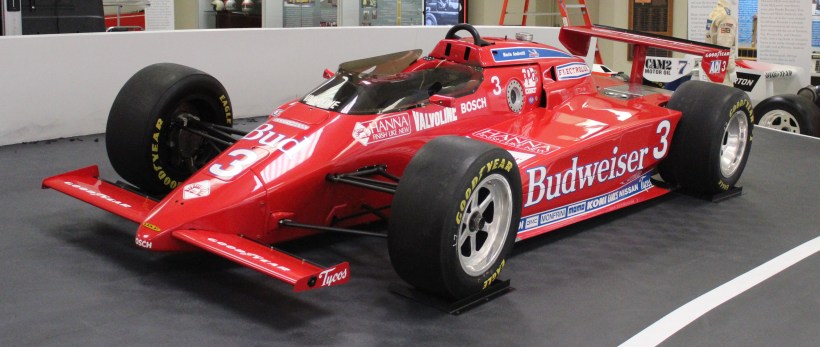
The room where other exhibits had memorabilia displayed was closed for a private event. I hope there are more items than the dozen or so displayed in the north hall.  Below are a few photos.  This is a must see exhibit which I’m not sure my descriptions have done justice.

Update

I just received this message from the IMS Museum:

47458458
1965 Indianapolis 500 Rookie car
47458466
1964- First Indycar ride
47458468
1970- Dirt car. This was the last season Indycar raced on 1 mile dirt tracks
47458464
1978- Formula 1 World Champion
47458470
1984- Winner of the 500 mile race at Michigan international Speedway
47458460
1994- Andretti’s car in his final Indycar season