
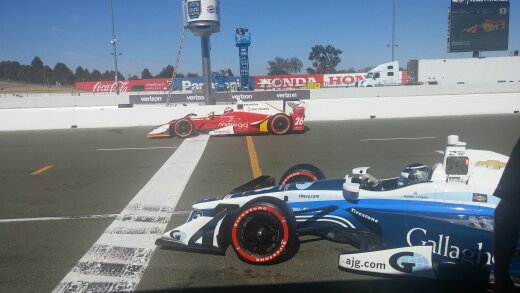
Yesterday Indycar announced format changes for race weekends. Most of the new procedures affect road and street course events. The oval races at Phoenix and Gateway will have a new prerace look also. Some of the changes affect certain tracks only. Here are the changes, followed by my thoughts. Thanks to Eric Smith of Race Review Online for providing the list.
• Phoenix and Gateway qualifications: Qualifying at two oval tracks – Phoenix Raceway and Gateway Motorsports Park – will be held on the same day as those Saturday night races. The first day of those two-day event weekends will focus on a pair of practice sessions, the latter falling within the same evening time slot as the race.
• Firestone alternate tires: At road and street courses, each car will receive an additional set of Firestone’s red-sidewall alternate tires, bringing the total to four sets of the softer-compound Firehawks available for the weekend and allowing teams to better gauge performance characteristics of the alternate tires in comparison to Firestone’s more-durable, black-sidewall, primary-compound tires prior to qualifications. Each entry must return one set of tires – either primary or alternate – following the first practice session of a weekend and another set – the opposite compound from the first returned set – following the second practice session.
• Overtake assist time allotment: Push-to-pass overtake assist in road and street races will be based on a maximum time allotment for each car instead of the number of uses. The events at the streets of St. Petersburg, Raceway at Belle Isle Park and Sonoma Raceway will have a total overtake time allotment of 150 seconds for each race, with the other road/street races set for 200 seconds. When a driver engages the overtake via a button on the steering wheel, it increases engine turbocharger boost pressure by 15 kilopascals (kPa) to 165 kPa – good for about 60 added horsepower. Once engaged, push-to-pass will run for a pre-established duration equivalent to approximately the time needed to drive the length of the track’s main straightaway (15-20 seconds). Drivers will now have the ability to disengage an overtake activation midway through its use to save time for a later use. In addition, push-to-pass will not be available at the start of a race or for any restarts, with the exception of a restart commencing with two laps remaining in the race.
• INDYCAR Grand Prix schedule: Verizon IndyCar Series on-track action at the INDYCAR Grand Prix on the Indianapolis Motor Speedway road course will consist of two days, Friday and Saturday, May 12-13, to create a more action-packed event. All three levels of the Mazda Road to Indy development ladder will still have track activity on Thursday, May 11.
• Chevrolet Detroit Belle Isle Grand Prix qualifications: For the Chevrolet Detroit Belle Isle Grand Prix doubleheader in June, qualifying sessions for each race will see the field divided into two groups based on practice times, with 12 minutes of track time allotted for each qualifying group (with five minutes of guaranteed green-flag time). Previously, qualifying for the first race followed the advancement round format used at other road/street events. Qualifying groups for Belle Isle will be based on best lap times from the practice session immediately preceding Race 1 qualifications. If a car causes a red-flag situation during a qualifying session, its best two timed laps will be disallowed and it will not be permitted to continue in the session. One driver and entrant championship point will be awarded to the fastest car in each qualifying group on both days.
• Standardized road/street practice times: Practice sessions on the first day of most road/street course event weekends will have standardized start times of 11 a.m. and 3 p.m. local. Each session will be 45 minutes in duration.
My thoughts:
I love same day qualifying. It is hectic for the teams, but it really provides value for the fans. I have been to many races where the race starts in late afternoon and there are no support events. A night practice for a night race makes sense, especially in the same time slot as the race. Indycars under the lights are an amazing sight. Unless there is a drastic change in weather in 24 hours, this will help teams know what to expect.
About time drivers are allowed to practice on the alternate reds during practice. I’ve always thought it was silly to not be able to practice on what you would use in qualifying. Another step helping the teams put on a better qualifying show. Thanks to Firestone for the extra work this involves making the extra sets available.
The push to pass change will make starts and restarts fairer and possibly safer. I really like that a driver can decide not to use a full burst and save time for later. This is essentially is the same amount of time as before, but a driver could get more uses from it. I wonder if all teams and the fans will be made aware of how much time other drivers have left. Indycar attempted to keep that information hidden for awhile last year, but that policy seemed to fade away.
Compressing the Indycar Grand Prix of Indianapolis schedule is a good idea. Thursday was mainly just let’s get the dust off the track day. I like the idea of the three Mazda Road to Indy series getting the entire Thursday to themselves. Anytime the future stars can get a showcase can only help Indycar in the long run.
The Chevrolet Detroit Belle Isle Grand Prix qualifying format makes sense for a couple reasons. The schedule at Belle Isle is really packed. It will free up 30-45 minutes of track time. This is the procedure used for race 2 qualifying, so it standardizes the weekend’s qualifying procedure. One thing I would change is have the groups on Sunday based on Saturday’s starting positions rather than have the same groups both days.
I will like going to a track on the first event day knowing when the practice sessions are. I always take a copy of the schedule with me, but it will be nice to know the first session is at 11 and the second one is at 3. Shortening the practice sessions to 45 minutes and allowing practice on the reds should make for more on track action during the sessions.
These are great changes for the Verizon Indycar Series. I like that they are trying to have practice sessions simulate qualifying and race conditions while providing more on track running. Adapting procedures to the situations of different tracks is helpful as well.
Notes:
Schmidt Peterson Motorsports announced Copper Moon Coffee will be the team’s official coffee supplier through 2018. Will the steering wheels have an espresso button?
Zachary Claman DeMelo signed with Carlin for his second Indy Lights season. I thought he showed steady improvement during the year. It appears there will be 12-14 cars on the Indy Lights grid. Considering that Schmidt is not entering the series this year, that is a nice number.
We are just 32 days away from the first practice day at St. Pete. I’m ready.
I’m working on my season preview, which I plan to publish March 1. I will be back before then. You can’t get rid of me that easily.
 The Pit Window by Mike Silver