Last in a series
1966 became a watershed year for the Indianapolis 500 and for North American auto racing. The race put the final in the coffin of the front engine roadster, solidified the European drivers as a force to be reckoned with, and caused the retirement of one of the last of the stars of the 1950s.
Mario Andretti qualified for the pole at 165.899 miles an hour, and he was joined in row 1 by Jim Clark and George Snider. The field also featured former F1 champion Graham Hill and a second year F1 diver, Jackie Stewart.
The 50th running of the Indianapolis 500 had all the ingredients to be one of the great races in IMS history. There were champions from both sides of the Atlantic, 14 different chassis, and nine Offenhauser power plants making one of their last stands against two dozen Fords.
Highly anticipated events sometimes don’t live up to their hype, and thus it was with 1966 Indianapolis . The field di not even get to turn after the green flag before cars spun, crashed into each other contacted both walls, and sent tires and parts flying. At least 15 cars were involved, 11 of the starters eliminated.
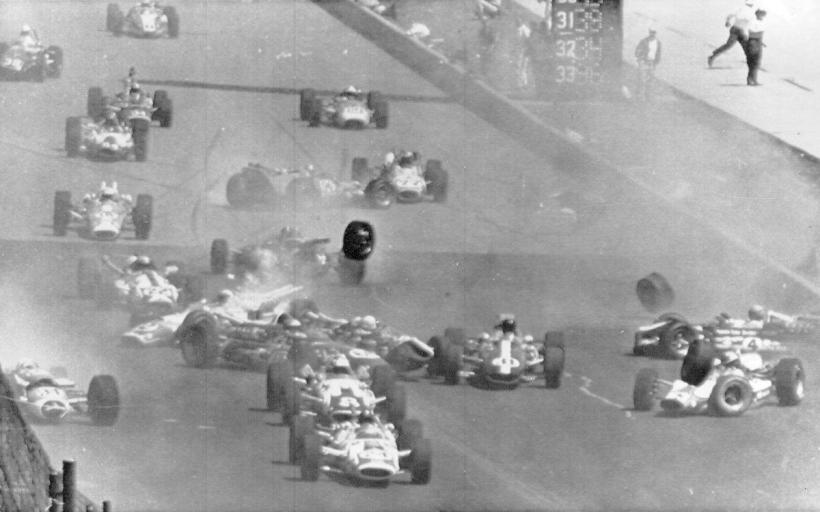
The consensus was that Billy Foster, starting 12th, ran over the wheel of sixth place starter Gordon Johncock. Foster slammed the outside wall, the tires broke free from his car and flew into the paths of the field as they hurtled toward turn 1. The only injury was to A. J. Foyt, who cut his knee and hand climbing the fence at the spot where his car came to rest.
Foster insisted that he was hit from behind, but the official cause pf the accident was that the Canadian hit Johncock.
After 1 delay of 100 minutes, the race resumed under caution. When the green flag waved on lap 5, Johnny Boyd crashed in turn 1. At this point in the race the green flag was out for less than five minutes.
The race resumed on lap 17. Andretti had the laps under caution, but Jim Clark took over the point on lap 17, followed by Lloyd Ruby leading on lap 65 after Clark spun without contact on the previous laPp. The race looked to be a fight between Ruby and Clark, with Ruby having a slight edge until Ruby retired with engine trouble on lap 166.
Clark still ran strong, but he spun again on lap 86. This spin may have led to the confusion at the end of the race.
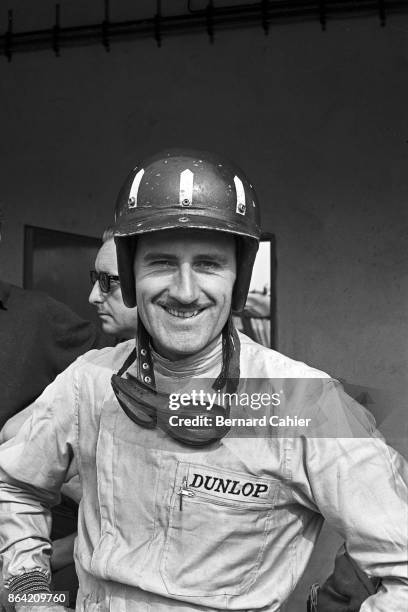
After Ruby lost the lead to Jackie Stewart, the Scotsman appeared to be in control. His only concern was Graham Hill. ;’Stewart lost oil pressure with 10 laps to go, handing the lead and the victory to Hill. Or did it? Clark and his team owner, Colin Chapman and sponsor Andy Granatelli were positive that Clark had won despite the two spins. With Hill in Victory Lane, Clark headed toward the winner’s area only to be stopped.
The Lotus team insisted that Clark had lapped Hill, but I recall seeing in a race replay that Hill passed Clark during one of his spins.
Behind the action among the leaders, cars failed and crashed. Only seven cars were running at the finish, the last runner, Jerry Grant was 33 laps behind. Grant finished 10th. The top four were the only cars to complete 200 laps.
The course for open wheel racing in North America was set, the Offenhauser engine would fade from the scene, and a new generation of drivers would rule for years.
Notes
Hill would race in just two more 400s and fail to finish either. He would win a second world championship in 1968. He died in a plane crash in 1975.
Jackie Stewart went on to win three world championships.
Rodger Ward, two time 500 winner, retired the day after the race, saying racing ” just wasn’t fun yesterday.”
Billy Foster never got the chance to redeem himself at Indianapolis. He was killed in a stock car accident at Riverside, California, in January of 1967.

