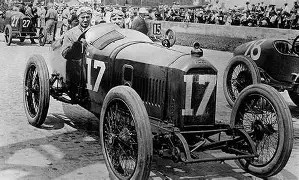
Editor’s note: Today begins a weekly series of looks back at anniversary races beginning with 1916. I will cover the 500s of 1916, 1926, 1936, 1946, 1956, and 1976 as we get closer to the 110th Running of the Indianapolis 500.
The distance for the sixth running of the Memorial Day Classic at the Indianapolis Motr Speedway was set at 300 miles, not the 500 miles run from 1911 to 1915. Speedway president Carl Fisher thought that 500 miles was too long, and that a shorter race would hold the fans’ attention and be more exciting.
According to the Indianapolis Star, the race wasn’t that exciting, with “only” 2 accidents. A crash on lap 61 caused serious injury to relief driver Jack LeCain, who suffered a double skull fracture. He was taken to the hospital. A newspaper story on June 3 reported that he would recover, although at that time he had not regained the ability to speak. Information on LeCain beyond that date could not be found.
In n1916 Europe was in turmoil as tensions which would lead to what became World War I were beginning to brew. Fisher liked to promote the race as an International Sweepstakes, and he encouraged participation from European drivers and manufacturers. The simmering conflicts caused parts shortages, and some European cars decided to skip the race. As a result, only 21 cars started the race, the smallest field in the history of the race.
Ralph Mulford qualified on the last qualifying day and started 20th. Louis Chevrolet started 21st. Jack LeCain qualified a car and would have started 22nd but had to withdraw the entry due to crankshaft problems. He would drive relief for Jules DeVigne, and he crashed on lap 61. Riding mechanic Harry Harkness also suffered injuries, although they were not as serious as KeCain’s.
At the start, Eddie Rickenbacker grabbed the lead from his mid front row spot from pole sitter Johnny Aitken and led the first nine laps. Aitken went to the point on lap 10 when Rickenbacker dropped out of the race and held the lead through lap 17. Dario Resta took first place on the 18th lap and led the rest of the way. Aitken retired on lap 69 with valve problems.
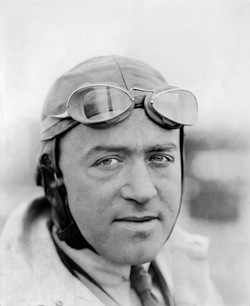
Resta, in a Peugeot, won by nearly two minutes over Wilbur D’Alene’s Duesenberg, with the Peugeot of Mulford another two and a half minutes back. Resta’ lead was comfortable enough that hie drove his last lap at a leisurely 60 miles an hour.
Resta went on to win the AAA National Championship, also winning the Vanderbilt Cup race for the second year in a row.
Resta drove in just three 500s, 1915, 1916, and 1923. He was second in 1915 from the outside front row starting position. His final 500 ended after 87 laps with mechanical issue. Resta won 10 AA championship races before returning to Europe. He died in a racing accident at Brooklands England, attempting to set a land speed record.
The 1917 was reset to the 500-mile distance, never to change again. A dispute between Fisher and local hotel owners over price gouging nearly caused Fisher to move the race to Cincinnati. Cooler heads prevailed.
It became a moot point, as the United States became involved in the European war. There was no race in 1917 or 1918.
The Things You Find Out
In researching for this story, I learned that Resta’s wife, Mary, was the sister of driver Spencer Wishart, who was killed in a 1914 race in Elgin, Illinois. Wishart had driven in the first four Indianapolis 400swith a best finish of second in 1913.
Only the top 10 finishers received prize money. Resta won $12,000 for the victory. 10th place Ora Haibe took home $800.
One thing i would like to find out is if tickets were printed for 1917, and if any exist today. What a collector’s item that would be!
 The Pit Window by Mike Silver