The First Harvest Classic

As we prepare for the Harvest Classic at IMS next week, here is a brief history of the last Harvest Classic.

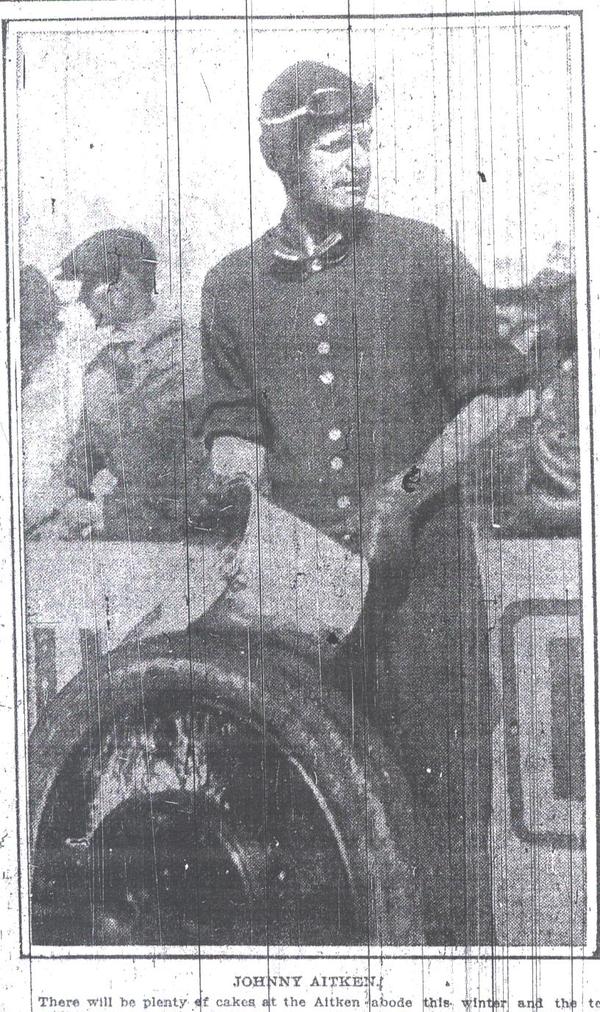
Photo: Johnny Aitken prepping his tires before the 1916 Harvest Classic at IMS. No, I did not take this photo.

Seven years into his venture of the Indianapolis Motor Speedway Carl fisher and the other founders were still searching for their footing. It had not been the success they had hoped. The 500 mile races were a hit with fans, but in 1916 the race was shortened to a 300 mile contest because Fisher thought 500 miles was too long. The fans were not happy about the decision. Dario Resta, who narrowly lost the 1915 500 to Ralph DePalma, won the 1916 event.

With war on the horizon, Fisher decided to add a September race meeting to the Speedway calendar. He was looking for extra income in case the 1917 race couldn’t run because of United States involvement in the European conflict. The Harvest Classic on September 9 featured three separate races of 20 miles, 50 miles, and 100 miles. There were separate purses of $1,000, $2,000, and $3,000. The first two races were not heat races for the 100 miler.

Attendance was disappointing. The event was a week after the Indian State Fair. People had spent their money going to the fair. Also, as the name of the evnt implies, the farmers were beginning preparations for harvest. Some estimates out the crowd at less than 10,000.

The event itself featured several current and future stars. 1915 500 winner Ralph DePalma entered in a Duesenberg. Eddie Rickenbacker drove a Maxwell. Tommy Milton, a future 500 mile race winner, made his first appearance at the speedway. Speedway star Johnny Aitken entered the event in a Peugeot.

Aitken won all three races. The 20 mile race was the easiest victory. In the fifty mile race, Aitken and Hughie Hughes had a wheel to wheel battle with Aitken winning by 0.28 seconds. There was more drama to come in the final race of the day.

In the 100 mile race, Aitken led most of the way, but battled with Rickenbacker during the last 50 miles. With four laps to go, Aitken’s steering broke, and Rickenbacker took the lead. He had his own issue, however. A loose right rear wheel buckled with two laps to go giving the lead back to Aitken.

This would be the final race at the Indianapolis Motor Speedway until 1919. After the 1916 event the speedway announced that the May race would again be 500 miles. When the United States entered World War I in 1917, racing halted until the war ended. Johnny Aitken never got a chance to race at Indianapolis again. He died in 1918 of pneumonia during the flu pandemic.

The Indianapolis 500 was the only race at the Speedway from 1919 until 1994, when the Brickyard 400 NASCAR event debuted. The stock car race was the first race outside of May since September 1916. Will this year’s Harvest Classic also be a one time event? I’m not so sure.

Fewer Venues, More Doubleheaders on Revised Schedule

The NTT Indycar Series released another new schedule this afternoon in response to the COVID-19 pandemic in hopes of getting in as many races as possible.  To do that, Detroit has been cancelled and Iowa and Laguna Seca will host doubleheader weekends.

Texas is now the scheduled opener on June 6. Toronto remains on the schedule, but the city’s closed order going until June 30, I don’t see how there will be enough time for the track build. The situation remains fluid, but I think the series might be better served to hold off on schedule announcements until necessary. There will likely be more changes. I could see the Indianapolis 500 becoming the opener with a compacted schedule rather than the one previously announced.

What is good about the new schedule? The two night races at Iowa, one of which is on a Friday night. The October race at Indianapolis Motor Speedway brings back a hint of the Harvest Classic race meet run at IMS in  the fall of 1916. The October race shares the track with the previously scheduled sports car program. Both road course races at the Speedway will share time with other racing disciplines. I love the concept of seeing multiple series on the same weekend. We might see the beginning of a trend here.

St. Pete is still listed as an October TBA and will possibly be the finale. Including St. Pete, the schedule is now 15 races at 12 venues. I’m glad the race count stays where it is, but I don’t like the limited number of venues. I realize these are extraordinary circumstances.

I don’t think this schedule is done yet. Stay tuned.

The schedule as of today:

wp-15861945375035824569167634257000.png

NBCSN Race Week Features Some Recent Indycar Classics

The iRacing has been fun. We can’t have actual new races this year yet, although I’m hopeful we can get in a few of them this summer and fall. Staring tomorrow, though, we can relive some of the best moments of the last few years in Indycar on NBCSN.

Seven Indycar races, including two Indianapolis 500s, will be part of the 60hours of racing shown on the current home of Indycar on television.

The schedule (all times Eastern)

Monday  3 pm   2015 Fontana

Tuesday  3 pm 2017 Long Beach

Thursday    1 pm 2019 Indycar Grand Prix

8 pm 2019 Indianapolis 500

11 pm  Drive Like Andretti

2 am 2016 Indianapolis 500

Saturday  10 pm 2015 Sonoma

Sunday      12:30 am  2016 Texas

I’m excited to relive some of these great moments of the last five years of Indycar. I would have preferred some much  older races. For times like this we need Speed to return.

I’ll be back tomorrow with updated thoughts on the current Indycar season.

Quick Thoughts- Barber iRace

Indycar teams are now taking this iRacing thing seriously. Teams brought in their engineers and pit strategy won the race.

It was great having the race on television. In addition tom the broadcast I hope something can be worked out where fans who don’t have access to NBCSN can watch online without subscribing to a service.

It was a decent race with more of an air of a real race than the Watkins Glen race

The best part of yesterday was having Robert Wickens participate. His 8th place finish after starting last was a great drive. He ran as high as third. Wickens definitely had the drive of the day.

I thought the track had a bit of a cartoonish look on television. I’m not sure if that was because I had never seen this type of race on a large screen before, but it I found it a bit unsettling. Where was the bridge by the museum?

Sage Karam proved once again that he is a master at iRacing, but he still doesn’t seem to handle adversity well.

What a great win by Scott McLaughlin. I wouldn’t be surprised if he repeats that feat when he gets his first real shot at Indycar.

Three of yesterday’s top five were not Indycar full time drivers.

It was nice to have an hour or so of distraction.

I’m very excited for next weekend’s race at Michigan. look for lots of flying cars.

The race summary:

wp-15860414930784986488951608308537.png

Wickens Return Highlights Indycar iRace at Barber

Robert Wickens returns to the cockpit although virtually today. No matter. It will be great to see him on “track.” The race is at 2:30 pm ET and also on NBC sports.c and the NBC Sports app.

Here is Wickens’tweet from yesterday:


Fast Facts for Barber iRace

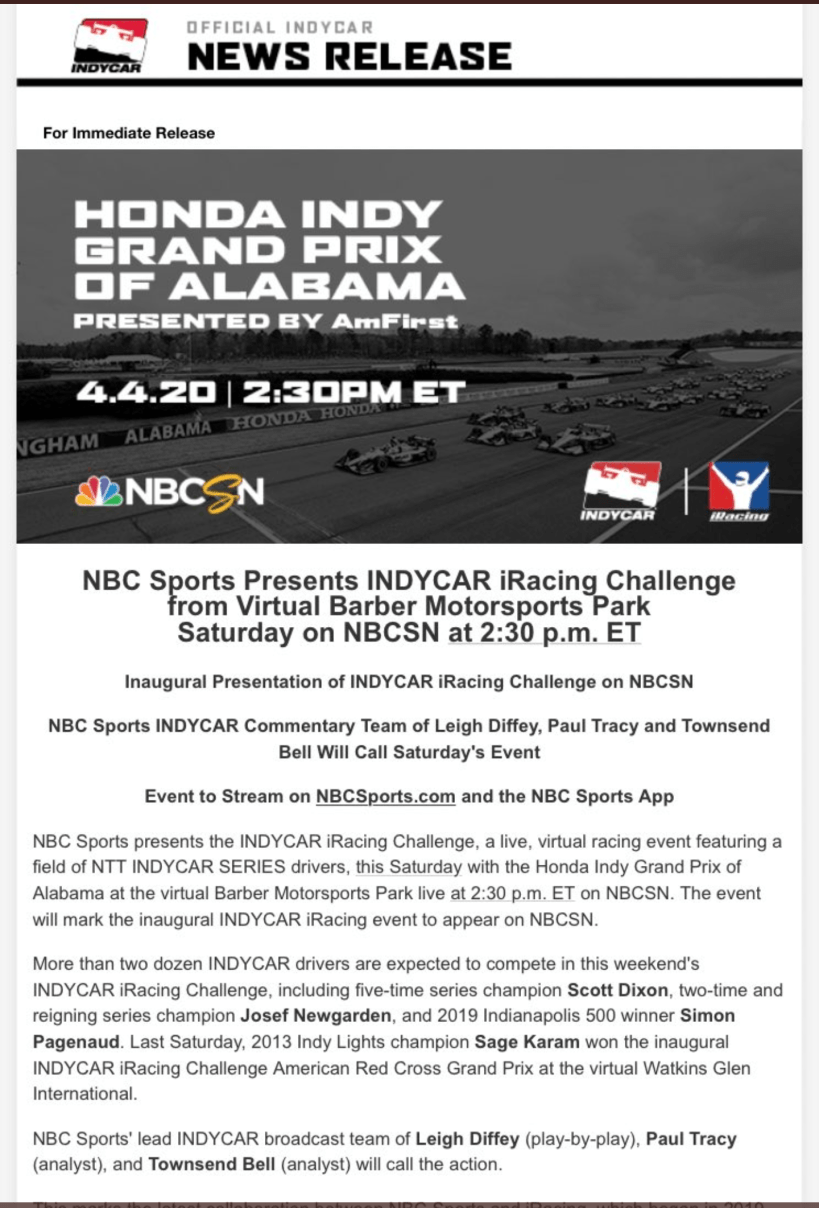
Virtual Honda Indy Grand Prix of Alabama Fast Facts

When: 2:30 p.m. ET Saturday, April 4

Track: Barber Motorsports Park, a 17-turn, 2.38-mile road course in Birmingham, Alabama

Race distance: 45 laps/107.1 miles (approximately 60 minutes)

Push-to-pass parameters: 10 activations for a 10-second duration

Expected pit stops: One. Cars will be allowed two “Fast Repairs” during the race.

Competition caution: A planned competition caution period will bunch the field on Lap 15. It will consist of three laps, followed by a single-file restart.

Twitter: @IndyCar, @iRacing, @BarberMotorPark, #INDYCARChallenge, #INDYCAR, #HIGPA

TV/Online: 2:30 p.m. ET Saturday on NBCSN, NBCSports.com, NBC Sports App. Leigh Diffey is the lead announcer, alongside the network’s INDYCAR analysts Townsend Bell and Paul Tracy. The pre-race activities will be highlighted by Miss Alabama 2019 Tiara Pennington singing the national anthem and NBA and Auburn University legend Charles Barkley giving the command to start engines. The podium finishers will be interviewed on the live NBCSN broadcast. Diffey also will host a post-race virtual press conference with the podium finishers for media members (call-in details will be distributed).

Spotter guide: Click here to see a detailed spotter guide for this Saturday’s race.

Race notes:

Sage Karam (Dreyer & Reinbold Racing) won the inaugural round of the INDYCAR iRacing Challenge on Saturday, March 28, the American Red Cross Grand Prix at Watkins Glen International. Karam beat Felix Rosenqvist (Chip Ganassi Racing) to the checkered flag by 3.6174 seconds. Will Power (Team Penske) finished third in the 25-driver field.

• INDYCAR has conducted 10 Indy car races at Barber Motorsports Park. Takuma Sato won the most-recent race at the track, in 2019. Helio Castroneves won the first Indy car race at Barber, in 2010.

• Reigning series champion Josef Newgarden is the winningest Indy car driver at Barber Motorsports Park with three victories (2015, 2017 and 2018). Newgarden is in the field for the virtual race Saturday after finishing seventh last Saturday at Watkins Glen.

• The field for Saturday’s race at Barber consists of 29 drivers, including 21 with previous starts in Indy car races at the track. Watkins Glen INDYCAR iRacing Challenge winner Sage Karam has just one previous start at Barber, in 2015 for Chip Ganassi Racing. Most notable among drivers without Indy car starts at Barber is seven-time NASCAR Cup Series champion Jimmie Johnson , who raced in an Indy car last Saturday at Watkins Glen after 18 Cup Series starts at that track.

• Four drivers are joining the INDYCAR iRacing Challenge for the first time this Saturday: Five-time series champion Scott Dixon (Chip Ganassi Racing), 2018 series Rookie of the Year Robert Wickens (Arrow McLaren SP), three-time Indianapolis 500 presented by Gainbridge pole winner Ed Carpenter (Ed Carpenter Racing) and Jack Harvey (Meyer Shank Racing).

• Nineteen of the 24 drivers who started the inaugural event last Saturday at Watkins Glen were running at the finish, proving these athletes are just as skilled in the virtual world as in reality.

Reader Request: The Speedway’s Greatest Cars

Originally published May 25, 2016

I’ll admit it. I am biased on this topic. I love the old front engine cars. Maybe it’s because growing up they were what a race car was. Unlike the rear engine cars, front engine machines came in a variety of shapes and sizes. Most rear engine cars look basically the same to me. I’m not talking about today’s Dallara.  The early rear engine cars were noticeably distinct from one another. A sameness crept into the design, especially after wings were added.

What were the greatest cars? My criteria is part objective and part subjective. Cars that won more than once easily make the cut. Design and livery are a big qualification as well.  I prefer the simpler liveries. Here are my top five greatest cars, front engine division.

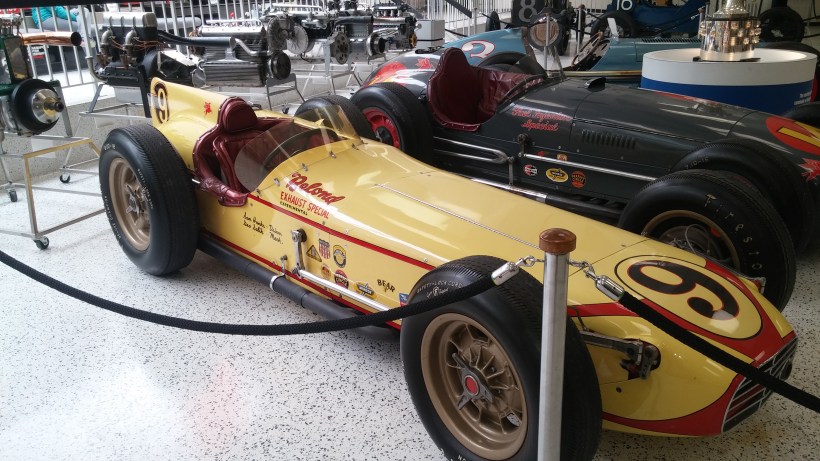
5. Belond Exhaust Special.  The car designed by George Salih won back to back to back races in 1957-58. The engine is laid on its side, allowing a lower profile. Note the fin

Note the fin behind the driver’s headrest.Hulmanclubfavcars 006.jpg

4.  Blue Crown Spark Plug Special.  This Offenhauser powered, front wheel drive machine won in 1947 and 1948 with Mauri Rose driving to victory both years. Car owner Lou Moore is second behind Roger Penske in victories by an owner with five.

Hulmanclubfavcars 009


3.  Sheraton-Thompson Special. The 1964 winning car is a A. J. Watson built roadster driven by A. J. Foyt to his second 500 win. It was the last front engine car to win the race.Hulmanclubfavcars 011

2.  Fuel Injection Special.  Bill Vukovich dominated in 1953 and 1954 in the original “roadster”. Note the cockpit offset to the right. The car was leading in 1952 when a steering rod broke with eight laps left. Vukovich led 435 laps in this car. Hulmanclubfavcars 008.jpg

  1. Boyle Special (top of story  photo) Another car that dominated the 500. Wilbur Shaw won in this Maserati in 1939 and 1940. He was leading in 1940 when a wheel collapsed late in the race. After the war, Ted Horn drove it from 1946-48  to finishes of third, third, and fourth. Future winner Lee Wallard took the car to the lead in the 1949 race. Bill Vukovich took his 1950 rookie test in the Maserati, but did not attempt to qualify it. This car was truly the chariot of the gods.

Entry List for Honda Grand Prix of Alabama- iRacing Saturday

Photo: Takuma Sato celebrates winning the pole at Barber in 2019.

Twenty -nine drivers are entered for Saturday’s event on NBCSN beginning at 2:30 ET. The biggest surprise- Ed Carpenter who last race on a road course in Indycar in 2013. Carpenter will be in the 21 car while Conor Daly stays in the 20. Scott Speed is in the 98 again this week.wp-1585844828134597717769225287296.png

The race is scheduled for 45 laps and will include a competition caution after the first round of pit stops has been completed around laps 28-31. The caution will last three laps and the race will resume with  a single file restart.

Starting positions will be determined by a 10 minute qualifying session just before the start of the race. All cars will have the same setup.