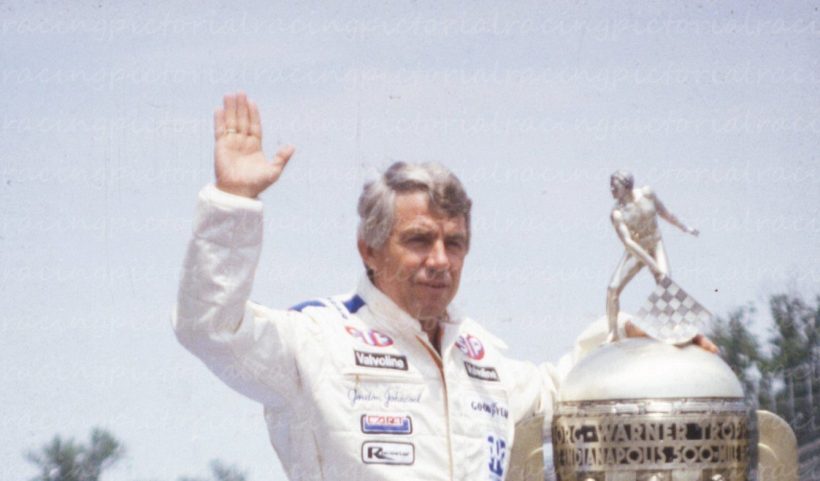
Gordon Johncock-Champion of Life

To live life like Gordon Johncock is to be content. He raced and excelled at it. He retired and put all things racing aside, then focused on his lumber business, shunning the spotlight. Johncock, two-time Indianapolis 500 winner and 1976 national champion, died last night at the age of 90.

Johncock had a stellar racing career in an era of auto racing superstars, competing with A. J. Foyt, Mario Andretti, and Johnny Rutherford. He competed on an equal footing and won his fair share of races. While he may bot have grabbed the headlines that Foyt or Andretti commanded, drivers knew Johncock was someone they would have to fight for a victory.

The first word that came to my mind to describe him was gritty. Johncock was a hard charging, no nonsense racer. A look at his results from his 1976 championship show one of the most consistent seasons in IndyCar history. Johncock won just two races, but he 12 podiums, 13 top fives, and just one DNF.

His career stats – 25 wins, 20 poles, and 2 Indianapolis 500 wins- stand among the best all time Johncock was one of the most consistent drivers in history. In addition to his 1976 championship, he had nine season finishes in the top five. Johncock was third int he standings three times. fourth twice, and fifth four times.

Indianapolis 500

Johncock had great success at Indianapolis with 11top 10 results, including eight top five finishes. He could have won more than twice. In 1966 he completed the 500 miles in less time on track than winner Graham Hill, but extended time in the pits cost him track position. In 1977 Johncock was leading when the crankshaft on his car broke on lap 184, handing Foyt his fourth Indianapolis win.

His two victories ironically stand out for very different reasons. The rain-delayed, rain shortened, tragedy filled race in 1973 was one of the most forgettable days in Speedway history, but his thrilling win over Rick Mears by 0.16 seconds. At the time that finish was the closest in 500 history. It still stands as the seventh closest finish.

Johncock has two other distinctions in his Speedway career. His fifth-place finish in 1965 was the last top five finish for a front engine roadster. Johncock’s win in 1982 made him the last winner of the Indianapolis 500 to have driven both a front engine and a rear engine car in their career.

There are now only three winners who driven front and rear engine cars- Foyt, Andretti, and Johnny Rutherford. Only Foyt had riven each type to victory at Indianapolis.

Fans were puzzled when Johncock retired briefly in 1985, but he returned in 1987 and competed through the 1992 race. He then reti4red quietly and returned to Michigan to run his lumber business. He described racing as “A job I once had.” Johncock seemed content to be away from racing. He was always direct, knew what he wanted, and knew when he had had enough. That’s a lesson some pro athletes today should learn from.

I saw on social media this morning that there are only nine drivers from the 1960s still living. Time catches up with all of us, and as I have said before, if you see one of these heroes at a track, stop, say hello and thanks. The opportunities to do so are quickly dwinding.
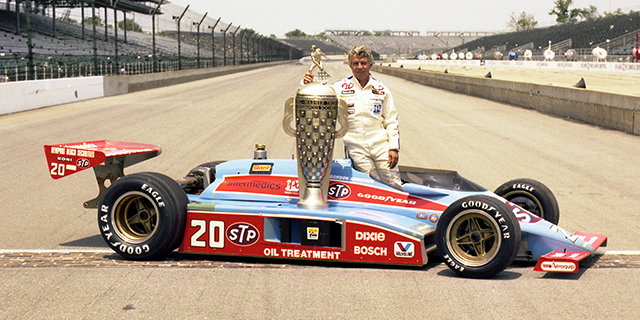
Two-Time Indy 500 Winner Johncock Dies at 90

Editor’s Note: A sad day for the 500 community. My thoughts will be posted tomorrow.

From IMS:

  INDIANAPOLIS (Monday, Sept. 28, 2026) – Gordon Johncock, whose stirring drive late in the 1982 Indianapolis 500 earned him a second victory in “The Greatest Spectacle in Racing,” died of natural causes Sept. 28 at his home in South Branch, Michigan. He was 90.

Born Aug. 5, 1936, in Hastings, Michigan, the lifelong resident of the state was the INDYCAR SERIES national champion in 1976 and won 25 races in the series. Yet, Johncock was known for winning both memorable and forgettable “500s,” each time driving for Patrick Racing.

Johncock’s duel with Rick Mears in the closing laps of the 1982 race was the most thrilling to that point, prompting renowned television broadcaster Jim McKay to claim he’d “never seen anything like it.”
Johncock masterfully covered Mears’ last-lap passing attempt in Turn 1, then outran the 1979 race winner to the finish line. Their margin at the checkered flag was a then-record .16 of a second, still the seventh closest ever

.Johncock later said he was fortunate to win as he hit an unfamiliar bump low in Turn 3 on the last lap that pushed his car up the track and gave Mears an opportunity to gain ground.

“I pretty near lost it,” he told The Indianapolis Star in 2016. “Ask Rick; he saw it (because) he was right there
“I had never run that low before in Turn 3, but I knew I had to if I was going to be able to stay in the throttle. It was just a little rougher down there than I expected.”

The 1973 “500” was one of tragedy and poor weather, with rain postponing the race two days. Johncock started 11th and grabbed his first lead on Lap 40, but soon after teammate Swede Savage and crew member Armando Teran were involved in separate horrifying accidents.

Johncock, who led 64 laps, was in front of Bill Vukovich II when rain ended the race on Lap 133. With the annual Victory Banquet canceled, Johncock and his Patrick crew “celebrated” with hamburgers at a local Burger Chef restaurant after visiting Savage in the hospital.

Johncock was able to properly celebrate following his 1982 victory, and Mears said he never felt so good finishing second.

“I remember thinking during the race that if we can’t win it would be great to see him win,” Mears said.

Said Johncock of watching replays of the duel with Mears, “It gives you goosebumps … (that) well, I did it again!”

After a successful stint as a sprint car racer, Johncock’s INDYCAR SERIES career began in 1964 with a dirt race in Springfield, Illinois, and it didn’t take him long to show his talent. Johncock finished fifth as a rookie in the 1965 “500” in a roadster, in a race that saw five rookies finish in the top nine. He won for the first time nine races later at the Milwaukee Mile. Johncock also scored the first of his 20 career poles that year.

Johncock started his own team in 1967, joining A.J. Foyt as the sport’s only owner/driver. Johncock won six races during that three-year span.

Johncock nearly won a few more Indianapolis 500s. He finished third in 1976 and 1978, and he was fourth on two other occasions (1966 and 1974).

In 1977, Johncock was leading Foyt, the eventual winner, with 16 laps remaining when his car’s crankshaft broke. He had led 129 laps.

Johncock’s career in the INDYCAR SERIES spanned 262 starts over 25 seasons. He actually retired twice, the first during the first week of “500” practice in 1985. He served on the IMS Radio Network for that race. Two years later, he replaced the injured Jim Crawford and finished 22nd.

Johncock’s last “500” was in 1992 after he retired on Lap 60 with engine failure. He finished 29th. His 24 starts in the race rank fifth among all drivers, tied with Johnny Rutherford and Scott Dixon.

Johncock led 339 laps in the Indianapolis 500, which stands 15th all time.

Johncock was one of the last living drivers to have competed in front- and rear-engine Indy cars.

He was successful in stock car racing, too, competing in 21 of NASCAR’s top-division races. He made three starts in the Daytona 500, qualifying fifth in 1973. He had three top-five finishes in NASCAR, highlighted by a fourth in the 1973 Firecracker 400 at Daytona International Speedway He also won a pole at Atlanta Motor Speedway that season.

After Johncock’s second retirement, he turned his focus to his timber business in South Branch, Michigan, located 200 miles north of Detroit. Johncock enjoyed such a quiet life away from racing that some employees were surprised to learn he had been a race car driver, much less a two-time Indy 500 winner.

Johncock kept most of his racing memorabilia in his basement, although his two winner’s plaques have shared a wall with artwork of the 1982 win, the race’s checkered flag and a stuffed deer head in his living room.

He seldom attended the “500” after retiring.

“It was a job I used to have,” Johncock said of racing.

“Now I have a different job.”

Johncock was inducted into the Indianapolis Motor Speedway Hall of Fame in 1997 and the International Motorsports Hall of Fame in 1999.Johncock is survived by his wife, Sue; three daughters (Patsy, Pamilee, Peggy), two sons (Gordon Jr., Wally); stepdaughter (Valerie); and 12 grandchildren, 17 great-grandchildren and one great-great grandchild.