IndyCar’s Engine Deal- A Win for the Series

Last week’s renewed cont5racts with Honda and Chevrolet allowed everyone involved to breathe a sigh of relief. rumors had been swirling since 2023 about Honda leaving the series when their contract end at the end of 2026. Chevy hinted that they may not want to be the sole supplier. The sticking point for HOnda was return on investment.

Honda gave out cryptic hints as late as August of last year. In a press availability during the Milwaukee weekend, David Salters responded to questions about Honda’s future in the sport with a vague “We love IndyCar.”

Chevy said that they love having competition, implying that they wouldn’t love racing alone.

In the end, all was resolved Beginning in 2028, the OEMs will provide new 2.4-liter V 6 engines with a hybrid component. To attempt to provide some return on the companies’ investment, IndyCar will grant each engine manufacturer a charter to field one car apiece. Honda and Chevy may field the cars separately, or they may affiliate with an existing two car team.

I really like this deal. It is innovative, and the contract gives Honda and Chevy a larger stake in the series. I am relieved that Honda is staying, and that Chevy will have the competition that they want.

I do, however, have some questions. There was talk of reducing the grid to around 25 cars. Is that talk now off the table since there will be 27 cars guaranteed spots in 2028? This deal leaves no room for new teams or cars outside of the Indianapolis 500. What happens to teams like Prema or their 2026 iteration? Will Dreyer & Reinbold want to continue as an Indy only team, just as they were on the cusp of expanding their program?

Exclusivity looks like a growing trend in motorsport, and I’m not5 sure that it’s necessarily a good thing. Established want to protect their investment. I get that, but I don’t think there is much chance a new team bumping a charter team from a race should the rules allow it.

Eventually new teams will need to come into the series. IndyCar needs to provide a mechanism for that. I don’t see any current team willing to sell a charter just yet.

Overall, the new engine agreements are one of the best deals IndyCar has ever made, but as with anything there are unintended consequences. I hope IndyCar can come up with a plan to avoid the possible pitfalls with this arrangement. Meanwhile, Iam excited for 2028.
INDYCAR Announces Historic, Multiyear Commitment from Chevrolet, Honda

Editor’s note: Huge news from IndyCar, Chevy, and Honda

 Manufacturer Charters To Accompany Boosted Investment Across NTT INDYCAR SERIES

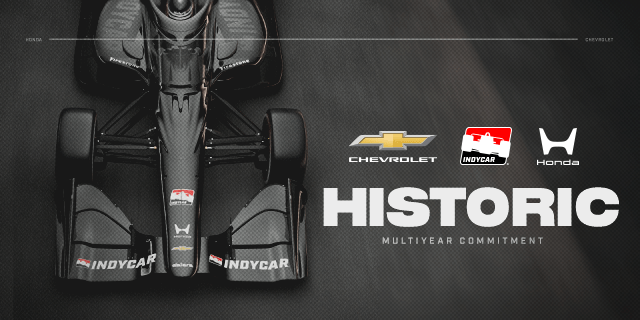
INDIANAPOLIS (Thursday, Feb. 12, 2026) – INDYCAR today announced a multiyear commitment from Chevrolet and Honda to continue as official Original Equipment Manufacturers (OEMs) of INDYCAR and the NTT INDYCAR SERIES. Each OEM agreement will commence in 2027 and run for multiple years, reflecting the upward trajectory of the sport and new investments in its growth.The new commitment from Chevrolet and Honda represents a significant financial investment in North America’s premier open-wheel series. It is also an endorsement of the momentum and continued growth of the series.
Both manufacturers will also be heavily involved in the development of the engine and competition rules to be implemented with the new NTT INDYCAR SERIES car, which is expected to begin competition in 2028.

“This is a monumental day for INDYCAR, fueled by a massive and historic commitment from two of our best and most trusted partners,” INDYCAR President J. Douglas Boles said.
“Chevrolet and Honda have worked tirelessly with us over the last 12 months to get to this point, and both have made it very clear that they are fully committed to this sport and invested in continuing the positive momentum the series generated in 2025.”
“Chevrolet has enjoyed a long, successful relationship with INDYCAR as an engine manufacturer, and this extension paves the way for the NTT INDYCAR SERIES to continue to grow and for us to further maximize technology transfer from race to road,” General Motors President Mark Reuss said.
“The addition of a charter allows Chevrolet to join with other stakeholders to continue to make the series even stronger. INDYCAR produces consistently exciting racing on road and street courses as well as ovals, and we look forward to building on our INDYCAR legacy and put on a great show for our loyal Chevrolet fans.”

“To our esteemed Honda fans, customers and associates, we are thrilled to announce our ongoing participation in the NTT INDYCAR SERIES,” Honda Racing Corporation USA President David Salters said.
“With a deep respect for the history and competitive spirit of INDYCAR racing, we are proud to continue our involvement after more than 30 years. This long-standing commitment strengthens our ability to allow us to further develop our people and technology at the pinnacle of open-wheel racing in North America.

“The partnership between INDYCAR and FOX continues to grow, bringing outstanding race coverage and elevating the experience for fans everywhere. The future of INDYCAR looks incredibly bright, and we at Honda are honored to play a critical role in its continued success.”

This multiyear announcement extends Chevrolet’s current participation in the INDYCAR SERIES. Chevrolet is a nine-time champion since its return to the sport 14 seasons ago in 2012. Including the 1988-93 and 2002 titles, Chevrolet has won 16 total INDYCAR SERIES manufacturer championships.
Honda began INDYCAR SERIES competition in 1994 and has been a continuous and key fixture on INDYCAR grids as an engine supplier for over 30 years – including six seasons as the sole engine supplier. The 2025 NTT INDYCAR SERIES season marked its 11th manufacturers’ title in multiple manufacturer competition and the fifth in the last eight years.
In addition to commitments made in engine development, engine supply and promotion of the series, each manufacturer will be entitled to own a charter to be utilized beginning with the 2028 NTT INDYCAR SERIES season.
“As charter entrants in 2028, Chevrolet and Honda now have a new and exciting opportunity to build on their incredible legacies across INDYCAR SERIES racing, while continuing their strong relationships with our current roster of teams and helping deliver an innovative and industry-leading new car in 2028,” Boles said.
The INDYCAR charter system was originally announced in September 2024. Charters were extended to teams based on full-time entries from the 2022-23 seasons, with a maximum of three awarded per team.
NTT INDYCAR SERIES teams with three charters are not eligible to utilize a fourth charter via an OEM.
Complete details of the powertrain parameters to be utilized with the new 2.4-liter, twin-turbocharged V6 engine with hybrid technology and introduced with the 2028 NTT INDYCAR SERIES car will be announced at a later date.
The 2026 NTT INDYCAR SERIES season begins Sunday, March 1 at the Firestone Grand Prix of St. Petersburg on the Streets of St. Petersburg, Florida.
Coverage of the race begins at noon ET on FOX, FOX Deportes, FOX One and the FOX Sports app. Audio coverage will be available via the INDYCAR Radio Network on SiriusXM Channel 218 and the INDYCAR App powered by NTT DATA.

Keeping Honda Indycar’s Primary Objective

Let’s put aside complaining about no new chassis and the delay of then hybrid system. Indycar has a bigger problem now.

A week of bad Indycar news got even worse Friday when Marshall Pruett published in Racer magazine that Honda is considering leaving Indycar when its contract expires after 2026. HPD wants cost reductions and would welcome a third OEM to reduce their supply burden. The series has tried in vain to add a third engine supplier.

It was hoped that adding the hybrid component would attract another engine, but the series’ frustration with launching the energy recovery system has halted any progress in that regard.

Honda has been a bedrock of Indycar racing since 1994. They were the sole engine supplier from 2006-2011, literally saving the IRL.

Should Honda leave, would Chevrolet be willing to supply 27 full time cars? Would the Indianapolis have 33 entries? It’s doubtful that there would be more than that.

As a fan I find the engine competition fascinating. How many other fans feel that way and would lose interest in a series with a single manufacturer?

There are solutions, many which have been suggested by others. The most obvious is a spec engine, perhaps a bit less sophisticated and cheaper to build. Cosworth and Ilmor could run unbadged powerplants.

A third OEM is the best solution. Ideally no manufacturer would need to supply more than 12 cars for the 500.

As I researched this topic, I found that this is not the first time Honda has expressed doubt about continuing in the series. I found an article by Gordon Kirby from 2007 in which Robert Clarke, then head of Honda IRL program, talked about what needed to be done.

The entire article, which is worth your time, can be found here:

https://www.gordonkirby.com/categories/columns/theway/2007/the_way_it_is_no102.html

An excerpt:

Clarke believes the key to attracting other manufacturers into the IRL is to write hybrid and energy-preserving technologies into the rules for 2011, matters discussed at length in this space over the course of this year.

“My thought is the series needs to become more relevant in using a product and technology which is related more toward production car technologies,” Clarke said. “We need something that we can actually talk about and promote. Right now, there’s nothing we can talk about, other than Honda quality and reliability.

“If the IRL were to embrace real-world challenges like fuel consumption, emissions, noise, and using energy better, I think other manufacturers will take notice. Hopefully, that would cause them to enter the series because they really can’t afford to let us continue to do it on our own and not be involved.

Indycar has always been more reactive than proactive when it comes to change. It is time to change the way they do things. Honda was fair to give htree year’s notice, but that is not a lot of time.

Development of INDYCAR Hybrid Unit Sees Significant Steps in Preparation for 2024 

From Indycar. Commentary to follow in a bit.

 Collaboration To Take Most Competitive Racing in World to New Heights
INDIANAPOLIS (Thursday, Dec. 7, 2023) – Since the initial on-track testing of hybrid components over a year ago, development of the new NTT INDYCAR SERIES 2.2-liter twin-turbocharged V-6 engine with hybrid technology has passed many significant milestones.
The INDYCAR SERIES 2.2-liter twin-turbocharged V-6 engine was initially paired and tested with the hybrid unit Aug. 16, 2023, at Sebring International Raceway. In just three months, a total of 15,256 miles of testing have been successfully completed with the new power unit among 13 NTT INDYCAR SERIES drivers.
The much-anticipated debut of the new power unit is expected to launch after the 108th Indianapolis 500 presented by Gainbridge, during the second half of the 2024 INDYCAR SERIES season.
“The partnership between Chevrolet and Honda has been phenomenal,” INDYCAR President Jay Frye said. “The INDYCAR-specific hybrid power unit is dynamic and an engineering marvel, and we’re completely committed to its successful introduction next season.”
The INDYCAR SERIES, Chevrolet and Honda are working in collaboration on the development of the first-of-its-kind hybrid unit with testing on tracks that mirror the disciplines of the NTT INDYCAR SERIES. Sessions have included ovals at Indianapolis Motor Speedway, Milwaukee Mile and World Wide Technology Raceway, road courses at IMS, Road America and Barber Motorsports Park and the street circuit-like surface at Sebring.
INDYCAR’s hybrid power unit will enhance the racing action with additional horsepower and further the series’ efforts to deliver the most competitive motorsport on the planet. The new powerplant unit will feature additional overtake (“push-to-pass”) options, ultimately giving INDYCAR SERIES drivers more choices and control – enhancing the on-track competition and excitement.
The start of the 2024 NTT INDYCAR SERIES season is expected to feature enhanced possibilities of track records with lighter chassis components (aeroscreen, bellhousing and gearbox) prepared for the hybrid addition. Once the hybrid unit is integrated, the remaining 2024 races will feature the intensified engineering and wheel-to-wheel precision of the hybrid power era.
The hybrid system is made up of the Motor Generator Unit (MGU) and Energy Storage System (ESS), which both fit inside the bellhousing, located between the INDYCAR SERIES combustion engine and the gearbox. Multiple strategies for regeneration and deployment have been tested as the power unit builds and transmits energy through the MGU before being saved in the ultracapacitor ESS.
The additional horsepower is deployed through the same motor generator. Unlike the traditional INDYCAR “push-to-pass” system, the hybrid power unit will not have a restriction on total time used over the course of a race.
Additional testing and continued development of the hybrid package will continue throughout the winter and spring months ahead of the first race in 2024.
More information on the competitive launch of the hybrid unit will be announced at a later date.
The 2024 NTT INDYCAR SERIES season begins Sunday, March 10 at the Firestone Grand Prix of St. Petersburg presented by RP Funding. Coverage will be available via NBC and Peacock with audio coverage provided by the INDYCAR Radio Network, SiriusXM channel 218 and the INDYCAR App powered by NTT DATA.

It’s Not the End of the World

News Tuesday afternoon that the anticipated 2.4 liter engine, set to debut in 2024, has been shelved sent a tsunami of gloom and doom through the Indycar fan base. Soaring production casts and issues with the new hybrid componen, as well as a lack of a third OEM, all contributed to the decision by Honda, Chevrolet, and the series to rake a step back.

The two engine manufacturers also had to redirect some of the resources for the new engine to help develop the ERS hybrid system.

The higher cost of the 2.4 liter twin turbo meant that fewer cars would be on the grid. Only as many as 12 cars, maybe fewer, could be supplied at that price. Indycar would have had a smaller grid, and likely a shrunken field for the 500.

Am I disappointed? Yes. i was looking forward to the sound of the bigger engine. Is the series doomed? I don’t think so. Indycar is coming off a great season and is anticipating a larger full time grid for the coming season. This is a setback, no doubt, but it prevents a shrinkage of the grid for 2024 and beyond.

I am more concerned about the series marketing efforts. When a new marketing director is on board, that needs a budget at least quadruple what it is now. The series has for far too long relied on others to promote for them. They need to be more proactive and give the new director more tools to work with.

While the optics of the engine n3ws looks bad, it is not the end of the world. Let’s enjoy what we have for now.

New Engine Test Moves to IMS Next Week; 20 Cars Test Next Thursday

Scott Dixon will be one of the first drivers to try out the new 2.4 liter Honda engine

The new 2.4 liter twin turbo V 6 engine will have its first on track test next Monday and Tuesday on the IMS road course. Team Penske and Chip Ganassi racing will test one Chevrolet and one Honda respectively. Josef Newgarden will drive the Penske car Monday and Will Power will test the new powerplant Tuesday. Scott Dixon will be the lone driver for Honda both days.

The engine was originally schedule for march 30 and 31 at Sebring.

The engines get their initial workouts on the old Formula 1 course to prevent either team from gaining an information advantage on the layout that Indycar uses for the GMR Grand Prix and the race on the NASCAR weekend.

The new engines will not have the hybrid components on board due to supply issues. The 2.4 liter engine and hybrid package will debut in the series in 2024. The hybrid components may be available by early summer.

On Thursday, March 31 the traditional IMS road course layout will host 20 cars from the NTT Indycar Series in a private test.

All full time drivers from A. J. Foyt Racing, Andretti Autosport, Juncos Hollinger racing, Meyer Shank Racing, Chip Ganassi Racing, Rahal Letterman Lanigan Racing, and Arrow McLaren SP will participate. AMSP will also have Juan Pablo Montoya in a car. Montoya will drive in both the GMR Grand Prix and the Indianapolis 500 for the team.

Jack Harvey, injured in a practice crash at Texas last Saturday, will drive in the test if he is cleared to drive by then.

The IMS Museum parking lot is open to the public. Track facilities are closed during the test days.

Indycar Notes- Is Mario Out of a Ride? Honda Ends Fastest Seat in Sports Commitment

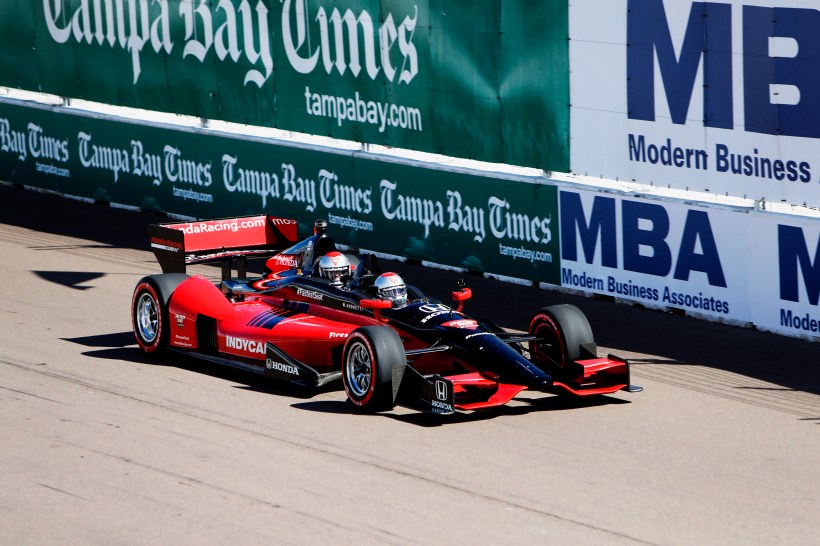
Photo: Mario Andretti drives the two seater before the start of the Firestone Grand Prix of St. Petersburg. Indycar photo, Chris Jones

A story that got curiouser and curiouser finally reached its conclusion this morning.

An article in The Drive by Steve Cole Smith on October 31 indicated that !969 Indianapolis 500 winner and World Champion Mario Andretti will not return to drive Honda’s Fastest Seat in Sports, the 2 seater that leads the grid before the start of races. Smith said he learned at St. Pete that Honda is removing Andretti from the ride.

Andretti later responded with a Tweet saying this was “Fake news.”

Robin Miller of Racer magazine in a story yesterday (November 1) says that Honda has denied firing Mario. Mario also stated his desire to continue with the program, which began in 2005.

Just a couple of hours ago, Marshall Pruett of Racer reports that Honda is ending its sponsorship of the Fastest Seat in Sports. Indycar is seeking a new sponsor for the program. The question left is, will Mario Andretti still be driving?

Testing at Barber Today

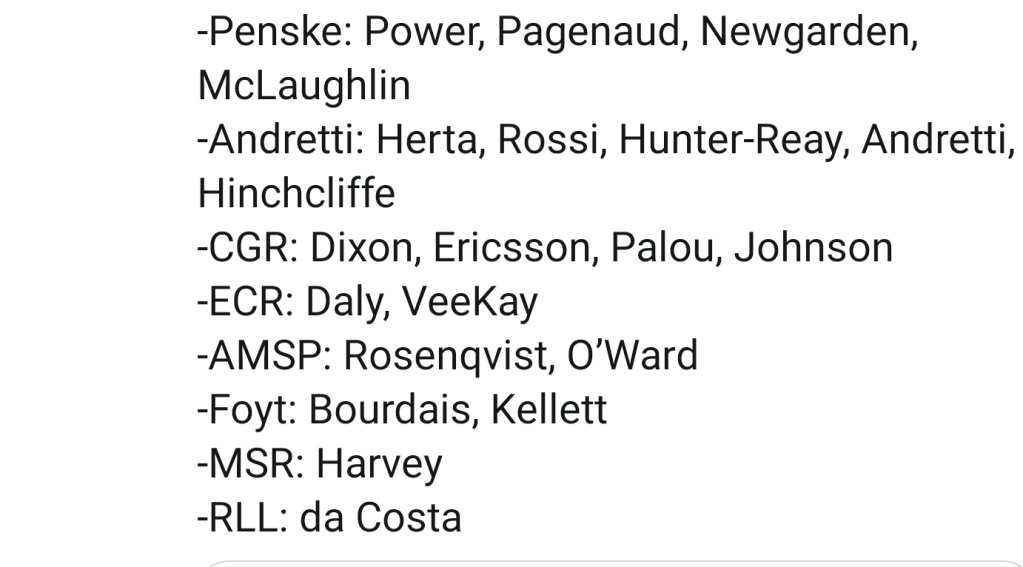
21 cars will participate in the first official day of offseason testing for the NTT Indycar Series today. First time drivers taking part are three time Australian Supercars Champion Scott McLaughlin for Team Penske, seven time NASCAR champion Jimmie Johnson for Chip Ganassi racing, and Formula E champion Antonio Felix da Costa for Rahal Letterman Lanigan Racing. The da Costa test is a courtesy test and not expected to lead to an Indycar ride.

The testing list, from Nathan Brown’s Twitter feed:

St. Pete Tears Down Track

My Eyes in Florida tells me that the St. Pete track is being torn down, to be rebuilt late February next year. the podiums for the race winner and championship celebrations are still up as of this morning. I would think they would leave the grandstands up as they did all summer. There is actually less time between the March 2021 race and the race two weekends ago than there was between the original date for this year and when the race was held.

Indycar Reaches Long Term Agreement with Honda and Chevy

Photo from Indycar
INDIANAPOLIS (Saturday, Oct. 3, 2020) – INDYCAR has reached a new, multi-year extension with engine partners Honda and Chevrolet, taking their partnership well into the end of the decade and providing stability and innovation for the NTT INDYCAR SERIES. “To be able to announce a long-term, multi-year extension with our two great partners is phenomenal,” INDYCAR President Jay Frye said. “It’s an exciting time in INDYCAR with the innovations in the car, the new 2.4-liter engine and hybrid technology.” Due to the global COVID-19 pandemic, the introduction of the 2.4-liter, twin-turbocharged V-6 with hybrid technology will be delayed to the year 2023. Working in partnership with Chevrolet and Honda, the new engine will give the most exciting and competitive racing series in the world an additional 100 horsepower, ultimately producing over 900. “Honda welcomes this step to the future by INDYCAR, action that mirrors Honda’s efforts to develop and manufacture high-performance, electrified products that will meet industry challenges and delight our customers,” said Ted Klaus, president of Honda Performance Development. “At Honda, we race to develop our people, to innovate technologies and to engage fans. We are proud of our uninterrupted, 27-year leadership in INDYCAR, and look forward to delivering a next-generation Honda 2.4-liter hybrid power unit with more than 900 horsepower.” “Chevrolet has enjoyed great success since joining the NTT INDYCAR SERIES in 2012 with our 2.2-liter, twin-turbocharged, direct-injected V6 engine,” said Mark Reuss, president of General Motors. “We are thrilled to be moving forward with INDYCAR because it’s the perfect showcase for our engine technology, in the only open-wheel racing series in America, a high-tech, growing series that Roger Penske and his team are absolutely taking to the next level.” The newly designed powertrain system also will provide a departure from the traditional, manual handheld starters and will let drivers restart the car quickly should it stall on the track. This will benefit the AMR INDYCAR Safety Team as it reduces exposure time on track and adds to the fan experience by potentially reducing the number of caution flags on track, leading to better flow and time of races. “Fast, loud, and authentic,” Frye said, “along with a history of innovation – that’s our racing roots and will continue to be the sport’s legacy. This announcement keeps that in mind while celebrating a stable and bright future.” The commitment and overall stability of the series will continue to allow INDYCAR future opportunities for an additional OEM (Original Equipment Manufacturer) to join its mainstay engine partners.

Qualifying Update- Where’s Chevy?

Andretti Autospport backed up their strong practice times, with the top four spots on the provisional grid after the initial round of qualifying. Marco Andretti did not get hurt by his 28th spot in line , setting the day’s fastest single lap at 232.177 mph. His four lap average of 231.351 just clipped teammate Ryan Hunter-Reay’s 231. 330. the top seven cars averaged more than 231 mph.

Chevys continued to struggle as Rinus Veekay is the only bowtie in the top nine. the next Chevy is Josef Newgarden in 13th.

The afternoon could be a scramble for the last four spots in the Fast Nine.

Notes

From head on, the aeroscreen looks like a cone that a dog wears after surgery.

It was a brilliant move by some teams to use a smaller air hose for qualifying to lessen the drag.  The hose and helmet need a redesign so that they are not protruding above the aeroscreen frame.

Helio Castroneves currently sits 28th, which would be his worst starting spot in his 20 500s.

The session was clean but there were several close calls in turn one.
Back after qualifying ends today.