1977- A Year of Firsts and Lasts

1977 was an historic year in the history of the Indianapolis Motor Speedway and the 500 Mile Race. It was the first year a woman made the starting field. There was the first four time winner. It was the first time someone other than Sid Collins would anchor the Race Day broadcast. It was the last win for a Speedway legend. Sadly, it was also the last race for Tony Hulman, who would die in the fall.

Collins died on May 2, so the program does not include tribute to him. Paul Page debuted as the new anchor for the IMS Radio Network.

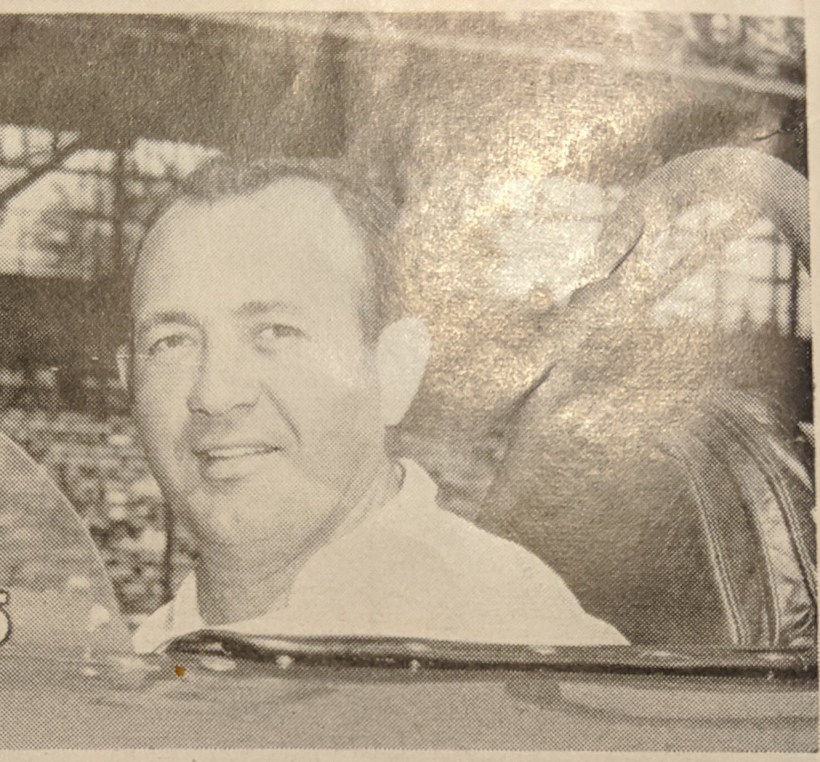
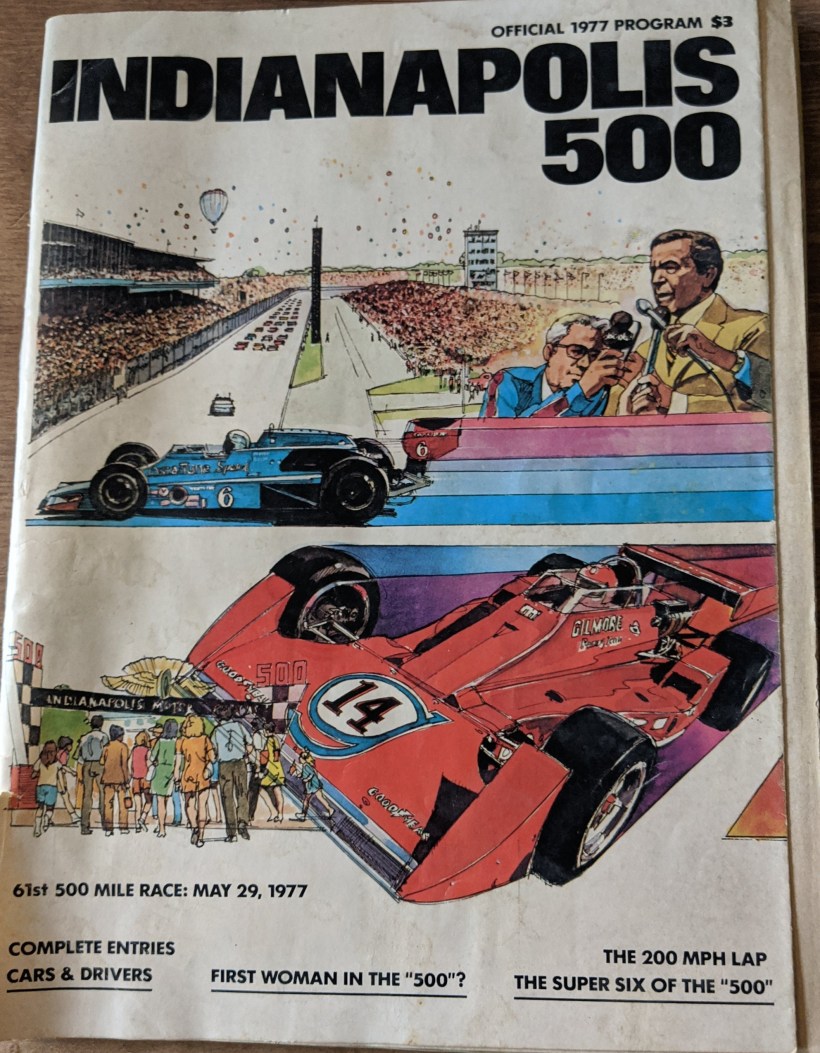
The program for 1977 seemed to have a penchant for clairvoyance. Hulman and A. J. Foyt were on the cover. It now seems ironic that they rode around the track together  in the pace car after the race. Other parts of the program continued the ability to see the future.

In a brief blurb about five of the rookies entered, the article wonders if a future winner might be in the group. Rick Mears was one of the rookies profiled. Of the drivers listed, only Bobby Olivero made the 1977 race. Another feature on a rookie is entitled “Janet Guthrie-First Woman in the 500?”

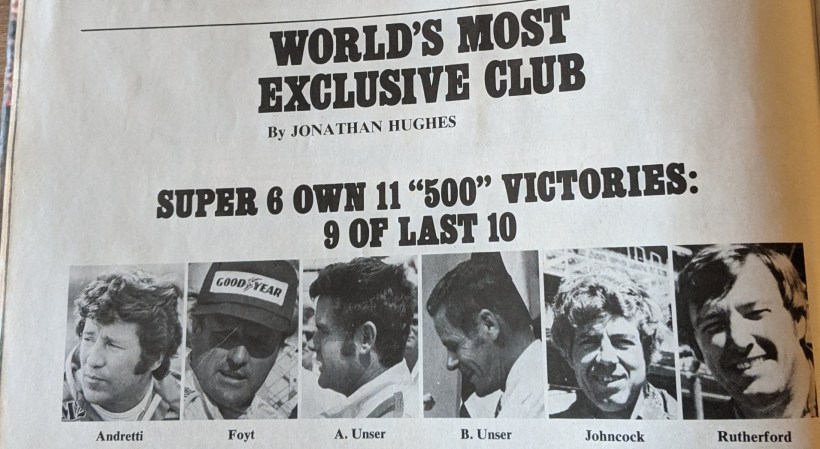
A piece by John Hughes titled “World’s Most Exclusive Club, highlighted the former winners in the race. A new, even more exclusive club would begin on race day.

img_20200511_1108358567194676042461550.jpg

Overall, the 1977 program is one of my least favorite. I find the graphics cartoonish and the print small. It continued a trend that began in 1976 when the cover departed from the traditional flags and wing and wheel designed that had graced the covers since the early 1950s. the programs are beginning to lose their soul, and I’m not sure they have ever recovered.

There are still the traditional elements of the program that I always seek out immediately- the Order of the Day, the Entry List,  and the summary of the previous year’s race. The Ortder of the Day was the usual. The “Star Spangled Banner” 10:44, “Gentleman, Start Your Engines” at 10:53, followed by the pace lap-s and the start. The command would be slightly modified this year. Some details from this page:

Jim Nabors sang. “(Back home Again in) Indiana”.

The pace car was an Oldsmobile Delta 88 deriven by James Garner.

Victory banquet tickets were $15. I have been to the last two banquets. I can assure you they cost a bit more now.

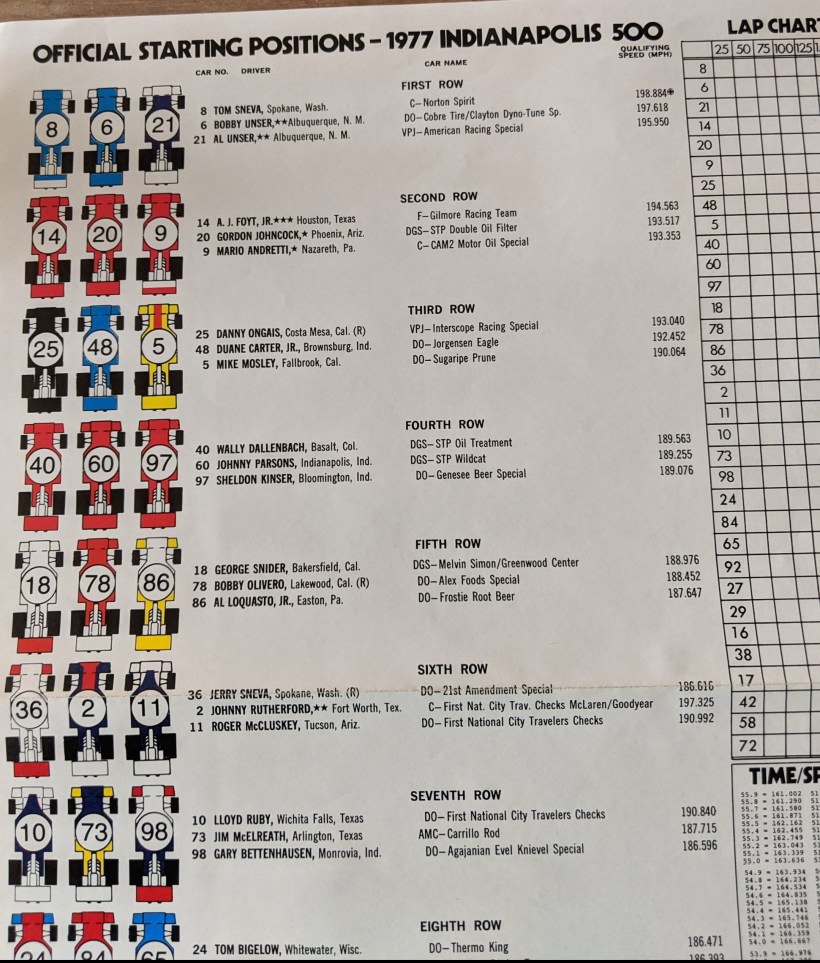
Continuing with the cartoonish theme, the starting lineup insert format thankfully didn’t last long. Before this year, the lineup simply listed names, car numbers and names, and speed by rows. For 1977, the y tried something which didn’t work:

img_20200511_1040188490479868232875053.jpg

The car colors are correct at least.

I also like to look through the programs for ads from companies that no longer exist  or participate in the race. In 1977, there were ads for Raybestos, Stark & Wetzel, and AyrWay.

The race featured the first woman starter, Janet Guthrie, who qualified after struggling for most of the month with the car. She started 26th and retired with timing gear issues after 27 laps.

Gordon Johncock dominated the race, leading 129 laps, but a failed crankshaft on lap 184 gave the lead to Foyt, who held it for his record fourth 500 victory.


The New World of Sport

Be prepared for a brave new world, race fans. Racing is set to resume, albeit under very different circumstances. NASCAR and Indycar will begin the season with no fans in the stands and strict procedures for teams during the events. This may be how we see racing for awhile. Every track presents a different set of circumstances, so the Texas model won’t work everywhere. It seems to be a good way to run oval races.

While I am as anxious as anyone to get to a race track, I want to be able to attend knowing my health is assured. The teams and drivers are assuming risk by participating in theses early races. Might it be better to wait until the country as a whole has a better handle on the situation? What happens when someone involved in one of the early races tests positive for COVID-19?

Indycar has the luxury to see how things go in the May NASCAR races. Future decisions might be based on what happens this month. The NTT Indycar series indicated yesterday that they are committed to completing the last schedule published April 6.

Track Updates

The governor of Oregon has announced that no fans will be at sports events in the state through September. That means no fans at the scheduled Grand Prix of Portland September 13.

The two Indycar races I see as least likely to happen are Toronto and Richmond. Canada has stricter lockdown procedures than the United States. The end date would not allow enough time for the track build. Richmond’s stay at home order expires June 10, two weeks before the race. It is a Porpermanent oval. In talking to people who live in the area, it doesn’t sound as if fans are going to be allowed at that race, if it goes on.

I also spoke with someone last night about Road America. It appears they are planning to have fans at the Indycar race. Whether that number will be limited has not been determined. The first part of the Indycar schedule could be a race with no fans, a race with fans, and another race with no fans.

Mark Miles said on Trackside Tuesday night that the Indianapolis 500 could be run as late as October if necessary. I would be fine with that, especially if it allows all fans wishing to attend to do so.

In these strange times, don’t expect a race to actually occur until you turn on your television and see it. We can ride this through. Stay safe and wash your hands.

Bump Tales: New Qualifying Format Causes Withdrawal Pains in 2010

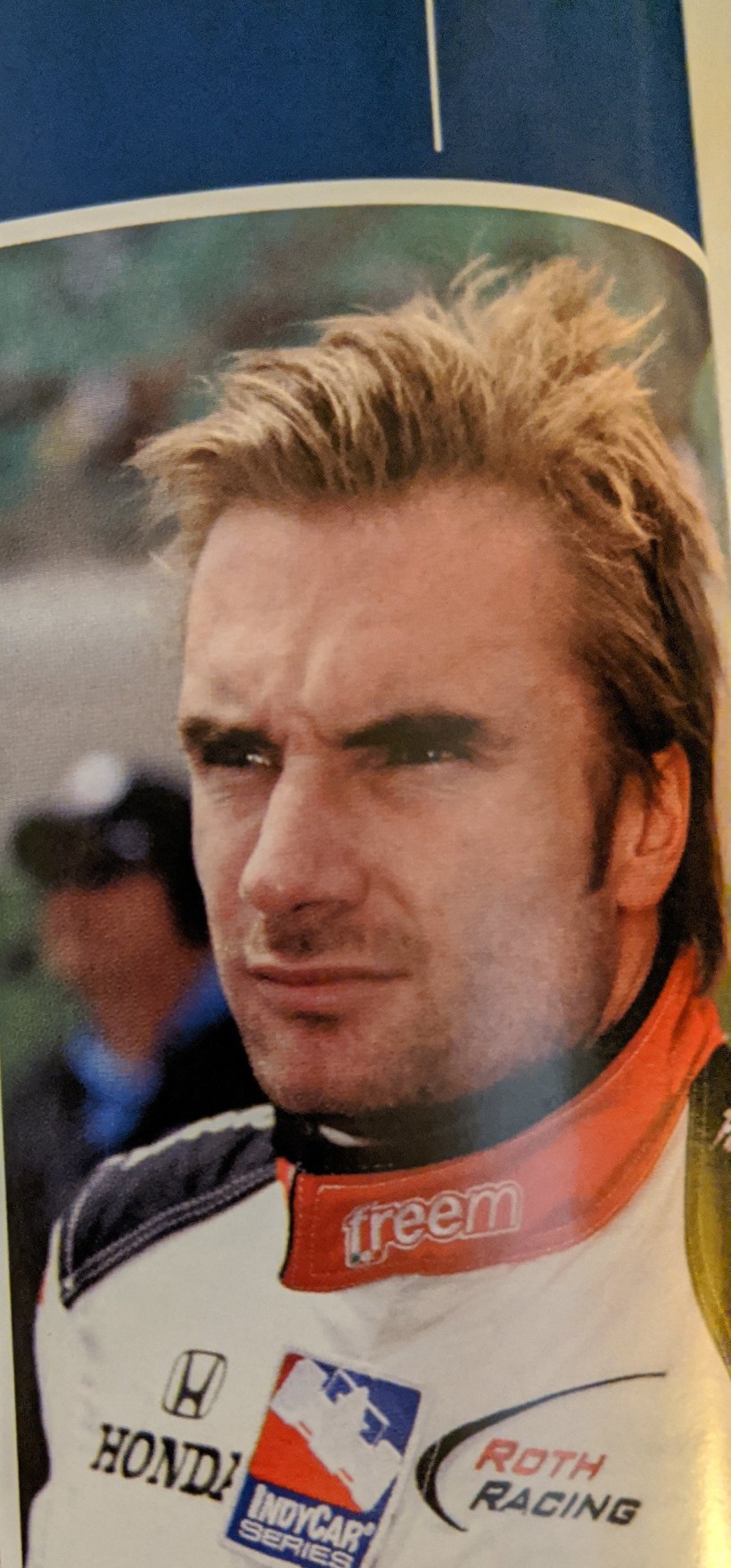
Photo; Jay Howard. Photo from the 2010 Indianapolis 500 Program

A change in qualifying procedures shook up the paddock in 2010. It was just the third year of the newly merged  Indy Racing League. In an attempt to revive interest in qualifying, a new format was created. One of the features was a Fast Nine shootout for the pole. The first day of qualify would establish 24 positions.  The cars who didn’t make the top 24 would try again Sunday to fill the last nine slots, and  the slowest of Saturday’s 24 could be bumped from the field. Qualify was just one weekend instead of the two weekends which had been in place most years since 1952.

The drama began early Saturday when Tony Kanaan crashed during practice. The perennial crowd favorite had never started worse than 6th. His car would not be ready until the next day, meaning 25th was the highest he could start the race. Helio Castroneves easily won the pole in the shootout. The defending race and pole winner posted a blistering average on his first attempt in the shootout which no one else could come close to.

The track was not finished with Kanaan. In Sunday morning’s practice, he crashed in nearly the same spot. His crew did not have the luxury of 24 hours to repair the car this time. In the final hour, a chess match developed between Jay Howard, driving for Sarah fisher’s team, and Paul Tracy, driving for KV Racing. Before they began to play the withdraw/requalify dance, Tony Kanaan made the field at 5:23 with a speed that was not completely safe, but time was on his side.

Howard was bumped from the field by Takuma Sato at 5:41. Howard went back to reclaim his spot, but his average was slower than his first attempt. Tracy withdrew his time, putting Howard back in the field. Tracy went out for another attempt but waved it off after two laps that weren’t fast enough. The Fisher team decided to withdraw Howard’s car, fearing that Tracy would find the speed to bump him on his last try. Howard was in line ahead of Tracy and got the day’s final attempt. It was even slower than his second attempt. Howard and Tracy were both out of the race. if they had kept their times, both would have made the field.

Adding to the strangeness of the situation was the case of Sebastian Saavedra. He had qualified, then crashed his car during a practice period. Saavedra was at Methodist Hospital being checked for injuries during the final hour. He had been bumped twice, but the Howard and Tracy withdrawals and failures to go to fast enough put his car back in the race.

An historic field was set. For the first time, four women, Sarah Fisher, Danica Patrick, Simona De Silvestro, and Ana Beatriz would start the Indianapolis 500. The first row would feature two former winners, Castroneves and Dario Franchitti, and a future winner, Will Power. The last row had two future winners, Sato and Kanaan.

Indystar writer Bob Kravitz said of the new qualifying format, “In the end, this gimmicky pole day format worked as well, if not better, than anybody could have expected. we will know for sure in 20 years, when the Indianapolis 500 is still doing it exactly the same way.”

It’s not exactly as it was in 2010 just 10 years later, and i think it still has a ways to go, but the format is evolving. It will never make everyone happy.

Dario Franchitti won the 2010 race, his second win in a span of four years.

The iRacing Challenge- Some Thoughts

The Indycar iRacing Challenge overall was a fun diversion. It kept Indycar in the public eye, allowed sponsors some publicity, and gave fans something to look forward to during the lockdown. I appreciate the time the drivers put in to making this work.

The first five races were fun, but the disappointing ending to Saturday’s race at Indianapolis Motor Speedway left me with a sour taste. The last lap wrecks, at least one of which was unnecessary, showed that iRacing is, after all, just a computer game.

ZD90pUew

The end of Saturday’s race reenacted the movie Turbo.

I did like several aspects of the six week series. I enjoyed the all star fields with drivers from different series joining every week. I thought it was nice to see some names who might not get much notice when the season actually begins have time at the front of the pack. the cars were realistic although I thought some of the tracks were not quite as I remember them.

The time slot probably wasn’t the most ideal for getting a large audience. I doubt if the series created any new fans because of this. In fact i know many diehard Indycar fans who didn’t watch any of the series.

There is not much from the results of these races we can transfer to the real thing. Some drivers who will not contend for the title are better sim racers than some title contenders. Alexander Rossi did not seem to enjoy this at all.  Simon Pagenaud and Will Power performed about the same as in real life, but they were about the only ones that did.

There has been talk of a winter iRacing Series after the season is complete. I don’t know that I would watch it again.  This was pretty much enough for me. I would prefer replays of actual races. The delayed start to the season is the perfect argument to bring back the equivalent of Speed channel.

The Month of May

It’s still may and I plan to continue Bump Tales on Thursdays. I will also look back at some Official Programs of the past on Tuesdays. In addition, i will repost some of my essays from the past. If you have a particular year you would like for me to talk about, let me know. Thanks for continuing to read during these strange times.


It’s a Different May 1

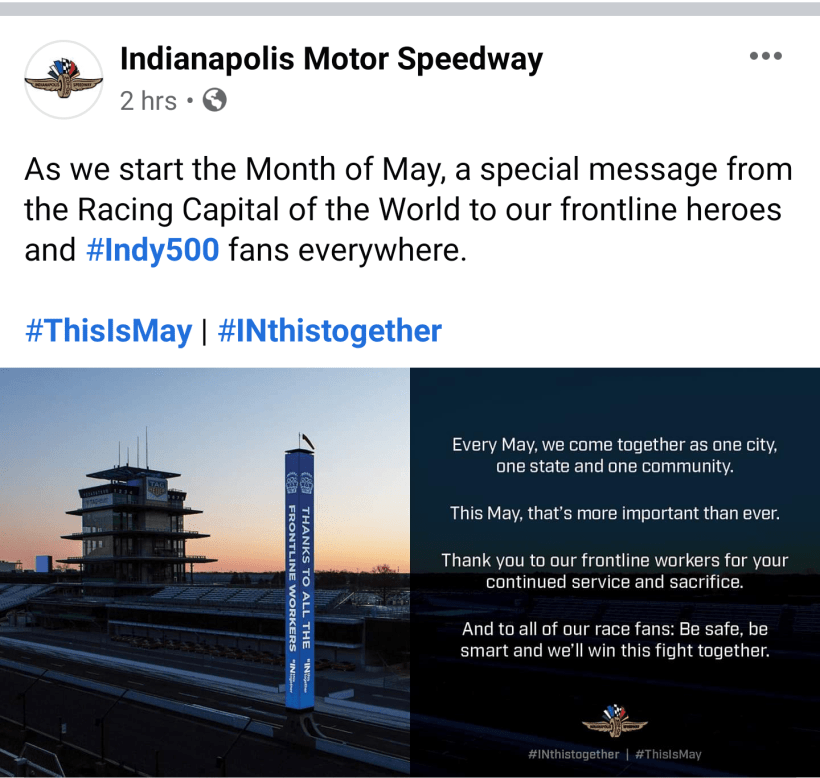
Photo above from the Indianapolis Motor Speedway Facebook page

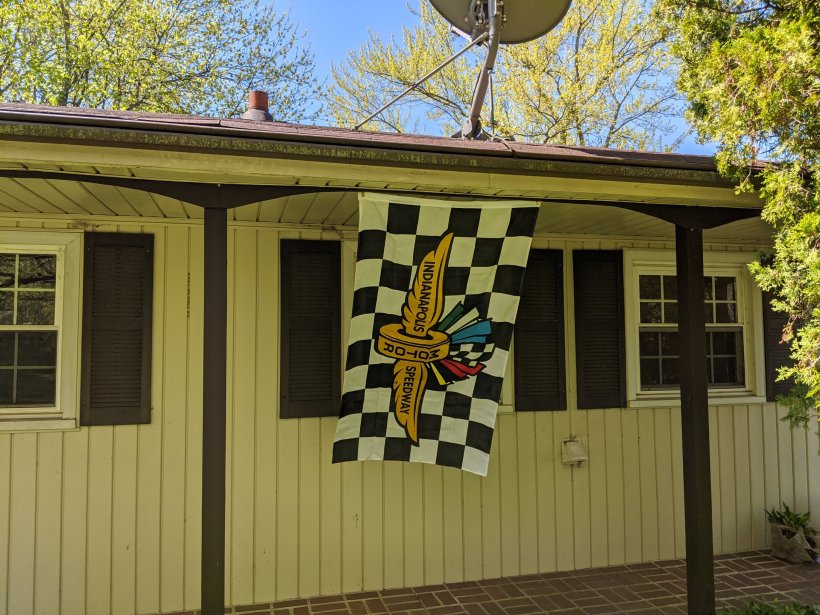
I have never been less excited about May 1 than I am today. Until 1974, the Indianapolis Motor Speedway opened for 500 mile race practice on this day. I was always excited to see who was the first car on track. After the time to prepare for the 500 was shortened, May 1 still meant that the time for the greatest race in the world was approaching. I still hung my flag up this morning, as did many others. It’s still May, dang it.

wp-15883477483873010505796851937999.jpg

I hope that the race can be run in August with fans. As I stated earlier, I’d rather the 500 be postponed until next year if fans can’t attend.

Blood and Smoke- Who Won the 1911 Indianapolis 500?

I found Blood and Smoke, the 2011 story of the first Indianapolis 500, to be a mixed bag. It is part Carl Fisher biography, part origin chronicle, and part conspiracy theory.  Charles Leerhsen presents a well researched case that perhaps someone other than Ray Harroun may have won the inaugural 500. There is, however, an argument supporting Harroun’s victory.

The book mainly focuses on the life of Carl Fisher, who is the Hoosier P. T. Barnum. Fisher never met a publicity stunt he didn’t like. He has a penchant for tossing vehicles from the roofs of downtown buildings to prove their strength. Fishrer jumps from one project to another. The Indianapolis Motor Speedway is one of his more focused and persistent endeavors.

The early days of the track are a financial and presentation disaster. Fatalities and accidents due to the rough track surface mar the 1909 and 1910 race meetings. the decision to brick the track surface and hold one 500 mile event are the beginning of the Speedway’s salvation.

Fisher has other motives besides running a successful race track. Indianapolis and Detroit are competing for the honor of being the nation’s auto manufacturing center. Fisher thinks the speedway will give Indianapolis the edge. He wanted a local manufacturer to win the race. He is best best friends with Howard Marmon, the owner of the car which is awarded the victory.

The 1911 race itself is a long day of confusion as to the standings. The situation is made more difficult by the inadequate timing system and the complicated way in which laps are recorded. The situation gets worse when cars begin pitting and after the accident in the pits. Ralph Mulford believes he wins the race, but when he gets to victory lane he sees Harroun in the Marmon Wasp already sitting there.

Race officials spend the next two days going over the timing and scoring records. Early in their review they make it clear that any changes in the finishing order will not include  changing the winner. Fisher orders that the records be destroyed after the official finish is published. What we see as the standings today is what we have to accept as official. Is it correct. Leerhsen doesn’t think so.

What I most enjoyed was the biographical information on Fisher, Harroun, Mulford, and others. The author gives some long overdue credit to some of the riding mechanics as well, telling some of their stories. The author does not gloss over the danger of auto racing in its infancy. This is a gritty, graphic depiction of the early days of the sport.

Blood and Smoke is a good book for background on the origin of the Indianapolis Motor Speedway and the 500 Mile Race. It deepened my understanding of what the event has grown to be. After a very difficult beginning, it is rather amazing that the 500 still exists.


Silent Stands

Editor’s Note: Sad to hear about the death of Bob Lazier, 1981 Indianapolis 500 starter and the father of 1996 500 winner Buddy Lazier and Indycar driver Jacques Lazier, from complications of COVID-19. Condolences to the Lazier family.

It’s great to be back in Indiana. The reality of the COVID-19 situation hit me the last two days as we drove on mostly empty roadways and breezed through normally traffic congested cities. The Downtown areas of Louisville and Indianapolis were stark in their emptiness.

As May begins next week we still don’t know when the Indycar season will actually start. I would not be surprised to see the first scheduled race, June 6 at Texas, postponed or cancelled. I’m not sure the next event at road America or the Following weekend at Richmond will happen either.

It’s all a matter of social distancing. Can a track afford the risk of having fans attend and potentially fall ill? I’m not sure I want to go to a race until after I have had a vaccination. NASCAR and Formula1 have discussed racing with no fans present. Conducting a race takes a lot of people. Track staff, series officials, media, and team personnel needed can comprise a small town alone. Is it worth the risk of exposure for those people just to to fulfill a schedule?

Eddie Gossage, president of Texas Motor Speedway, is discussing the possibility of a NASCAR/Indycar doubleheader without fans. I like the double header idea but there would be twice the amount of people at the track to run races from two different series.

Roger Penske has said he would not run the Indianapolis 500 without fans. I’m glad to hear that. I don’t think the 500 should be run just for the sake of running it. I would rather wait until it is safe for fans to be present. I’m not sure this August is the time for 300,000 people to gather in one spot. . The race has been cancelled in the past due to major world events. This may be the third time in its history that we need to wait another year. I would hate for that to happen, but it may be in everyone’s best interests.

The Indycar iRacing Challenge series has given us a taste of what watching a race without fans in the stands might be like. It is a bit eerie, but I enjoy the only type of racing available right now. Will there be more events after this six week challenge ends May 2?

We are all anxious to get back to the track. We must be patient and think safety and health first. If this entire year is wiped out, it will be tough to take, but I’d rather go to to a track with a feeling of comfort and safety.

Everyone stay safe and wash your hands.

I’ll be back later to begin coverage of his week’s iRacing event from COTA.


Radio Days- Listening to the 1960 Indianapolis 500

Photo: (left) Rodger Ward leads Jim Rathmann late in the 1960 Indianapolis 500; (right) Rathmann took the lead for good on lap 197 and won by 13 seconds.

Editor’s note: I learned Sunday afternoon of the death of Pat Kennedy, who has authored several trivia books about the Indianapolis 500. I have all of them and use them constantly for quick reference. My condolences to his family. For more about Pat, please read  George Phillips’s post on Oilpressure from yesterday at https://oilpressure.com/2020/04/13/a-major-loss-to-the-indycar-community/

The interminable days of quarantine afforded me the time to listen to a complete radio broadcast of one of my favorite 500s, the 1960 race. I listened to the race at home that year. It was a great race. This story is more about the broadcast than the race. Several things stood out to me about the radio call in 1960. It was quite a contrast to today’s radio broadcast. I’m not saying one was better than the other, but the evolution of the radio network is very clear.

1960 was the eighth year of the Indianapolis Motor Speedway Radio Network. It was still growing.  Lead announcer Sid Collins welcomed a new station from Minneapolis to the network, for example. I had listened to the broadcast of the 1953 race, the  first year of the network. The earlier broadcast had some rough spots, many of which had been smoothed out by 1960. There were still a few glitches in communication between the broadcast booth and pit reporters.

As the speeds of the cars increased, the coverage had to change. Today the radio call is rapid fire coverage of non stop  track action. In 1960, the broadcast coverage of the race was rather leisurely. They knew they had a three and a half hour race to cover and that there would be many lulls in the action. Pit stops only happened every 40-50 laps. Not every one came in at one time.

The pace of the race allowed for time to talk to celebrities and guests. Stopping in to chat with Collins and his color commentator Freddie Agabashian this day were Indiana governor Harold Handley, Guy Lombardo, David Crosby, and former winners Johnnie Parsons and Bill Holland. Parsons spoke first, the Holland followed. Holland referred to the 1950 race by joking, “Ten years later and I’m still following Parsons.”

The five reporters stationed around the track- one in each turn and one in the middle of the backstretch gave somewhat laconic reports and descriptions of the action. “Eddie Russo spun and hit the wall. Back to you, Sid.” The team employed the same relay system in use today in which one corner reporter calls for the person at the next station to continue the action. The two pit reporters had a lot of ground to cover during stops. Sometimes it sounded as if Collins had a better view of the pit action than the pit reporters did.

The broadcast as presented on Indycar Radio cut most of the commercials. They left a couple Stark & Wetzel spots in. I always enjoyed the whistle in those commercials. While the ads ran you could still hear the cars on track in the background. I always loved that.

Speaking of commercialization, I didn’t hear a lot of brands mentioned except for Firestone tires and Champion spark plugs. Not every thing during the race had a sponsor. It was refreshing. The car names were mentioned when the starting lineup was presented, but after that the announced interval standings included just the car number and driver’s name.

One difference from the 1953 broadcast I noticed was how Collins referred to the drivers. In 1953 he called them “lads.” In 1960 they were “boys.” I guess they had grown up in seven years. The safety crews and mechanics, however, were “men.”

As the race got closer to the finish, the broadcasters paid more attention to it. A great three way battle for the lead began around lap 145 between Rodger Ward, Jim Rathmann, and Johnny Thompson. Thompson would drop out of the race about 30 laps later, setting the stage for Ward and Rathmann to conduct their classic duel. Collins and Agabashian were excited that this race might be the closest in history. In 1960 the closest finish to date was Wilbur Shaw beating Ralph Hepburn by 2.16 seconds in 1937. The record would stay in tact a while longer.

A couple of interviews with drivers who dropped out of the race made me sad since I knew what the future held. Eddie Sachs- it was great to hear his voice again- proclaimed that he would definitely win next year. He was almost right. Tony Bettenhausen, the great driver with an awful record at IMS said he would be back for his 15th race in 1961. He was killed in a practice accident the day before Pole Day while testing Paul Russo’s car.

I recommend you go to Indycar radio and find an old race broadcast to listen to. I plan to listen to another one in the mid 1960s or early 1970s. I will not listen to the 1964 race. I still have nightmares about that one.


The First Harvest Classic

As we prepare for the Harvest Classic at IMS next week, here is a brief history of the last Harvest Classic.

Photo: Johnny Aitken prepping his tires before the 1916 Harvest Classic at IMS. No, I did not take this photo.

Seven years into his venture of the Indianapolis Motor Speedway Carl fisher and the other founders were still searching for their footing. It had not been the success they had hoped. The 500 mile races were a hit with fans, but in 1916 the race was shortened to a 300 mile contest because Fisher thought 500 miles was too long. The fans were not happy about the decision. Dario Resta, who narrowly lost the 1915 500 to Ralph DePalma, won the 1916 event.

With war on the horizon, Fisher decided to add a September race meeting to the Speedway calendar. He was looking for extra income in case the 1917 race couldn’t run because of United States involvement in the European conflict. The Harvest Classic on September 9 featured three separate races of 20 miles, 50 miles, and 100 miles. There were separate purses of $1,000, $2,000, and $3,000. The first two races were not heat races for the 100 miler.

Attendance was disappointing. The event was a week after the Indian State Fair. People had spent their money going to the fair. Also, as the name of the evnt implies, the farmers were beginning preparations for harvest. Some estimates out the crowd at less than 10,000.

The event itself featured several current and future stars. 1915 500 winner Ralph DePalma entered in a Duesenberg. Eddie Rickenbacker drove a Maxwell. Tommy Milton, a future 500 mile race winner, made his first appearance at the speedway. Speedway star Johnny Aitken entered the event in a Peugeot.

Aitken won all three races. The 20 mile race was the easiest victory. In the fifty mile race, Aitken and Hughie Hughes had a wheel to wheel battle with Aitken winning by 0.28 seconds. There was more drama to come in the final race of the day.

In the 100 mile race, Aitken led most of the way, but battled with Rickenbacker during the last 50 miles. With four laps to go, Aitken’s steering broke, and Rickenbacker took the lead. He had his own issue, however. A loose right rear wheel buckled with two laps to go giving the lead back to Aitken.

This would be the final race at the Indianapolis Motor Speedway until 1919. After the 1916 event the speedway announced that the May race would again be 500 miles. When the United States entered World War I in 1917, racing halted until the war ended. Johnny Aitken never got a chance to race at Indianapolis again. He died in 1918 of pneumonia during the flu pandemic.

The Indianapolis 500 was the only race at the Speedway from 1919 until 1994, when the Brickyard 400 NASCAR event debuted. The stock car race was the first race outside of May since September 1916. Will this year’s Harvest Classic also be a one time event? I’m not so sure.