Photo by Kyle McInnes
Sounds like it was a rainy practice.

From earlier
Le Mans Journal- Day 2: Everyone’s Day in the Sun
Qualifying Groups

Photo by Kyle McInnes
Sounds like it was a rainy practice.
From earlier
Le Mans Journal- Day 2: Everyone’s Day in the Sun
Qualifying Groups
Photo by Kyle McInnes

Editor’s note: Come on Indycar. I’m supposed to be on vacation. Anyway here is some good Indycar news from MSR.
Set to race the No. 66 AutoNation / Arctic Wolf Honda for remainder of INDYCAR Season
Pataskala, Ohio (XX June 2024) – David Malukas will race in the Meyer Shank Racing (MSR) No. 66 AutoNation / Arctic Wolf Honda for for the remainder of the NTT INDYCAR SERIES season starting with the Firestone Grand Prix of Monterey on June 23. Ahead of his debut race with the team, Malukas will gain experience with MSR at the test at Milwaukee Speedway on June 11th.
Meyer Shank Racing will look to build momentum with the No. 66 AutoNation / Arctic Wolf Honda entry, which will be driven in this weekend’s Xpel Grand Prix at Road America by Helio Castroneves.
“This whole process has been extremely difficult on myself and (team co-owner) Jim Meyer,” said Mike Shank. “There were so many things for us to consider as we need to do everything we can to make up ground in the championship and Leader Circle standings. We are pleased to have David (Malukas) join us as he has both experience and potential and we are looking forward to having him join us starting in Milwaukee for the test and then going racing with him at Laguna.”
Malukas had his 2024 plans change following a pre-season training injury, and the young American-Lithuanian racer is eager to open the next chapter in his INDYCAR career with MSR.
“I am extremely grateful to Jim Meyer, Mike Shank and the entire Meyer Shank Racing team for the opportunity to finish out the 2024 NTT INDYCAR SERIES season,” said Malukas. “Despite setbacks earlier this year, I have been diligently focusing on my recovery, putting in the necessary effort and dedication to get back to peak condition. I am ready and excited to be back in the car, aiming to make the most of this chance and deliver strong performances for the team and our supporters. This opportunity means a great deal to me, and I am determined to repay the faith shown in me with my best efforts on the track.”
Meyer Shank Racing thanks Tom Blomqvist for his efforts through the first six INDYCAR events and the Brit remains a part of the MSR family.
Meyer Shank Racing heads to Road America this weekend with Felix Rosenqvist (No. 60 AutoNation / SiriusXM Honda) currently ninth in the championship points standings. Castroneves will sub one again in the No. 66 AutoNation / Arctic Wolf Honda for the Road America weekend.
In my den I have a wall of photos of drivers and cars who have won the 500. Most are from the 30s, 40s, and 50s. But one of the three I have from 1960 and later is of Parnelli Jones, he of that magical lap in 1962 that set the tone for the speeds we see today.
While he was a threat at every track he went to, and his name was on everyone’s mind, A. J. Foyt and Mario Andretti grabbed most of the headlines and endorsements in the early and mid 60s. But Parnelli Jones was arguably even more versatile than either Foyt or Andretti.
Jones, who died yesterday at the age of 90 after a long battle with Parkinson’s, won in Indycar, NASCAR, sprints, midgets, off-road, also found success as a car owner.
I was at Pole Day in 1962 when Jones drove the first official 150 mile an hour lap. Through the years I have been to many record setting pole days, but the roar from the crowd that day has never been matched. At the time 150 seemed like an unimaginable threshold. 200 miles an hour was just a matter of time after that.
Like Mario, Parnelli’s Indianapolis 500 should include at least two more victories. he had the field covered in 1962 until brake failure caused him to slow his pace and pit stops were difficult. Yet he somehow finished sixth.
Jones came back the next year, won the pole again, then won the race. In 1967, driving the controversial turbine, Jones was leading comfortably on lap 196 when a bearing failed, ending his day.
After he retired from driving, Jones came back to IMS as a car owner. Al Unser won in the Johnny Lightning Special owned by Panelli and Vel Melitich in 1970 and 1971.
Another legend from my racing childhood has gone, and I know more will pass in the next few years. If you were at the track this year and passed up chances to say hi to AL, Mario, or Johnny Rutherford, don’t make that mistake next year. Tell them what they mean to you.
Last night after the news broke, I was thinking I will be sad as I leave for Le Mans today. But the more I thought about it, I won’t be sad. It’s a cause for celebration. This is the perfect time to go. It’s a way to say thank you to Parnelli and the legends living and dead for their gift of a love of the sport
Editor’s note: This story is from IMS. I will have my thoughts up tomorrow morning, if I have collected them by then. What a way to begin my trip to Le Mans.
INDIANAPOLIS (Tuesday, June 4, 2024) – Parnelli Jones, the 1963 Indianapolis 500 winner and the first driver to qualify for the “500” faster than 150 mph, passed away peacefully with his family by his side June 4 in Torrance, California. He was 90.
One of the most versatile drivers in history, Jones was so highly rated by all his competitors, including several of the best from Europe. He only competed in the Indianapolis 500 seven times yet led in all but two of them for a total of 492 laps, still the eighth-highest laps led total in the race’s history. And in the only two starts he didn’t lead – 1965 and 1966 – he ran many laps in second place, finishing in that position in 1965 and retiring from there with mechanical trouble in 1966.
Jones, who was born Rufus Parnell Jones on Aug. 12, 1933, in Texarkana, Arkansas, is the only person ever to have led the Indianapolis 500 for 400 or more miles on two occasions. The first came when he won in 1963 and the second when his Andy Granatelli-entered, STP turbine-powered car failed after leading 171 of the first 196 laps in 1967.
Winner of the pole position with track-record qualifying speeds faster than 150 mph in 1962 and 1963, Jones never started lower than sixth in any of his seven “500s.”
Even after retiring from INDYCAR SERIES competition as a driver, somewhat prematurely in 1968 at the age of only 34, the street-smart Jones continued to be a winner. He fielded a team with a longtime business partner Vel Miletich that won the “500” in 1970 and 1971 with a pair of PJ Colt chassis, built in-house under the direction of chief mechanic George Bignotti and driven by Al Unser. This combination also won the United States Auto Club National Championship in 1970 followed by a second and third straight title in 1971 and 1972 with former motorcycle racing standout Joe Leonard behind the wheel.
Vel’s Parnelli Jones Racing even briefly ventured into Formula One. They fielded Mario Andretti in the 1974 season-closing Canadian and United States rounds, followed by the entire Grand Prix circuit in 1975, and all the races up through the Long Beach, California, round in spring 1976, at which point lack of sufficient sponsorship brought the campaign to an end.
During this same period, the team also fielded Andretti and Unser in the Sports Car Club of America’s Formula 5000 road racing series and the USAC Dirt Car (later Silver Crown) series on 1-mile dirt ovals, the two drivers consistently recording top-three finishes in each of these widely contrasting forms of motorsport.
Jones was named after a local judge, Rufus Parnell, whom his mother respected. The family moved from Arkansas to Fallbrook, California, when Jones was 2 and then to Torrance, California, when Jones was 7
.At age 17, while racing old cars in Gardena, California, Jones needed an alias to prevent race officials from learning he wasn’t the minimum legal age of 18 to compete.
Jones’ school friend, Billy Calder, came up with an idea to solve the problem. There was a girl in their school named Nellie, and Calder used to tease Jones about her liking him. Calder knew Jones’ middle name was Parnell, and he would joke around with him, calling him “Parnellie.” Calder painted the name “Parnellie” on the jalopy door, and the rest is racing history, with the “e” dropped somewhere along the way.
As a driver, Jones burst on the USAC scene in 1960, joining his friend and traveling partner Jim Hurtubise in defeating all the venerable Offenhauser-powered sprint cars with much less expensive V8 “stock block” Chevrolet powerplants. Jones was offered cars to drive at Indianapolis that first year, but the savvy newcomer chose instead to watch from the sidelines as Hurtubise smashed the qualifying track records and dominated the Rookie of the Year honors. Jones had decided instead to make his championship debut after the “500” to potentially enjoy a full season on “the circuit” before returning to Indianapolis the following May with valuable miles under his belt.
It worked out better than expected.
By the time he almost won the 1960 Milwaukee 200 with a Quin Epperly-built “laydown” that August, Jones already had been blessed with the break of a lifetime by testing tires for Firestone, thus racking up hundreds of miles at IMS before ever taking a rookie test. Everything seemed to be in place for him to drive the same Epperly car the following May until veteran Tony Bettenhausen took it out for a “test hop,” raved over its handling and convinced car owner Lindsey Hopkins he should purchase it for Bettenhausen to drive.
Jones wasn’t out of a ride for long.
J.C. Agajanian, for whom Bettenhausen had previously agreed to drive in 1961, was already somewhat of a mentor to Jones, and it didn’t take long for Agajanian to hire him in Bettenhausen’s place. Jones qualified fifth for the “500,” led 27 laps and might have been a late-race contender for victory had he not been hit in the eye by a rock. Even with blood streaming into his goggles and an engine down on power due to a fouled spark plug, he refused to give up, flagged off several laps behind at the end in 12th place. The Rookie of the Year balloting resulted in a tie between Jones and Bobby Marshman, who finished seventh.
Jones’ 1960 USAC Sprint Car season had culminated with the final Mid-West Sprint Car title and was followed in 1961 by the inaugural National Sprint Car title, the first in which the previously separate championships of the Mid-West, East and Pacific Coast were merged. Jones eventually won 25 USAC Sprint Car feature events, along with another 25 wins in USAC Midget Car feature events despite competing only on an occasional basis.
At the end of the 1961 season, Jones posted his first of six USAC National Championship victories with a win in the season-ending 100-mile dirt track event at the Arizona State Fairgrounds.
By this time, Jones had already been heeding the advice of his racing hero, 1952 Indy 500 winner Troy Ruttman, in seeking Agajanian’s help with investments. It had begun with steady contributions from Jones’ sprint car earnings until their holdings, as partners, grew to include a variety of valuable real estate acquisitions. Set up with a Firestone store in 1965, Jones worked hard with that investment, and it wasn’t long before he opened a second store and a third, eventually topping out with no less than 47 of them. Even after selling the whole enterprise many years later, he remained on board as a consultant, with his iconic name still appearing above the main entrances.
Although Rodger Ward won his second “500” in 1962, Ward often said Jones was the moral winner of that race. The first – and only – driver to qualify faster than 150 mph that year, Jones, in only his second “500” start, proceeded to lead 120 of the first 125 laps of the race until failing brakes obliged him to slow down. Never giving up, as was typical, he nursed his ailing car home to seventh after having run for almost 200 miles without brakes
.In 1963, Jones won the Indianapolis 500 in the No. 98 Watson-Offy nicknamed “Calhoun,” although the race was not without controversy. Late in the running, oil began to seep from a tiny crack in an externally mounted oil tank, placing Chief Steward Harlan Fengler in the unenviable position of having to decide whether or not to black-flag the leader. While he was still deliberating, the leak stopped, and Jones was allowed to continue to the victory.
Just over a year later, Jones was invited to drive two races for Team Lotus, the first being the August Milwaukee 200 when Jim Clark was not available, and the other as Clark’s teammate for the Trenton (New Jersey) 200 in September
.Jones won both races.
It was quite a compliment when Lotus team principal Colin Chapman came forth with an offer to have Jones partner World Champion Clark on the Formula One circuit, but for a variety of reasons, Jones politely declined, preferring to race at home. He landed yet another title, capturing the 1964 USAC Stock Car championship with eight wins in 15 starts for Bill Stroppe’s Mercury team, and he even trounced the sports car contingent in the late-season Los Angeles Times Grand Prix at Riverside Raceway in California.
Jones’ sixth and final USAC Championship victory came in June 1965 in the Milwaukee 100, driving the same Agajanian-owned Lotus with which he had finished second to Clark in the most recent “500.” He had decided to cut back on INDYCAR SERIES racing at that point and made only one more start for the balance of the year, racing USAC Stock Cars instead and becoming more and more involved with off-road racing.
Despite Jones’ numerous victories and accomplishments, he also will be remembered for almost winning the “500” in 1967 with Andy Granatelli’s controversial, STP-sponsored, four-wheel-drive turbine.
Jones qualified a disappointing sixth with the dominant car, but it didn’t take him long to get to the front on Race Day. Using the four-wheel-drive system to its fullest extent, Jones negotiated the turns above the accepted “groove,” and by the time he entered Turn 2 of the opening lap, he had driven around the outside of all but pole sitter Mario Andretti. As they cleared Turn 2 and headed down the backstretch, Jones moved to the inside and sped past Andretti with apparent ease to lead the first lap by a huge margin.
Rain fell after only 18 laps, forcing the race into a second day, but then the story pretty much remained the same. When an inexpensive bearing in the rear end failed within sight of the finish, Jones had led for 171 of the 197 laps.
In 1968, Jones was supposed to drive the much-revised No. 40 turbine in the “500,” but he ended up never turning a lap, having weighed his chances of winning against the growing responsibilities of his many business investments and his family. He decided instead to step down and turn over the car to Leonard, who was driving for the team Jones co-owned with Miletich.
Although he was now no longer an Indianapolis 500 driver, that did not mean Jones was through with driving. He became part of Ford’s effort to win the SCCA Trans-Am championship, and he won the driver’s title in 1970. In off-road racing, he teamed up again with Stroppe to score five major wins with a much-modified Ford Bronco, sponsored by Olympia Beer and affectionately nicknamed “Big Oly.” The combination won the Baja 1000 in 1971 and 1972, the Baja 500 in 1970 and 1973, and the Las Vegas Mint 400 in 1973.Jones is survived by his wife of nearly 57 years, Judy, and sons PJ and Page, both of whom had professional racing careers. PJ Jones followed in his father’s footsteps by starting the Indianapolis 500 in 2004 and 2006. Page Jones was making great strides on Midwest short tracks until he suffered serious injuries in a crash in 1994, ending his driving career.
Parnelli Jones was inducted into numerous Halls of Fame, including the Indianapolis Motor Speedway Hall of Fame, the National Motorsports Hall of Fame and both the National Sprint Car and National Midget Halls of Fame.
All times Central
Friday, June 7
Practice 1 3 pm-4:15 pm
Saturday, June 8
10:10 am-11:10 am Practice 2
2:25 pm-3:55 pm Qualifying
Sunday, June 9
11:15 am-11:45 am Warmup
2:45 pm– Green Flag 55 laps
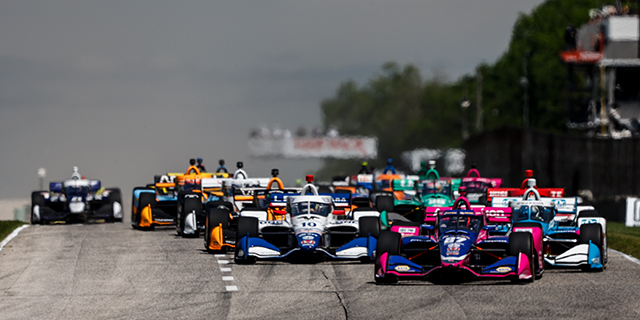
Photo by Kyle McInnes
When the dust settles in a chaotic Indycar race, fans can rest assured that either Scott Dixon or Marcus Ericsson will be out front. Both drivers thrive on chaos, whether of their own doing or the rest of the field’s.
Dixon drove another masterful fuel saving race, squeezing 44 laps out of his last fill up. He has two wins and a third place in 2024, and now leads the championship by 18 points over Alex Palou.
Meanwhile, Marcus Ericsson charged hard but fell eight tenths of a second short. Ericsson needed a good result coming off a nightmarish Indianapolis 500 and battling electrical gremlins Friday.
It seems as if every car had contact at some point. If you drove your car into turn three, you expected to get hit. half of the eight cautions were for issues in turn 3. Several incidents did not bring out the yellow flag there as well.
17 of the first 40 laps had Oriol Servia in the pace car at the head of the field.
Penalties were assessed early and often. Of the 12 handed down, Will Power received four of them. Still, because of the numerous cautions, he ended up sixth. His last penalty came on lap 60. Power had another penalty rescinded, or he would have fouled out.
When the green flew on lap 73 for the final time, fans saw the best racing of the day as a three-way battle for the lead between Dixon, Marcus Armstrong, and Ericsson developed. Armstrong, like Dixon, was saving fuel and to yield second place. he ran out of fuel just as he took the checkered flag.
Was it pretty? No. Was it sloppy? Yes. There will be a race or two like this during a season. I’m glad we got one out of the way so early. I think the twelve days at IMS were exhausting for everyone, and the four hour rain delay didn’t help matters much.
Today we saw the aftereffects of the 500 fortnight. Road America will be a welcome sight next weekend.
Should Detroit be the next race after the 500? With the mazing viewership numbers last Sunday, which may have brought in some new fans, Indycar chooses to go to a tight street track which invites crashes and televises it on an obscure cable channel. I don’t see how this keeps the momentum going after Indianapolis.
I am not against racing in Detroit. The city’s automotive history alone makes it worthy of having a race. There are parts of detroit I really like.But a better track where actual racing can take place would be great. perhaps this race could be at the end of June.
Indycar also needs to look into taking a week off after the 500. it would give the winner more time for appearance at more leisurely pace.
The 500 winner’s next race curse continues. Josef Newgarden had a fueling issue on his first stop, ran over an air gun on his next visit, nearly injuring a crewman in another pit, served a penalty for it, then hit the wall and broke a toe link, ending his day in 26th place.
This date in Alex Palou history: Palou finished 18th, his first finish outside the top 10 in 637 days.
I’m not sure what it will take for Colton Herta to win a race. He has to be the most frustrated driver in the paddock.
Felix Rosenqvist improved 16 positions to finish sixth. Saturday was the first time this year he had not qualified in the top 10.
Thanks for following along this weekend. I will be posting just basic information about Road America the next couple of days, and I’m not sure how much coverage I will be able to do. I leave for France and LeMans Wednesday afternoon.


A cool damp track made for a tricky warmup session this morning. Josef Newgarden edged Colton Herta for the fastest lap with a 1:02.0463 circuit. Herta was just 184 ten thousandths slower.
Early morning rain left the track still damp, especially near the walls. Many cars got sideways but the drivers were able to recover.
The session ended 90 seconds early when Theo Pourchaire had trouble refiring his car after ending up in a runoff area.
Televison coverage begins at noon on USA and Peacock. green flag is set for 12:45 Eastern..

 The Pit Window by Mike Silver