The Last Cowboys

Summer 2024 has been rough on us older race fans. In June Parnelli Jones, 1963 Indianapolis 500 winner, died at the age of 90, and last Friday Paul Goldsmith, two-time USAC stock car champion and six-time 500 starter who finished third in the 1960 race, left us at the age of 98.

Jones and Goldsmith had something in common with just three other drivers still alive. The five were the last to drive front engine cars in the Indianapolis 500. The remaining three are all multiple Indianapolis 500 winners- A. J. Foyt, age 89; Gordon Johncock, 87; and Johnny Rutherford, 86. The trio has nine 500 victories between them, as many as the Unser family.

Gordon Johncock
Johnny Rutherford

The front engine cars of the 1950s and 60s were tanks, built with little regard to driver safety. Stepping into one of these cars knowing that any run could be your last one, took a certain amount of fearlessness The front engine design had probably reached its top speed at the Speedway, a touch over 150 miles per hour, as the rear engine cars quickly pushed them aside in the mid ‘60s.

The drivers mentioned survived one of the deadliest 20 year periods in the sport’s history, and the three still living all are within shouting distance of their 90th birthdays. Is there a correlation between getting through that difficult era of racing and being extremely talented?  How much can be ascribed to good fortune?

Both Foyt and Rutherford suffered severe injuries on the track. How Foyt survived his accidents at Road America and Riverside is nothing short of miraculous.

On the other hand, there are drivers just as gifted as these three who had fatal injuries on track- Bill Vukovich, Bob Sweikert, Ted Horn, Rex Mays, and Jimmy Bryan- to name a few.

Racing needs to do more to honor these three living pioneers of the modern era.  While IndyCar’s popularity is just a shadow of what it once was, it would probably have disappeared had it not been for the efforts of these men and a few others. Foyt alone brought some new life to IndyCar with his incredible success in the early 60s. I hope all three are still here next May.  Foyt will be 90 by then, and Johncock and Rutherford will be one year closer to their 10th decade. I would like to see IMS go all out to give these men, and the other drivers of front engine cars their due, as a thank you.

Because of drivers like Jones, Foyt, Johncock, Rutherford, and Goldsmith, IMS and auto racing went through a renaissance, and we older fans should be able to cheer for them one more time. If you are an old timer like me, and you are at the track, seek out Foyt or Rutherford to say hi and thank them \. Johncock rarely ventures to IMS.

90 isn’t too far away for some of us either.

Indianapolis 500 Veteran Goldsmith Dies at 98  

This is very sad news. I was a huge Goldsmith fan back in the day. What a life he lived.

From IMS:

 INDIANAPOLIS (Friday, Sept. 6, 2024)– Indianapolis 500 veteran Paul Goldsmith, a winning competitor on two and four wheels, died Sept. 6 in Munster, Indiana. He was 98, the oldest Indianapolis 500 starter at the time of his passing.West Virginia native Goldsmith made six consecutive “500” starts between 1958-63. His best finish came in 1960, a third-place result in the No. 99 Demler Epperly/Offy car overshadowed by the sensational duel for victory between Jim Rathmann and Rodger Ward.
Goldsmith also finished fifth in 1959. That strong result came a year after he completed zero laps as a rookie starter in 1958, as he was caught in the multi-car accident that claimed the life of Pat O’Connor.
Goldsmith’s best qualifying position was ninth for his final start, in 1963.Incredibly, Goldsmith achieved such success at the top level of open-wheel racing despite making only eight career starts in cars without fenders. All eight races were USAC Championship events, including the six Indianapolis 500 starts.
Few racers in his era were more versatile and successful than the humble, quiet Goldsmith.
Raised in Detroit, he began racing motorcycles as a teenager after the end of World War II. He jumped immediately to American Motorcyclist Association expert status on Harley-Davidson machines, competing while working full time at a Chrysler factory. Goldsmith’s first major AMA motorcycle win came in 1952 on the 1-mile dirt track at Wisconsin State Fair Park, now paved and known as the Milwaukee Mile
.In 1953, Goldsmith won the Daytona 200 motorcycle race on the old beach road course, with his Harley prepared by legendary engine builder and tuner Smokey Yunick. He also won the 100-mile race at treacherous Langhorne (Pennsylvania) Speedway.
Goldsmith finished second in the AMA standings in 1954 to a protegee and friend from the West Coast who also achieved success on two and four wheels – Joe Leonard.
While still racing motorcycles, Goldsmith tried his hand at stock car racing, winning a 250-mile race in 1953 at the Detroit Fairgrounds. He made his final motorcycle start in 1956 and then focused on stock car racing, earning his first NASCAR victory that year in a 300-mile race at Langhorne for Yunick’s team.
Goldsmith was the final NASCAR Grand National winner on the old beach course in 1958 in Daytona Beach, Florida, while the construction of Daytona International Speedway was underway. He is the only competitor to win on the beach course in a car and on a motorcycle
.In 1959, Goldsmith teamed up with ace mechanic Ray Nichels and dominated the USAC Stock Car circuit in Nichels Engineering machines during the first half of the 1960s. He won the USAC Stock Car championship in 1961 and 1962 and finished second in 1960 and 1965.Goldsmith won 26 USAC Stock Car races in 85 starts, with 44 top-three finishes. Nineteen of those wins came in 39 starts during his title-winning seasons in 1961 and 1962.
He won nine races and earned 59 top-10 finishes in 127 NASCAR starts. His last NASCAR win came in 1966 at Bristol (Tennessee) Motor Speedway.
Despite only six starts at Indianapolis Motor Speedway, Goldsmith turned many laps at the Racing Capital of the World as Firestone’s chief test driver.
He also participated in one of the most unique events in IMS history, a 24-hour race between two cars Nov. 21-22, 1961. Goldsmith and fellow star drivers Ward, Len Sutton, Fireball Roberts, Marvin Panch and Joe Weatherly alternated between a Police Enforcer version of a Pontiac Catalina and a conventional Catalina in heavy rain, a test of the machinery and drivers. They were the first drivers to compete on the completely paved 2.5-mile oval, as the front straightaway of original brick was covered with asphalt in October 1961.
His noteworthy accomplishments on two and four wheels were honored with membership in several Halls of Fame, including the IMS Hall of Fame, Motorsports Hall of Fame of America, Motorcycle Hall of Fame, USAC Hall of Fame and Michigan Motorsports Hall of Fame.
Goldsmith retired as a driver in 1969 to focus on his growing aviation exploits. He was a noted pilot, one of the first drivers to fly himself to and from races. He also trained pilots for China East Airlines, flew parts to races in his plane, and owned an aviation engine repair business and an airport in Griffith, Indiana. Goldsmith also owned a series of ranches and restaurants.
Goldsmith was predeceased by his wife, Helen, and son, Greg. He is survived by his daughter, Linda Goldsmith-Slifer. 
 

An IMS Legend is Gone

Chuck Lynn, a fixture n Pagoda Plaza and Gasoline Alley, died today. Chuck sold the Indianapolis Star for many years at the Speedway. He was part of the place, and his absence will be felt next May. I occasionally bought a paper from Chuck, because that’s what you do.

I did not know Chuck well but seeing him upon arriving in the plaza gave me comfort. I knew I was in the right place. How odd it will seem next spring to not hear the call of “Paper!” as i walk by his bike.

It’s fitting that Chuck passed away three years and a day after his good friend Robin Miller. The two had a special bond. Tony Kanaan also had a great relationship with Chuck.

IMS will feel a little emptier in May 2025. It seems the regulars are leaving too quickly the last few years, losing the race none of us will win. Say Hi to Robin for me, Chuck.

McLaughlin Stays on Top

Photo by Kyle McInnes

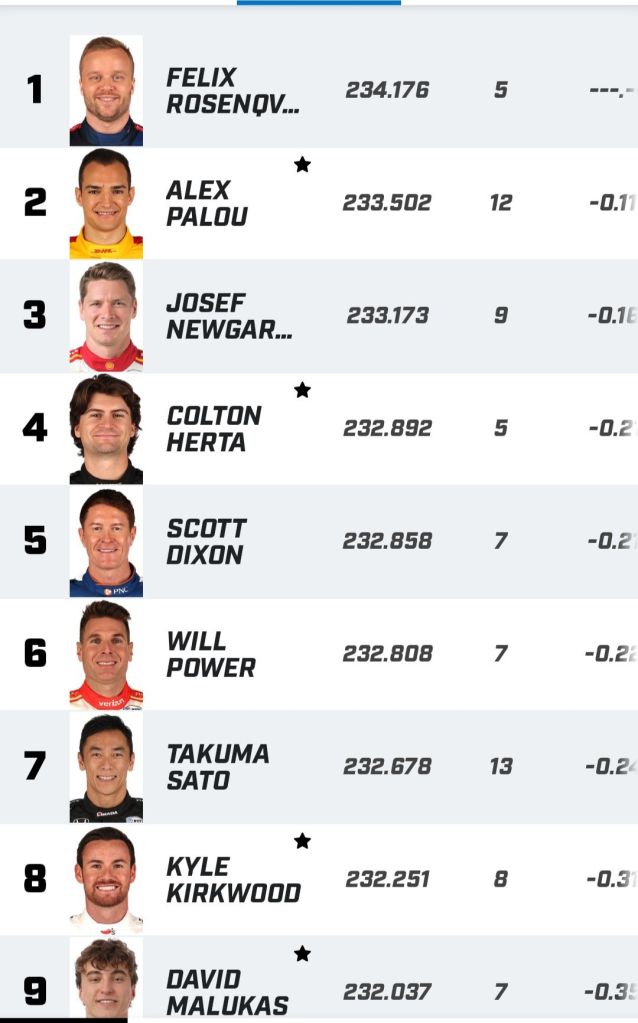
Scott McLaughlin continues to pace the Indycar field at Portland after the second practice. McLaughlin turned a lap 0f 58.8605 seconds this morning under cool conditions. David Malukas was just two hundredths of a second behind. Malukas will serve a six spot grid penalty for the race.

The field is quite tight. 26 of the 28 cars were within seven tenths of the leader. Only Felix Rosenqvist and Toby Sowery were more than a second behind the leader.

Felix Rosenqvist had a wild ride over the turn 1 curbing, captured by Peacock. He is now just two hours short of getting his pilot’s license.

Three red flags stopped the session briefly, but the field id get the full 45 minutes of green flag time allotted. Will Power spun and stalled in the first five minutes of the session. Sting Ray Robb went off track in turn 11 and went nose first into the tire barrier. Toby Sowery went off tack requiring a stoppage near the end of the session.

Qualifying begins at 12:30 pm Pacific Time.

Results

Notes

Get your spotters guide handy. There are nine cars this weekend with a shade of red and white liveries here. Several cars, notably the number 14, are in a livery that is a complete departure from their usual colors.

It is warming up quickly, and conditions for qualifying should near ideal.

Longtime IMS Media Center Manager York Dies at 91 

Editor’s Note: The following story is from IMS Public Relations. I never met Bill York, but you could not go to a sporting event in Indianapolis without hearing the name Bill York. You just knew he was there, even if you didn’t hear his name mentioned. A huge loss for the city.

 INDIANAPOLIS (Wednesday, Aug. 21, 2024) – Bill York, who worked in and managed the media center at Indianapolis Motor Speedway for more than 50 years, died Aug. 20 near Nashville, Tennessee.
He was 91.

York, a proud native of Peru, Indiana, served and befriended journalists from around the globe and drivers and race team officials in his roles in the media center at the Racing Capital of the World from the late 1950s to the mid-2010s. His contributions spanned every event at IMS during that time, including the Indianapolis 500, Brickyard 400, United States Grand Prix Formula One race, Red Bull Indianapolis GP MotoGP race and more.

The colorful, genial York ran the IMS media center with a fair, firm hand, mixing a no-nonsense approach with a hearty laugh that earned admiration and respect from all journalists and officials.

York and longtime IMS media official Bob Laycock created handwritten Indianapolis 500 qualifying cards – complete with driver and primary sponsor name, and time and speed for each of the four laps of every qualified driver, written in color-coded markers to match sponsor colors – that became legendary fixtures on the walls of the old media center located adjacent to Gasoline Alley and the current media center adjacent to the Pagoda.

Drivers often sought their qualifying cards as keepsakes, especially from their rookie year in the “500.”

He also was instrumental in helping to increase the recognition of the Stark & Wetzel Indy 500 Rookie of the Year Award in the 1950s when he was a sales representative for the Indianapolis-based meat company.

York began working in the IMS press room in 1958 as a statistician, eventually taking over management duties in the media center through 2008. He then continued to serve as a media center liaison into the mid-2010s. Working at IMS was a part-time job for York – he was a very successful salesman during his professional career – but a role he fulfilled with full-time passion and skill.

He earned a variety of auto racing awards for his work, including the 2010 Bob Russo Founders Award for lifelong contributions to the sport, the 2011 Jim Chapman Award for excellence in motorsports public relations and the STP Unsung Hero Award.

While York was a renowned figure among global racing media, he also was respected and admired by National Football League and professional basketball journalists due to his longtime work in the media rooms of the Indianapolis Colts and Indiana Pacers.

York was the first leader of the statistics crew for the Pacers in 1967, a role he maintained for five decades and more than 2,000 games as the franchise moved from the American Basketball Association to the National Basketball Association. The Pacers’ media room in Gainbridge Fieldhouse is named in his honor

.He also led the stat crew and worked in the media room for the Colts from their arrival in Indianapolis in 1984 through the 2010s, working at both their original home at the RCA Dome and their current home, Lucas Oil Stadium.

York was predeceased by his wife, Jay, and son Rick. He is survived by a daughter, Marla.

Parnelli Jones- The Racer’s Racer

In my den I have a wall of photos of drivers and cars who have won the 500. Most are from the 30s, 40s, and 50s. But one of the three I have from 1960 and later is of Parnelli Jones, he of that magical lap in 1962 that set the tone for the speeds we see today.

While he was a threat at every track he went to, and his name was on everyone’s mind, A. J. Foyt and Mario Andretti grabbed most of the headlines and endorsements in the early and mid 60s. But Parnelli Jones was arguably even more versatile than either Foyt or Andretti.

Jones, who died yesterday at the age of 90 after a long battle with Parkinson’s, won in Indycar, NASCAR, sprints, midgets, off-road, also found success as a car owner.

I was at Pole Day in 1962 when Jones drove the first official 150 mile an hour lap. Through the years I have been to many record setting pole days, but the roar from the crowd that day has never been matched. At the time 150 seemed like an unimaginable threshold. 200 miles an hour was just a matter of time after that.

Like Mario, Parnelli’s Indianapolis 500 should include at least two more victories. he had the field covered in 1962 until brake failure caused him to slow his pace and pit stops were difficult. Yet he somehow finished sixth.

Jones came back the next year, won the pole again, then won the race. In 1967, driving the controversial turbine, Jones was leading comfortably on lap 196 when a bearing failed, ending his day.

After he retired from driving, Jones came back to IMS as a car owner. Al Unser won in the Johnny Lightning Special owned by Panelli and Vel Melitich in 1970 and 1971.

Another legend from my racing childhood has gone, and I know more will pass in the next few years. If you were at the track this year and passed up chances to say hi to AL, Mario, or Johnny Rutherford, don’t make that mistake next year. Tell them what they mean to you.

Last night after the news broke, I was thinking I will be sad as I leave for Le Mans today. But the more I thought about it, I won’t be sad. It’s a cause for celebration. This is the perfect time to go. It’s a way to say thank you to Parnelli and the legends living and dead for their gift of a love of the sport

1963 Indianapolis 500 Winner Jones Dies at 90

Editor’s note: This story is from IMS. I will have my thoughts up tomorrow morning, if I have collected them by then. What a way to begin my trip to Le Mans.

INDIANAPOLIS (Tuesday, June 4, 2024) – Parnelli Jones, the 1963 Indianapolis 500 winner and the first driver to qualify for the “500” faster than 150 mph, passed away peacefully with his family by his side June 4 in Torrance, California. He was 90.

One of the most versatile drivers in history, Jones was so highly rated by all his competitors, including several of the best from Europe. He only competed in the Indianapolis 500 seven times yet led in all but two of them for a total of 492 laps, still the eighth-highest laps led total in the race’s history. And in the only two starts he didn’t lead – 1965 and 1966 – he ran many laps in second place, finishing in that position in 1965 and retiring from there with mechanical trouble in 1966.

Jones, who was born Rufus Parnell Jones on Aug. 12, 1933, in Texarkana, Arkansas, is the only person ever to have led the Indianapolis 500 for 400 or more miles on two occasions. The first came when he won in 1963 and the second when his Andy Granatelli-entered, STP turbine-powered car failed after leading 171 of the first 196 laps in 1967.

Winner of the pole position with track-record qualifying speeds faster than 150 mph in 1962 and 1963, Jones never started lower than sixth in any of his seven “500s.”

Even after retiring from INDYCAR SERIES competition as a driver, somewhat prematurely in 1968 at the age of only 34, the street-smart Jones continued to be a winner. He fielded a team with a longtime business partner Vel Miletich that won the “500” in 1970 and 1971 with a pair of PJ Colt chassis, built in-house under the direction of chief mechanic George Bignotti and driven by Al Unser. This combination also won the United States Auto Club National Championship in 1970 followed by a second and third straight title in 1971 and 1972 with former motorcycle racing standout Joe Leonard behind the wheel.

Vel’s Parnelli Jones Racing even briefly ventured into Formula One. They fielded Mario Andretti in the 1974 season-closing Canadian and United States rounds, followed by the entire Grand Prix circuit in 1975, and all the races up through the Long Beach, California, round in spring 1976, at which point lack of sufficient sponsorship brought the campaign to an end.

During this same period, the team also fielded Andretti and Unser in the Sports Car Club of America’s Formula 5000 road racing series and the USAC Dirt Car (later Silver Crown) series on 1-mile dirt ovals, the two drivers consistently recording top-three finishes in each of these widely contrasting forms of motorsport.

Jones was named after a local judge, Rufus Parnell, whom his mother respected. The family moved from Arkansas to Fallbrook, California, when Jones was 2 and then to Torrance, California, when Jones was 7

.At age 17, while racing old cars in Gardena, California, Jones needed an alias to prevent race officials from learning he wasn’t the minimum legal age of 18 to compete.

Jones’ school friend, Billy Calder, came up with an idea to solve the problem. There was a girl in their school named Nellie, and Calder used to tease Jones about her liking him. Calder knew Jones’ middle name was Parnell, and he would joke around with him, calling him “Parnellie.” Calder painted the name “Parnellie” on the jalopy door, and the rest is racing history, with the “e” dropped somewhere along the way.

As a driver, Jones burst on the USAC scene in 1960, joining his friend and traveling partner Jim Hurtubise in defeating all the venerable Offenhauser-powered sprint cars with much less expensive V8 “stock block” Chevrolet powerplants. Jones was offered cars to drive at Indianapolis that first year, but the savvy newcomer chose instead to watch from the sidelines as Hurtubise smashed the qualifying track records and dominated the Rookie of the Year honors. Jones had decided instead to make his championship debut after the “500” to potentially enjoy a full season on “the circuit” before returning to Indianapolis the following May with valuable miles under his belt.

It worked out better than expected.

By the time he almost won the 1960 Milwaukee 200 with a Quin Epperly-built “laydown” that August, Jones already had been blessed with the break of a lifetime by testing tires for Firestone, thus racking up hundreds of miles at IMS before ever taking a rookie test. Everything seemed to be in place for him to drive the same Epperly car the following May until veteran Tony Bettenhausen took it out for a “test hop,” raved over its handling and convinced car owner Lindsey Hopkins he should purchase it for Bettenhausen to drive.

Jones wasn’t out of a ride for long.

J.C. Agajanian, for whom Bettenhausen had previously agreed to drive in 1961, was already somewhat of a mentor to Jones, and it didn’t take long for Agajanian to hire him in Bettenhausen’s place. Jones qualified fifth for the “500,” led 27 laps and might have been a late-race contender for victory had he not been hit in the eye by a rock. Even with blood streaming into his goggles and an engine down on power due to a fouled spark plug, he refused to give up, flagged off several laps behind at the end in 12th place. The Rookie of the Year balloting resulted in a tie between Jones and Bobby Marshman, who finished seventh.

Jones’ 1960 USAC Sprint Car season had culminated with the final Mid-West Sprint Car title and was followed in 1961 by the inaugural National Sprint Car title, the first in which the previously separate championships of the Mid-West, East and Pacific Coast were merged. Jones eventually won 25 USAC Sprint Car feature events, along with another 25 wins in USAC Midget Car feature events despite competing only on an occasional basis.

At the end of the 1961 season, Jones posted his first of six USAC National Championship victories with a win in the season-ending 100-mile dirt track event at the Arizona State Fairgrounds.

By this time, Jones had already been heeding the advice of his racing hero, 1952 Indy 500 winner Troy Ruttman, in seeking Agajanian’s help with investments. It had begun with steady contributions from Jones’ sprint car earnings until their holdings, as partners, grew to include a variety of valuable real estate acquisitions. Set up with a Firestone store in 1965, Jones worked hard with that investment, and it wasn’t long before he opened a second store and a third, eventually topping out with no less than 47 of them. Even after selling the whole enterprise many years later, he remained on board as a consultant, with his iconic name still appearing above the main entrances.

Although Rodger Ward won his second “500” in 1962, Ward often said Jones was the moral winner of that race. The first – and only – driver to qualify faster than 150 mph that year, Jones, in only his second “500” start, proceeded to lead 120 of the first 125 laps of the race until failing brakes obliged him to slow down. Never giving up, as was typical, he nursed his ailing car home to seventh after having run for almost 200 miles without brakes

.In 1963, Jones won the Indianapolis 500 in the No. 98 Watson-Offy nicknamed “Calhoun,” although the race was not without controversy. Late in the running, oil began to seep from a tiny crack in an externally mounted oil tank, placing Chief Steward Harlan Fengler in the unenviable position of having to decide whether or not to black-flag the leader. While he was still deliberating, the leak stopped, and Jones was allowed to continue to the victory.

Just over a year later, Jones was invited to drive two races for Team Lotus, the first being the August Milwaukee 200 when Jim Clark was not available, and the other as Clark’s teammate for the Trenton (New Jersey) 200 in September

.Jones won both races.

It was quite a compliment when Lotus team principal Colin Chapman came forth with an offer to have Jones partner World Champion Clark on the Formula One circuit, but for a variety of reasons, Jones politely declined, preferring to race at home. He landed yet another title, capturing the 1964 USAC Stock Car championship with eight wins in 15 starts for Bill Stroppe’s Mercury team, and he even trounced the sports car contingent in the late-season Los Angeles Times Grand Prix at Riverside Raceway in California.

Jones’ sixth and final USAC Championship victory came in June 1965 in the Milwaukee 100, driving the same Agajanian-owned Lotus with which he had finished second to Clark in the most recent “500.” He had decided to cut back on INDYCAR SERIES racing at that point and made only one more start for the balance of the year, racing USAC Stock Cars instead and becoming more and more involved with off-road racing.

Despite Jones’ numerous victories and accomplishments, he also will be remembered for almost winning the “500” in 1967 with Andy Granatelli’s controversial, STP-sponsored, four-wheel-drive turbine.

Jones qualified a disappointing sixth with the dominant car, but it didn’t take him long to get to the front on Race Day. Using the four-wheel-drive system to its fullest extent, Jones negotiated the turns above the accepted “groove,” and by the time he entered Turn 2 of the opening lap, he had driven around the outside of all but pole sitter Mario Andretti. As they cleared Turn 2 and headed down the backstretch, Jones moved to the inside and sped past Andretti with apparent ease to lead the first lap by a huge margin.

Rain fell after only 18 laps, forcing the race into a second day, but then the story pretty much remained the same. When an inexpensive bearing in the rear end failed within sight of the finish, Jones had led for 171 of the 197 laps.

In 1968, Jones was supposed to drive the much-revised No. 40 turbine in the “500,” but he ended up never turning a lap, having weighed his chances of winning against the growing responsibilities of his many business investments and his family. He decided instead to step down and turn over the car to Leonard, who was driving for the team Jones co-owned with Miletich.

Although he was now no longer an Indianapolis 500 driver, that did not mean Jones was through with driving. He became part of Ford’s effort to win the SCCA Trans-Am championship, and he won the driver’s title in 1970. In off-road racing, he teamed up again with Stroppe to score five major wins with a much-modified Ford Bronco, sponsored by Olympia Beer and affectionately nicknamed “Big Oly.” The combination won the Baja 1000 in 1971 and 1972, the Baja 500 in 1970 and 1973, and the Las Vegas Mint 400 in 1973.Jones is survived by his wife of nearly 57 years, Judy, and sons PJ and Page, both of whom had professional racing careers. PJ Jones followed in his father’s footsteps by starting the Indianapolis 500 in 2004 and 2006. Page Jones was making great strides on Midwest short tracks until he suffered serious injuries in a crash in 1994, ending his driving career.

Parnelli Jones was inducted into numerous Halls of Fame, including the Indianapolis Motor Speedway Hall of Fame, the National Motorsports Hall of Fame and both the National Sprint Car and National Midget Halls of Fame.

Indianapolis 500 Purse Soars to New Heights 

From IMS
 Back-to-Back Winner Newgarden Receives Largest Payout in ‘500’ History

INDIANAPOLIS (Monday, May 27, 2024) – The Indianapolis 500 purse record was shattered for the third year in a row after a weather-delayed 108th Running of the Indianapolis 500 presented by Gainbridge, with two-time race winner Josef Newgarden of Team Penske earning $4.288 million from a total purse of $18,456,000.

After record-breaking payouts in 2022 and 2023, this is the largest purse and largest winner’s payout in the century-plus history of “The Greatest Spectacle in Racing.” The year’s average payout for NTT INDYCAR SERIES drivers was $543,000, which also exceeds last year’s average of $500,600.

In 2023, the Indianapolis 500 purse was $17,021,500, and the year’s winner payout was $3.666 million. In 2022, the Indianapolis 500 purse was $16,000,200, and the winner earned $3.1 million. Prior to 2022, the largest Indianapolis 500 purse was $14.4 million for the 2008 Indianapolis 500.

Second-place finisher Pato O’Ward of Arrow McLaren took home $1,050,500, exceeding the take-home prize for last year’s second-place finisher.

“The Indianapolis 500 is the greatest race in the world, and this record-breaking purse is reflective of just how monumental competing in and winning at Indy is for these drivers,” Penske Entertainment President and CEO Mark Miles said.
“Despite weather challenges, the Month of May featured packed grandstands and intense on-track action. Presenting this purse is the ideal end cap to an epic month.”

NASCAR Cup Series champion Kyle Larson earned Indianapolis 500 Rookie of the Year honors for his performance during the Month of May. Larson, driving for Arrow McLaren/Rick Hendrick, made his first attempt to complete “The Double,” by racing both the 108th Indianapolis 500 presented by Gainbridge and the NASCAR Cup Series Coca-Cola 600. Larson earned a $50,000 bonus for being named Rookie of the Year, adding to a total take-home prize of $178,000.

The Indianapolis 500 purse consists of Indianapolis Motor Speedway and NTT INDYCAR SERIES awards, plus other designated and special awards. Purse awards are presented annually at the Victory Celebration, held this year at the JW Marriott in downtown Indianapolis Monday night.

Newgarden’s purse included a $440,000 rollover bonus from BorgWarner for earning back-to-back wins in the “The Greatest Spectacle in Racing.” The jackpot increases by $20,000 each year but has only been awarded one other time since its inception when Helio Castroneves won the Indy 500 in both 2001 and 2002.

The next NTT INDYCAR SERIES race is the Chevrolet Detroit Grand Prix presented by Lear on Sunday, June 2 on the streets of Downtown Detroit. The race will be broadcast live on USA Network, Peacock and the INDYCAR Radio Network starting at noon (ET).