First Responder 175 Entry List Provides Taste of May

The entry list for Saturday’s First Responder 175 Presented by GMR will be the only action we see from Indianapolis Motor Speedway this May. No events are scheduled at the track until July 4th weekend, and at this point we don’t know if fans will be allowed to attend. So enjoy Saturday’s virtual action.

A 15 minute qualifying session tomorrow will set the field. Yesterday, a qualifying session was held to whittle the field to 33. Stefan Wilson, James Davison, R C Enerson, and Scott Speed advanced to the final entry list. Helio Castroneves earned a spot by virtue of being a former 500 winner.  Scott McLaughlin and Lando Norris earned guaranteed entries by winning races in the iRacing Series.

The entry list:

wp-15882598786835976994541527702879.png

Enerson, Top Gun Racing Look to Join Indycar; Entering iRacing Challenge

The Coronavirus pandemic has certainly changed the way things happen. In a reverse twist, Top Gun Racing and R C Enerson will attempt to qualify for the Indycar iRacing Challenge at Indianapolis Motor Speedway. Qualifying for Saturday’s 175 mile race is today. The team does not have one of the guaranteed spots.

Top Gun Racing hopes to use the virtual race effort to solidify their plans to join the NTT Indycar Series when the 2020 racing season actually starts. The team principals are Gary Trout and Bill Throckmorton with support from Hagerty Insurance. The car will carry number 99.

Enerson is a capable driver and will help the team. They have not come to to terms with an engine supplier. The team will operate out of a shop in Brownsburg, Indiana.

It’s nice to see that a new team is in the works in these uncertain times. It will be nicer when we can actually start the season.

I’ll be back later with some thoughts on fans attending races this year.


Blood and Smoke- Who Won the 1911 Indianapolis 500?

I found Blood and Smoke, the 2011 story of the first Indianapolis 500, to be a mixed bag. It is part Carl Fisher biography, part origin chronicle, and part conspiracy theory.  Charles Leerhsen presents a well researched case that perhaps someone other than Ray Harroun may have won the inaugural 500. There is, however, an argument supporting Harroun’s victory.

The book mainly focuses on the life of Carl Fisher, who is the Hoosier P. T. Barnum. Fisher never met a publicity stunt he didn’t like. He has a penchant for tossing vehicles from the roofs of downtown buildings to prove their strength. Fishrer jumps from one project to another. The Indianapolis Motor Speedway is one of his more focused and persistent endeavors.

The early days of the track are a financial and presentation disaster. Fatalities and accidents due to the rough track surface mar the 1909 and 1910 race meetings. the decision to brick the track surface and hold one 500 mile event are the beginning of the Speedway’s salvation.

Fisher has other motives besides running a successful race track. Indianapolis and Detroit are competing for the honor of being the nation’s auto manufacturing center. Fisher thinks the speedway will give Indianapolis the edge. He wanted a local manufacturer to win the race. He is best best friends with Howard Marmon, the owner of the car which is awarded the victory.

The 1911 race itself is a long day of confusion as to the standings. The situation is made more difficult by the inadequate timing system and the complicated way in which laps are recorded. The situation gets worse when cars begin pitting and after the accident in the pits. Ralph Mulford believes he wins the race, but when he gets to victory lane he sees Harroun in the Marmon Wasp already sitting there.

Race officials spend the next two days going over the timing and scoring records. Early in their review they make it clear that any changes in the finishing order will not include  changing the winner. Fisher orders that the records be destroyed after the official finish is published. What we see as the standings today is what we have to accept as official. Is it correct. Leerhsen doesn’t think so.

What I most enjoyed was the biographical information on Fisher, Harroun, Mulford, and others. The author gives some long overdue credit to some of the riding mechanics as well, telling some of their stories. The author does not gloss over the danger of auto racing in its infancy. This is a gritty, graphic depiction of the early days of the sport.

Blood and Smoke is a good book for background on the origin of the Indianapolis Motor Speedway and the 500 Mile Race. It deepened my understanding of what the event has grown to be. After a very difficult beginning, it is rather amazing that the 500 still exists.


Homecoming- A Trip to IMS

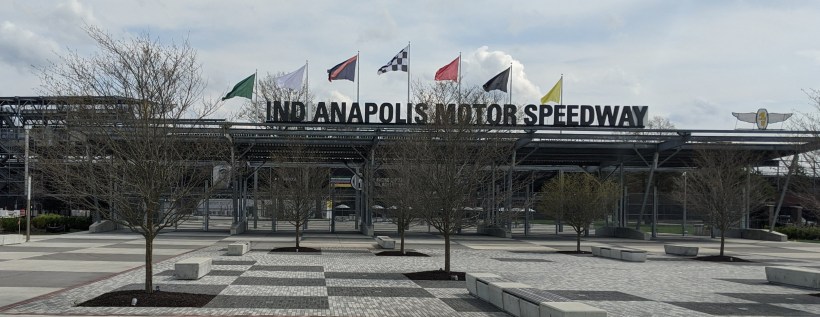
I have been back in Indianapolis since Wednesday afternoon. This morning I took a drive to the Indianapolis Motor Speedway.  I had to for my own peace of mind. Just driving by it on 16th street brought a measure of comfort.  I parked on Main Street and walked back to the track.

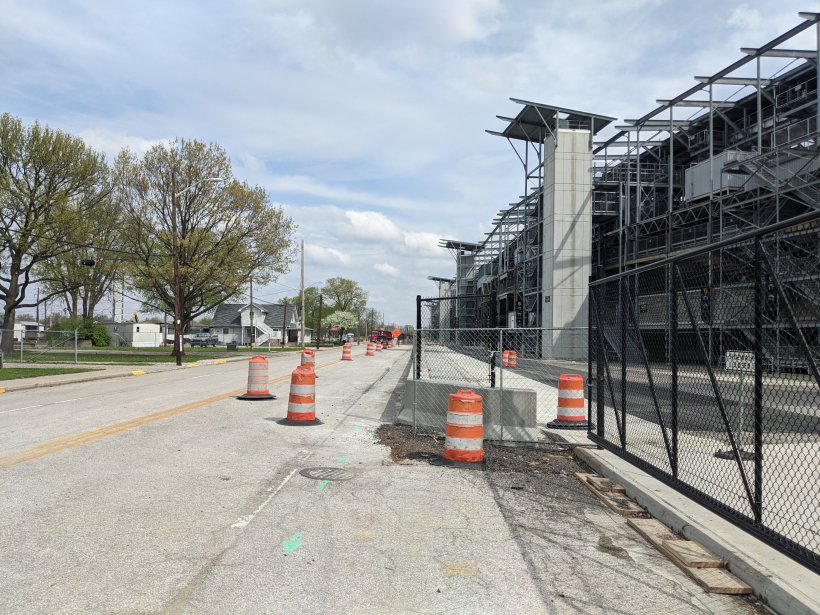
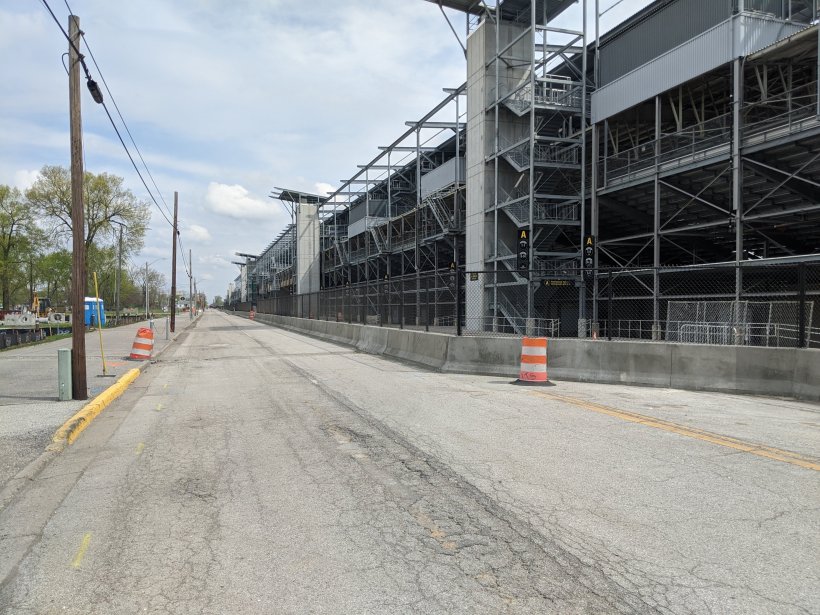
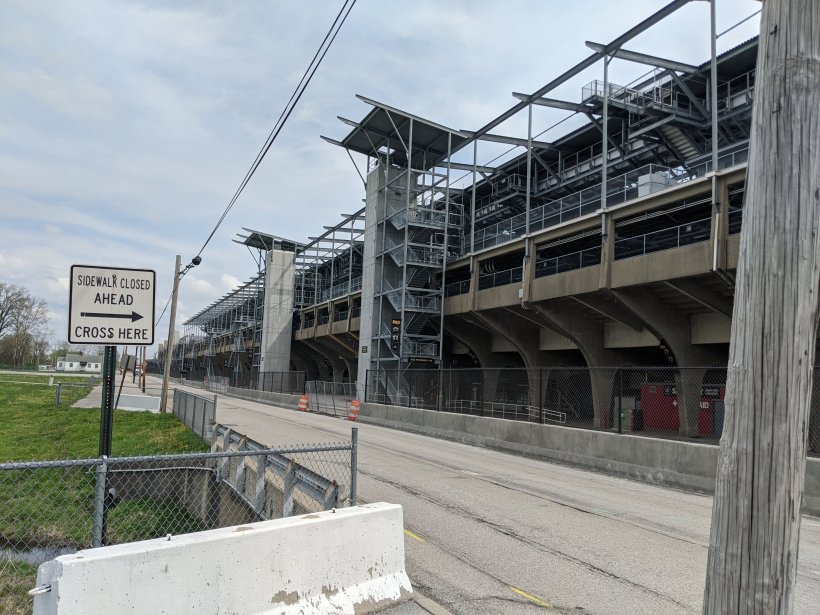
The first thing I noticed was the lot on the corner of 16th and Georgetown being paved. Further up Georgetown a lot of construction is happening on the west side. I’m not sure what the end product will be, but it will be an improvement. The most noticeable major renovation is the extension of outer fence into Georgetown Road. A perhaps unintended consequence of the boundary extension is the creation of a biking/walking path which people were taking advantage of this pleasant Saturday morning.

It was sad knowing that the track will not be opening as originally scheduled in 13 days, or if there will even be activity here at all in 2020. We will wait and see.

wp-1587832673862680056204249932264.jpg

wp-15878326592826195161516731359826.jpg

wp-15878326222392975087330331474970.jpg

wp-15878326448015602602617171816628.jpg

Silent Stands

Editor’s Note: Sad to hear about the death of Bob Lazier, 1981 Indianapolis 500 starter and the father of 1996 500 winner Buddy Lazier and Indycar driver Jacques Lazier, from complications of COVID-19. Condolences to the Lazier family.

It’s great to be back in Indiana. The reality of the COVID-19 situation hit me the last two days as we drove on mostly empty roadways and breezed through normally traffic congested cities. The Downtown areas of Louisville and Indianapolis were stark in their emptiness.

As May begins next week we still don’t know when the Indycar season will actually start. I would not be surprised to see the first scheduled race, June 6 at Texas, postponed or cancelled. I’m not sure the next event at road America or the Following weekend at Richmond will happen either.

It’s all a matter of social distancing. Can a track afford the risk of having fans attend and potentially fall ill? I’m not sure I want to go to a race until after I have had a vaccination. NASCAR and Formula1 have discussed racing with no fans present. Conducting a race takes a lot of people. Track staff, series officials, media, and team personnel needed can comprise a small town alone. Is it worth the risk of exposure for those people just to to fulfill a schedule?

Eddie Gossage, president of Texas Motor Speedway, is discussing the possibility of a NASCAR/Indycar doubleheader without fans. I like the double header idea but there would be twice the amount of people at the track to run races from two different series.

Roger Penske has said he would not run the Indianapolis 500 without fans. I’m glad to hear that. I don’t think the 500 should be run just for the sake of running it. I would rather wait until it is safe for fans to be present. I’m not sure this August is the time for 300,000 people to gather in one spot. . The race has been cancelled in the past due to major world events. This may be the third time in its history that we need to wait another year. I would hate for that to happen, but it may be in everyone’s best interests.

The Indycar iRacing Challenge series has given us a taste of what watching a race without fans in the stands might be like. It is a bit eerie, but I enjoy the only type of racing available right now. Will there be more events after this six week challenge ends May 2?

We are all anxious to get back to the track. We must be patient and think safety and health first. If this entire year is wiped out, it will be tough to take, but I’d rather go to to a track with a feeling of comfort and safety.

Everyone stay safe and wash your hands.

I’ll be back later to begin coverage of his week’s iRacing event from COTA.


Radio Days- Listening to the 1960 Indianapolis 500

Photo: (left) Rodger Ward leads Jim Rathmann late in the 1960 Indianapolis 500; (right) Rathmann took the lead for good on lap 197 and won by 13 seconds.

Editor’s note: I learned Sunday afternoon of the death of Pat Kennedy, who has authored several trivia books about the Indianapolis 500. I have all of them and use them constantly for quick reference. My condolences to his family. For more about Pat, please read  George Phillips’s post on Oilpressure from yesterday at https://oilpressure.com/2020/04/13/a-major-loss-to-the-indycar-community/

The interminable days of quarantine afforded me the time to listen to a complete radio broadcast of one of my favorite 500s, the 1960 race. I listened to the race at home that year. It was a great race. This story is more about the broadcast than the race. Several things stood out to me about the radio call in 1960. It was quite a contrast to today’s radio broadcast. I’m not saying one was better than the other, but the evolution of the radio network is very clear.

1960 was the eighth year of the Indianapolis Motor Speedway Radio Network. It was still growing.  Lead announcer Sid Collins welcomed a new station from Minneapolis to the network, for example. I had listened to the broadcast of the 1953 race, the  first year of the network. The earlier broadcast had some rough spots, many of which had been smoothed out by 1960. There were still a few glitches in communication between the broadcast booth and pit reporters.

As the speeds of the cars increased, the coverage had to change. Today the radio call is rapid fire coverage of non stop  track action. In 1960, the broadcast coverage of the race was rather leisurely. They knew they had a three and a half hour race to cover and that there would be many lulls in the action. Pit stops only happened every 40-50 laps. Not every one came in at one time.

The pace of the race allowed for time to talk to celebrities and guests. Stopping in to chat with Collins and his color commentator Freddie Agabashian this day were Indiana governor Harold Handley, Guy Lombardo, David Crosby, and former winners Johnnie Parsons and Bill Holland. Parsons spoke first, the Holland followed. Holland referred to the 1950 race by joking, “Ten years later and I’m still following Parsons.”

The five reporters stationed around the track- one in each turn and one in the middle of the backstretch gave somewhat laconic reports and descriptions of the action. “Eddie Russo spun and hit the wall. Back to you, Sid.” The team employed the same relay system in use today in which one corner reporter calls for the person at the next station to continue the action. The two pit reporters had a lot of ground to cover during stops. Sometimes it sounded as if Collins had a better view of the pit action than the pit reporters did.

The broadcast as presented on Indycar Radio cut most of the commercials. They left a couple Stark & Wetzel spots in. I always enjoyed the whistle in those commercials. While the ads ran you could still hear the cars on track in the background. I always loved that.

Speaking of commercialization, I didn’t hear a lot of brands mentioned except for Firestone tires and Champion spark plugs. Not every thing during the race had a sponsor. It was refreshing. The car names were mentioned when the starting lineup was presented, but after that the announced interval standings included just the car number and driver’s name.

One difference from the 1953 broadcast I noticed was how Collins referred to the drivers. In 1953 he called them “lads.” In 1960 they were “boys.” I guess they had grown up in seven years. The safety crews and mechanics, however, were “men.”

As the race got closer to the finish, the broadcasters paid more attention to it. A great three way battle for the lead began around lap 145 between Rodger Ward, Jim Rathmann, and Johnny Thompson. Thompson would drop out of the race about 30 laps later, setting the stage for Ward and Rathmann to conduct their classic duel. Collins and Agabashian were excited that this race might be the closest in history. In 1960 the closest finish to date was Wilbur Shaw beating Ralph Hepburn by 2.16 seconds in 1937. The record would stay in tact a while longer.

A couple of interviews with drivers who dropped out of the race made me sad since I knew what the future held. Eddie Sachs- it was great to hear his voice again- proclaimed that he would definitely win next year. He was almost right. Tony Bettenhausen, the great driver with an awful record at IMS said he would be back for his 15th race in 1961. He was killed in a practice accident the day before Pole Day while testing Paul Russo’s car.

I recommend you go to Indycar radio and find an old race broadcast to listen to. I plan to listen to another one in the mid 1960s or early 1970s. I will not listen to the 1964 race. I still have nightmares about that one.


The First Harvest Classic

As we prepare for the Harvest Classic at IMS next week, here is a brief history of the last Harvest Classic.

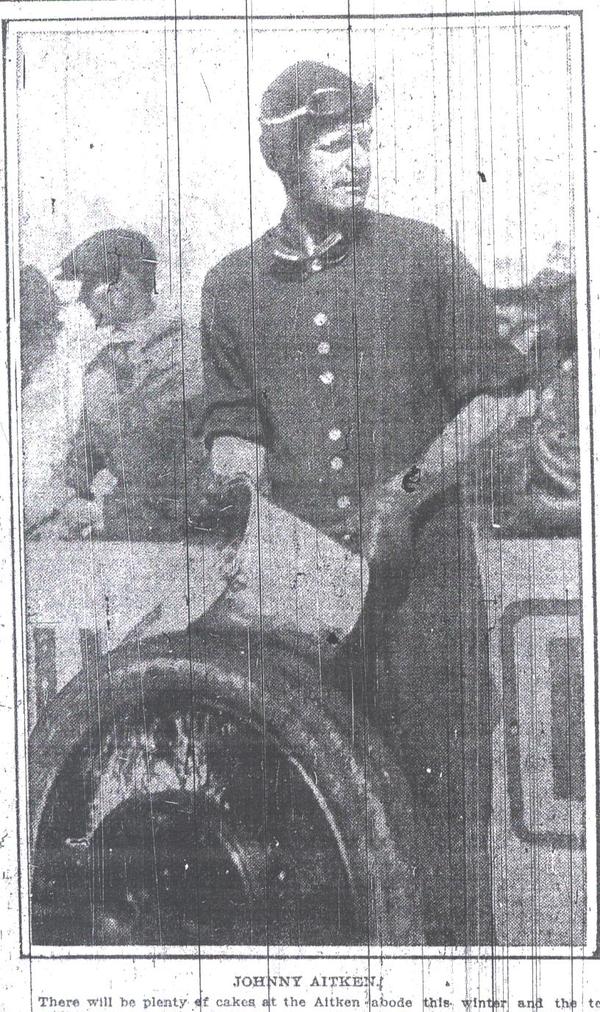
Photo: Johnny Aitken prepping his tires before the 1916 Harvest Classic at IMS. No, I did not take this photo.

Seven years into his venture of the Indianapolis Motor Speedway Carl fisher and the other founders were still searching for their footing. It had not been the success they had hoped. The 500 mile races were a hit with fans, but in 1916 the race was shortened to a 300 mile contest because Fisher thought 500 miles was too long. The fans were not happy about the decision. Dario Resta, who narrowly lost the 1915 500 to Ralph DePalma, won the 1916 event.

With war on the horizon, Fisher decided to add a September race meeting to the Speedway calendar. He was looking for extra income in case the 1917 race couldn’t run because of United States involvement in the European conflict. The Harvest Classic on September 9 featured three separate races of 20 miles, 50 miles, and 100 miles. There were separate purses of $1,000, $2,000, and $3,000. The first two races were not heat races for the 100 miler.

Attendance was disappointing. The event was a week after the Indian State Fair. People had spent their money going to the fair. Also, as the name of the evnt implies, the farmers were beginning preparations for harvest. Some estimates out the crowd at less than 10,000.

The event itself featured several current and future stars. 1915 500 winner Ralph DePalma entered in a Duesenberg. Eddie Rickenbacker drove a Maxwell. Tommy Milton, a future 500 mile race winner, made his first appearance at the speedway. Speedway star Johnny Aitken entered the event in a Peugeot.

Aitken won all three races. The 20 mile race was the easiest victory. In the fifty mile race, Aitken and Hughie Hughes had a wheel to wheel battle with Aitken winning by 0.28 seconds. There was more drama to come in the final race of the day.

In the 100 mile race, Aitken led most of the way, but battled with Rickenbacker during the last 50 miles. With four laps to go, Aitken’s steering broke, and Rickenbacker took the lead. He had his own issue, however. A loose right rear wheel buckled with two laps to go giving the lead back to Aitken.

This would be the final race at the Indianapolis Motor Speedway until 1919. After the 1916 event the speedway announced that the May race would again be 500 miles. When the United States entered World War I in 1917, racing halted until the war ended. Johnny Aitken never got a chance to race at Indianapolis again. He died in 1918 of pneumonia during the flu pandemic.

The Indianapolis 500 was the only race at the Speedway from 1919 until 1994, when the Brickyard 400 NASCAR event debuted. The stock car race was the first race outside of May since September 1916. Will this year’s Harvest Classic also be a one time event? I’m not so sure.

Reader Request: The Speedway’s Greatest Cars

Originally published May 25, 2016

I’ll admit it. I am biased on this topic. I love the old front engine cars. Maybe it’s because growing up they were what a race car was. Unlike the rear engine cars, front engine machines came in a variety of shapes and sizes. Most rear engine cars look basically the same to me. I’m not talking about today’s Dallara.  The early rear engine cars were noticeably distinct from one another. A sameness crept into the design, especially after wings were added.

What were the greatest cars? My criteria is part objective and part subjective. Cars that won more than once easily make the cut. Design and livery are a big qualification as well.  I prefer the simpler liveries. Here are my top five greatest cars, front engine division.

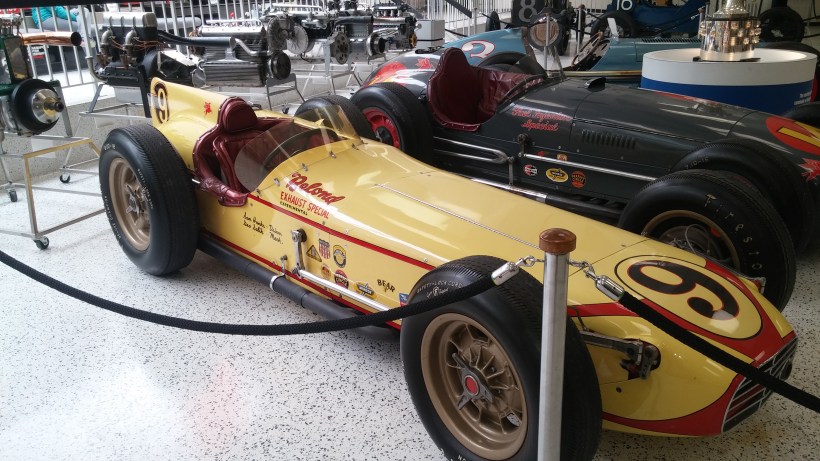
5. Belond Exhaust Special.  The car designed by George Salih won back to back to back races in 1957-58. The engine is laid on its side, allowing a lower profile. Note the fin

Note the fin behind the driver’s headrest.Hulmanclubfavcars 006.jpg

4.  Blue Crown Spark Plug Special.  This Offenhauser powered, front wheel drive machine won in 1947 and 1948 with Mauri Rose driving to victory both years. Car owner Lou Moore is second behind Roger Penske in victories by an owner with five.

Hulmanclubfavcars 009


3.  Sheraton-Thompson Special. The 1964 winning car is a A. J. Watson built roadster driven by A. J. Foyt to his second 500 win. It was the last front engine car to win the race.Hulmanclubfavcars 011

2.  Fuel Injection Special.  Bill Vukovich dominated in 1953 and 1954 in the original “roadster”. Note the cockpit offset to the right. The car was leading in 1952 when a steering rod broke with eight laps left. Vukovich led 435 laps in this car. Hulmanclubfavcars 008.jpg

  1. Boyle Special (top of story  photo) Another car that dominated the 500. Wilbur Shaw won in this Maserati in 1939 and 1940. He was leading in 1940 when a wheel collapsed late in the race. After the war, Ted Horn drove it from 1946-48  to finishes of third, third, and fourth. Future winner Lee Wallard took the car to the lead in the 1949 race. Bill Vukovich took his 1950 rookie test in the Maserati, but did not attempt to qualify it. This car was truly the chariot of the gods.

Revised Schedule: Thoughts on a Historic Route to the Championship

Who thought a jigsaw puzzle could be put together a different way? The NTT Indycar Series revised schedule is impressive on several fronts. To change a race date involves many moving pieces- sponsors, promoters, television networks, vendors- all to agree. To move three races to accommodate one big is a feat only Roger Penske could accomplish. Here some of my mostly incoherent thoughts about yesterday’s events.

Could anyone besides Roger Penske pulled this off? Not likely. His connections across auto racing greatly aided everything coming together. Penske and the series took full advantage of the gap left by the postponement of the Olympics to work in the complete Indianapolis 500 program minus one practice day. My thought was when the race was rescheduled that there would be a day of practice, a day of qualifying, a day off then the race. I’m glad the entire schedule stays intact.

There is still some historic tradition left despite how much of the new schedule enters unfamiliar territory. The season starts May 30. 22 times in the past the Indianapolis 500 was the first race of the year. The last time it opened the season was 1957. The 500 has never been run outside of the month of May before. I’m not sure how to deal with May 24 yet.

The inevitable Indycar/NASCAR double header has become a reality a couple of years earlier than I expected. The GMR Grand Prix will run on July 4, the day before the Brickyard 400. The Xfinity series will have the first stock car road race at IMS following the Indycar race. I think this will be the model for future doubleheaders. I don’t think it’s to NASCAR’s advantage to run on an oval after Indycar runs a race the day before on that same track.

If you like all types of racing, the first five days of July will be heaven. Midgets, Indycar, Road to Indy, and NASCAR all at the Indianapolis Motor Speedway. It’s the type of race meet Carl Fisher dreamed of.

Could this  be the new date for the GMR Grand Prix in the future? I don’t think so. The May lead in is important to the Speedway. If it is successful, who knows? I think it is worth the consideration. Add the two days in May back to the practice schedule for the Indianapolis 500.

Will the 500 lose another practice day going forward? When the series sees that the cars can get along fine with just three days, I could see the May schedule shrink again. I would hate to see it happen, bet I’m not going to bet against it.

I hope the race at World Wide Technology Raceway the week after the 500 can be moved to NBC. The move would help continue momentum from the 500. I love that the 500 is followed by a short oval. It will be just like the old days when Milwaukee followed Indianapolis.

I’m impressed that  Indycar still has 14 races scheduled. I originally thought 12 was the most that could get in, if any racing occurred at all in 2020. Keep in mind, that nothing is certain as we are still at the mercy of the coronavirus.

Seeing St. Pete at the end of the schedule was a huge surprise. Green Savoree has worked hard to keep this event on the calendar. I know Mayor Kriseman is a big advocate for the race. October is a good time to hold a race in St. Pete. It is before the snowbirds arrive in great numbers. It will also relieve some of the economic hit caused by the abbreviated Spring Break.

Now that an October race is on the schedule, can we keep at least one there in future years? Maybe two?

The thing that doesn’t thrill me about St. Pete is ending the season on a street course. Qualifying is key there, although St. Pete usually jumbles the order with yellows at some point. It really bothers me to award double points for a street race.

Let’s hope that this schedule can run in its entirety. Everyone stay safe and be well.