Radio Days- Listening to the 1960 Indianapolis 500

Photo: (left) Rodger Ward leads Jim Rathmann late in the 1960 Indianapolis 500; (right) Rathmann took the lead for good on lap 197 and won by 13 seconds.

Editor’s note: I learned Sunday afternoon of the death of Pat Kennedy, who has authored several trivia books about the Indianapolis 500. I have all of them and use them constantly for quick reference. My condolences to his family. For more about Pat, please read  George Phillips’s post on Oilpressure from yesterday at https://oilpressure.com/2020/04/13/a-major-loss-to-the-indycar-community/

The interminable days of quarantine afforded me the time to listen to a complete radio broadcast of one of my favorite 500s, the 1960 race. I listened to the race at home that year. It was a great race. This story is more about the broadcast than the race. Several things stood out to me about the radio call in 1960. It was quite a contrast to today’s radio broadcast. I’m not saying one was better than the other, but the evolution of the radio network is very clear.

1960 was the eighth year of the Indianapolis Motor Speedway Radio Network. It was still growing.  Lead announcer Sid Collins welcomed a new station from Minneapolis to the network, for example. I had listened to the broadcast of the 1953 race, the  first year of the network. The earlier broadcast had some rough spots, many of which had been smoothed out by 1960. There were still a few glitches in communication between the broadcast booth and pit reporters.

As the speeds of the cars increased, the coverage had to change. Today the radio call is rapid fire coverage of non stop  track action. In 1960, the broadcast coverage of the race was rather leisurely. They knew they had a three and a half hour race to cover and that there would be many lulls in the action. Pit stops only happened every 40-50 laps. Not every one came in at one time.

The pace of the race allowed for time to talk to celebrities and guests. Stopping in to chat with Collins and his color commentator Freddie Agabashian this day were Indiana governor Harold Handley, Guy Lombardo, David Crosby, and former winners Johnnie Parsons and Bill Holland. Parsons spoke first, the Holland followed. Holland referred to the 1950 race by joking, “Ten years later and I’m still following Parsons.”

The five reporters stationed around the track- one in each turn and one in the middle of the backstretch gave somewhat laconic reports and descriptions of the action. “Eddie Russo spun and hit the wall. Back to you, Sid.” The team employed the same relay system in use today in which one corner reporter calls for the person at the next station to continue the action. The two pit reporters had a lot of ground to cover during stops. Sometimes it sounded as if Collins had a better view of the pit action than the pit reporters did.

The broadcast as presented on Indycar Radio cut most of the commercials. They left a couple Stark & Wetzel spots in. I always enjoyed the whistle in those commercials. While the ads ran you could still hear the cars on track in the background. I always loved that.

Speaking of commercialization, I didn’t hear a lot of brands mentioned except for Firestone tires and Champion spark plugs. Not every thing during the race had a sponsor. It was refreshing. The car names were mentioned when the starting lineup was presented, but after that the announced interval standings included just the car number and driver’s name.

One difference from the 1953 broadcast I noticed was how Collins referred to the drivers. In 1953 he called them “lads.” In 1960 they were “boys.” I guess they had grown up in seven years. The safety crews and mechanics, however, were “men.”

As the race got closer to the finish, the broadcasters paid more attention to it. A great three way battle for the lead began around lap 145 between Rodger Ward, Jim Rathmann, and Johnny Thompson. Thompson would drop out of the race about 30 laps later, setting the stage for Ward and Rathmann to conduct their classic duel. Collins and Agabashian were excited that this race might be the closest in history. In 1960 the closest finish to date was Wilbur Shaw beating Ralph Hepburn by 2.16 seconds in 1937. The record would stay in tact a while longer.

A couple of interviews with drivers who dropped out of the race made me sad since I knew what the future held. Eddie Sachs- it was great to hear his voice again- proclaimed that he would definitely win next year. He was almost right. Tony Bettenhausen, the great driver with an awful record at IMS said he would be back for his 15th race in 1961. He was killed in a practice accident the day before Pole Day while testing Paul Russo’s car.

I recommend you go to Indycar radio and find an old race broadcast to listen to. I plan to listen to another one in the mid 1960s or early 1970s. I will not listen to the 1964 race. I still have nightmares about that one.


Sir Stirling Moss- F1’s Uncrowned Champion

It was a life full of irony. Stirling Moss could have won the F1 World Championship seven consecutive years. Circumstances got in the way. He had to compete against Fangio. His sense of sportsmanship cost him a title. Miscommunication with the pits cost him another. Today is a sad day with his passing.  On the other hand, for a driver of that dangerous racing era to live to 90 years is amazing.  Moss was one of my first racing heroes. Like Dan Gurney, he excelled in several forms of motorsport. Moss survived broken legs, an accident that put him in a coma for a month, and a fall down an elevator shaft at his home a few years ago. Only A. J. Foyt has survived more perils.

wp-15866960839175688930146759560248.png
After he retired from racing, Moss was a fixture at revivals and vintage festivals through the age of 81.

Moss had the unfortunate luck of driving at the same time as Juan Manuel Fangio, the five time world champion. Yet, one could argue that Moss was the most consistent driver over a seven year period. He finished second in the Formula 1 standings four straight years from 1955 through 1958. From 1959 through 1961 he finished third. Still today Moss is considered the greatest driver to never win the World Championship.

1955 may have been Moss’s best year. He won his first F1 race at the British Grand Prix at Aintree in a Mercedes. He also won the Targa Florio and the Mille Miglia, two grueling road races. His prowess in endurance  racing was unparalleled at the time. He had already earned a runner-up spot at Le Mans and won the 1954 Sebring 12 Hour race, the first non American to do so.

Moss will always be remembered for his sense of sportsmanship. In 1958 Moss lost the F1 title, by a point after convincing the stewards to reverse a penalty against Mike Hawthorne in the Portugese Grand Prix. The points restored to Hawthorn turned out to be enough to give Hawthorn the crown.

I find it difficult to say goodbye to one of my early racing heroes, but there are still many legends left. We still have Mario Andretti, A. J. Foyt, the Unsers, and Johnny Rutherford with us.  Moss and Bill Vukovich were my first two heroes who were driving after I was born.

I will close with one of my favorite photos of Moss at the wheel.

wp-15866949552862288169882436850838.png

An Homage to Past Races at Michigan

Some random thoughts on today’s iRace

Today’s iRace at Michigan International Speedway had many elements of the actual Indycar races that were staged there through 2007. The first lap accident was reminiscent of the start of the U. S. 500 in 1996. The eight lead swaps between Sage Karam and Will Power made it looks as if the cars had the Handford Device added to them. In the end, the race came down to fuel strategy.

Of the nine podium spots in the three races so far, five of them have gone to series non-regulars who have never started a real Indycar race.

This was Will Power’s worst finish in the three races. He would be having a championship type start to his season if these races counted.

Dale Earnhardt, Jr.’s third place was a bit of a shock. he had never raced an Indycar in sim racing before.

Simon Pagenaud’s win from his 22nd starting spot was the mirror image of his win in the Indianapolis 500 last May. He was in full attack mode then. Today he played the waiting game.

Another realistic element today was the Team Penske 1-2 finish. Power gave the team three of the top four spots. Penske cars have won two of the three races to date. Sim imitates life.

The site of next week’s race is yet to be determined.

The box score:

wp-15866477663877033225624819626335.png


New Names on Michigan iRace Entry List

Four drivers make their first appearance in the Indycar iRacing Challenge Series at Saturday’s race at Michigan International Speedway. Series regulars Ryan Hunter-Reay and Marco Andretti, part timer James Davison, and former NASCAR driver Dale Earnhardt, Jr. join the 31 car field for the third race in the six race series. The race will be on NBCSN at 2:30 pm ET tomorrow.

wp-1586478253967625802346474159811.png


The First Harvest Classic

As we prepare for the Harvest Classic at IMS next week, here is a brief history of the last Harvest Classic.

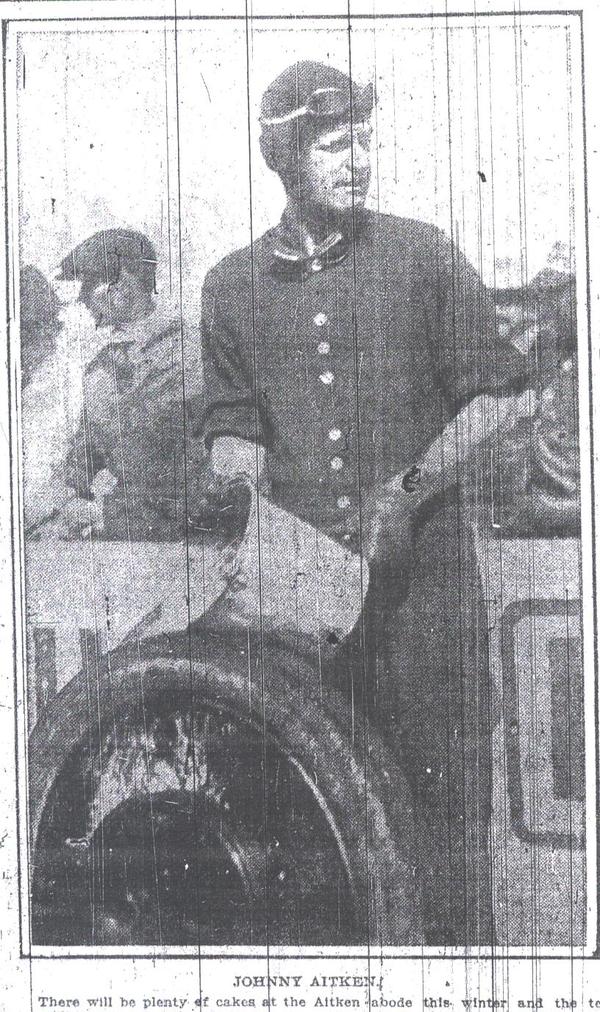
Photo: Johnny Aitken prepping his tires before the 1916 Harvest Classic at IMS. No, I did not take this photo.

Seven years into his venture of the Indianapolis Motor Speedway Carl fisher and the other founders were still searching for their footing. It had not been the success they had hoped. The 500 mile races were a hit with fans, but in 1916 the race was shortened to a 300 mile contest because Fisher thought 500 miles was too long. The fans were not happy about the decision. Dario Resta, who narrowly lost the 1915 500 to Ralph DePalma, won the 1916 event.

With war on the horizon, Fisher decided to add a September race meeting to the Speedway calendar. He was looking for extra income in case the 1917 race couldn’t run because of United States involvement in the European conflict. The Harvest Classic on September 9 featured three separate races of 20 miles, 50 miles, and 100 miles. There were separate purses of $1,000, $2,000, and $3,000. The first two races were not heat races for the 100 miler.

Attendance was disappointing. The event was a week after the Indian State Fair. People had spent their money going to the fair. Also, as the name of the evnt implies, the farmers were beginning preparations for harvest. Some estimates out the crowd at less than 10,000.

The event itself featured several current and future stars. 1915 500 winner Ralph DePalma entered in a Duesenberg. Eddie Rickenbacker drove a Maxwell. Tommy Milton, a future 500 mile race winner, made his first appearance at the speedway. Speedway star Johnny Aitken entered the event in a Peugeot.

Aitken won all three races. The 20 mile race was the easiest victory. In the fifty mile race, Aitken and Hughie Hughes had a wheel to wheel battle with Aitken winning by 0.28 seconds. There was more drama to come in the final race of the day.

In the 100 mile race, Aitken led most of the way, but battled with Rickenbacker during the last 50 miles. With four laps to go, Aitken’s steering broke, and Rickenbacker took the lead. He had his own issue, however. A loose right rear wheel buckled with two laps to go giving the lead back to Aitken.

This would be the final race at the Indianapolis Motor Speedway until 1919. After the 1916 event the speedway announced that the May race would again be 500 miles. When the United States entered World War I in 1917, racing halted until the war ended. Johnny Aitken never got a chance to race at Indianapolis again. He died in 1918 of pneumonia during the flu pandemic.

The Indianapolis 500 was the only race at the Speedway from 1919 until 1994, when the Brickyard 400 NASCAR event debuted. The stock car race was the first race outside of May since September 1916. Will this year’s Harvest Classic also be a one time event? I’m not so sure.

Fewer Venues, More Doubleheaders on Revised Schedule

The NTT Indycar Series released another new schedule this afternoon in response to the COVID-19 pandemic in hopes of getting in as many races as possible.  To do that, Detroit has been cancelled and Iowa and Laguna Seca will host doubleheader weekends.

Texas is now the scheduled opener on June 6. Toronto remains on the schedule, but the city’s closed order going until June 30, I don’t see how there will be enough time for the track build. The situation remains fluid, but I think the series might be better served to hold off on schedule announcements until necessary. There will likely be more changes. I could see the Indianapolis 500 becoming the opener with a compacted schedule rather than the one previously announced.

What is good about the new schedule? The two night races at Iowa, one of which is on a Friday night. The October race at Indianapolis Motor Speedway brings back a hint of the Harvest Classic race meet run at IMS in  the fall of 1916. The October race shares the track with the previously scheduled sports car program. Both road course races at the Speedway will share time with other racing disciplines. I love the concept of seeing multiple series on the same weekend. We might see the beginning of a trend here.

St. Pete is still listed as an October TBA and will possibly be the finale. Including St. Pete, the schedule is now 15 races at 12 venues. I’m glad the race count stays where it is, but I don’t like the limited number of venues. I realize these are extraordinary circumstances.

I don’t think this schedule is done yet. Stay tuned.

The schedule as of today:

wp-15861945375035824569167634257000.png

NBCSN Race Week Features Some Recent Indycar Classics

The iRacing has been fun. We can’t have actual new races this year yet, although I’m hopeful we can get in a few of them this summer and fall. Staring tomorrow, though, we can relive some of the best moments of the last few years in Indycar on NBCSN.

Seven Indycar races, including two Indianapolis 500s, will be part of the 60hours of racing shown on the current home of Indycar on television.

The schedule (all times Eastern)

Monday  3 pm   2015 Fontana

Tuesday  3 pm 2017 Long Beach

Thursday    1 pm 2019 Indycar Grand Prix

8 pm 2019 Indianapolis 500

11 pm  Drive Like Andretti

2 am 2016 Indianapolis 500

Saturday  10 pm 2015 Sonoma

Sunday      12:30 am  2016 Texas

I’m excited to relive some of these great moments of the last five years of Indycar. I would have preferred some much  older races. For times like this we need Speed to return.

I’ll be back tomorrow with updated thoughts on the current Indycar season.

Quick Thoughts- Barber iRace

Indycar teams are now taking this iRacing thing seriously. Teams brought in their engineers and pit strategy won the race.

It was great having the race on television. In addition tom the broadcast I hope something can be worked out where fans who don’t have access to NBCSN can watch online without subscribing to a service.

It was a decent race with more of an air of a real race than the Watkins Glen race

The best part of yesterday was having Robert Wickens participate. His 8th place finish after starting last was a great drive. He ran as high as third. Wickens definitely had the drive of the day.

I thought the track had a bit of a cartoonish look on television. I’m not sure if that was because I had never seen this type of race on a large screen before, but it I found it a bit unsettling. Where was the bridge by the museum?

Sage Karam proved once again that he is a master at iRacing, but he still doesn’t seem to handle adversity well.

What a great win by Scott McLaughlin. I wouldn’t be surprised if he repeats that feat when he gets his first real shot at Indycar.

Three of yesterday’s top five were not Indycar full time drivers.

It was nice to have an hour or so of distraction.

I’m very excited for next weekend’s race at Michigan. look for lots of flying cars.

The race summary:

wp-15860414930784986488951608308537.png