Frye Joins RLL as Team President

What great news to begin April. I am so happy that Jay Frye will remain in IndyCar. The team announcement from RLL:

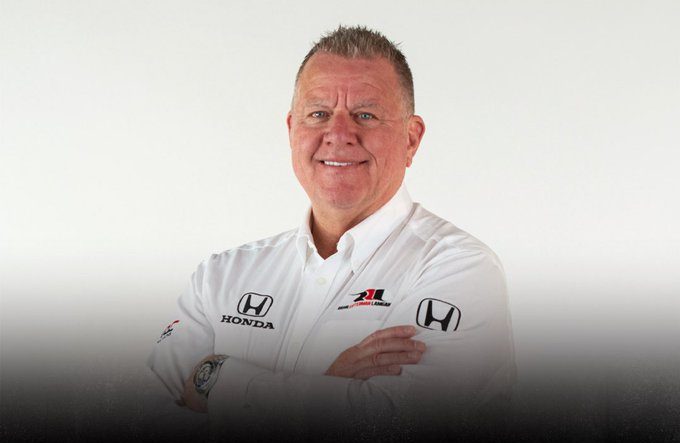
ZIONSVILLE, Ind. (April 1, 2025) – Rahal Letterman Lanigan Racing (RLL) announced today that well-respected industry executive Jay Frye has joined the team as president. Frye will report directly to team ownership and will oversee operations for the team’s involvement in the NTT INDYCAR SERIES and IMSA WeatherTech SportsCar Championship. Frye’s experience spans over 30 years and includes series and team leadership on both the competition, marketing, sales and ownership sides.

The team also announced that they have parted ways with Steve Eriksen, who held the role of chief operating officer since January 2023.

“First, I would like to thank Steve Eriksen for all of the work he did for us, particularly at a critical moment in time for the company and we certainly wish him the best in his next endeavor,” said Bobby Rahal, team co-owner with David Letterman and Michael Lanigan. “I’m very pleased to have Jay Frye join the team as president of Rahal Letterman Lanigan Racing. I’ve known him since his arrival on the INDYCAR scene in 2013 and have spent a lot of time with him and think highly of his character and his passion for the sport. I look forward to working with him in the future to take RLL to the place we all want it to be.”

“Rahal Letterman Lanigan Racing has a tremendous history of success, both on and off the track,” added Jay Frye. “I am very proud to be joining the dedicated and talented team of people at RLL. RLL has the foundation, infrastructure and an incredible commitment to continue being successful well into the future.”

BMW M Team RLL returns to action in the IMSA WeatherTech SportsCar Series on Saturday, April 12 on the streets of Long Beach while the NTT INDYCAR SERIES season resumes with the Acura Grand Prix of Long Beach on Sunday, April 13. For more information about the series or team, visit http://www.indycar.com and http://www.rahal.com.


About Jay Frye

Most recently, Frye served as INDYCAR president until February 2025. He left a legacy that includes a strategic plan for future financial stability and innovative safety, competition and partnership developments during his tenure.

Frye joined Hulman & Company in 2013 as chief revenue officer of Hulman Motorsports and led the combined team of INDYCAR and Indianapolis Motor Speedway sponsorship sales, licensing and account services. In 2016, Frye introduced an effective, rolling five-year plan that serves as a strategic blueprint and assists in cost containment for the teams moving into the future. The impetus for the plan was built around the introduction and successful implementation of the AK-18 universal aero kits in 2018. That initial five-year plan has extended through the 2026-28 seasons of the NTT INDYCAR SERIES, where Frye has set up the series to continue to succeed strategically and competitively.

Named president in December 2018 after spending the previous three years as INDYCAR’s president of competition and operations, Frye made significant contributions to the commercial and competition sides of the business. NTT, a Fortune Global 500 global informational technology and communications leader, opened the 2019 season as the new series title sponsor. Frye initiated and consummated this multiyear deal that was pivotal to the future growth of the series.

In May 2019, Frye spearheaded a partnership with Red Bull Advanced Technologies to design the aeroscreen, an industry-changing, total driver cockpit safety solution, which debuted in the 2020 NTT INDYCAR SERIES season. The innovative addition to the open-wheel cars proved extremely effective in competition when put to the test. For his accomplishments and leadership, he was recognized by Autosport on its prestigious 2019 Motorsports Power List covering the 50 most powerful people in global motorsport.

In October 2020, the NTT INDYCAR SERIES’ engine manufacturers, Chevrolet and Honda, extended their long-term agreements with the series, providing stability.

The 2024 season featured the successful implementation of the INDYCAR hybrid power unit. Highlighted by a first-of-its-kind collaboration with Chevrolet and Honda, the hybrid engine package produced over 800 horsepower and completed a remarkable 94,244 miles after full-field introduction. The record-breaking 2024 season also produced 14 on-track passing records and the fastest pole speed in the 108-year history of the Indianapolis 500. As an indicator of overall series health, 2024 featured 27 full-time starters – matching the record set in 2023.

Prior to joining Hulman & Co., Frye flourished in team management roles in the NASCAR industry. He was vice president and general manager for Red Bull Racing’s NASCAR team (2008-11) and was named 2008 NASCAR Executive of the Year by ESPN and the Kansas City Star. From 1996-2007, Frye was chief executive officer and general manager of MB2 Motorsports, a team he created and built. Before his executive roles with NASCAR teams, Frye worked at Valvoline Racing, and his extensive sales and marketing experience began with a variety of roles at Anheuser-Busch Inc.

Frye, a native of Rock Island, Illinois, graduated with a marketing/education degree from the University of Missouri, where he played tight end and offensive tackle for four years on the Tigers’ football team. He and his wife, Danielle, have two daughters.

Frye: Test Results Produce More Questions

Photo: Pato O’Ward leads the group during testing at IMS Friday. -Joe Skibinski, Indycar

Jay Frye declared it a good day. It gave Indycar a direction although there is still work to do.

“When we came into this, we thought really at the end of the day that this would precipitate more questions than answers. That’s probably what happened, right. Which is fine. That’s what we expected,” the Indycar president told the media after the four var test at Indianapolis Motor Speedway Friday.

“We did learn a lot. But it did also create a lot of other questions,” Frye concluded.

The test, with drivers Scott Dixon, and Alexander Rossi representing Honda, and Josef Newgarden and Pato O’Ward driving Chevrolets, involved various versions of push to pass in an attempt to simulate what the hybrid component might look like in 2023.

Frye explained what Indycar was looking for.

I think today we’ve got a lot of data off the car in a direction on what approach to go with,” he said. “In the way that we have push to pass, with the hybrid system that would kind of be obsolete. You’ll have a bank of energy that you have with the hybrid system that once it will go away, that you will be able to recharge it so it will be on all the time basically. With push to pass there’s an amount of time or there’s an amount of pushes. That’s what we looked at today. We just gave the drivers for every 200 seconds, you’re going to go do a 20 lap run. Use it as you want it. Most used about half, so 100 seconds. It was interesting to see how it played out.”

“We thought they would have liked that for a longer time. This is new. We’ve never done this on an oval. We’ve tested it at Pocono, Texas and Phoenix before but that was with the old package. For this new one, it definitely is much better than it was before which is cool,” Frye concluded. He also noted that trap speeds which are normally around 230 mile an hour, were 236 miles an hour Friday.

The new, larger 2.4 liter 2023 engine, and the hybrid energy recovery system should give the cars 200 more horsepower in 2023. Frye said the series will not allow that much all at once, but adjust the and work up to 900 horsepower.

Alexander Rossi, Scott Dixon, and and Josef newgarden discuss what they learned in Friday’s test at IMS. Photo by Chris Owens, Indycar.

The Pit Window spoke with three of the drivers after the early end to the test day.

Scott Dixonliked some of the changes and noticed the increase in speed.

“Obviously there’s a lot of power and some of the durations are quite long,” Dixon said. “10 seconds at 70-80 horsepower, especially in a car that’s trimmed out. Your average lap speed could jump by several mph. There’s some good changes to see how you can apply that and to what effect or not effect on the tire and in regards to running in traffic.”

Dixon’s concern with the push to pass is how long a driver would be locked out of the system after using it. He prefers a shorter lock out time.

Alexander Rossi doesn’t think the push to pass would change anything on an oval.

“Yes it’s a pretty big horsepower boost with the push to pass,” said the Andretti Autosport driver. “We’re going to have to look at it to see if it changed anything for the better or worse. It’s definitely different. We got that test accomplished and have some hard data to look at for the future.”

Josef Newgarden was happy to help Indycar gather data and glad that he learned some tings.

“I thought it went well. When you learn something in testing you’re happy about it. I thought we learned some stuff today on our cars on how things works and how they could potentially work in use scenario.

“The horsepower bump was tunable. You could definitely raise the horsepower increase up or down so that jump in the performance off the corner could be bigger or smaller. The length of it is all adjustable. We ran through a couple of scenarios and a couple of configurations. It’s definitely noticeable. A couple of configurations were noticeable. If you want to run a system like that, it’s really what’s the right configuration to give to the field. I think that’s the type of info we were trying to arm INDYCAR with and now it’s on to them to see what we do in the future.”

Frye said that testing of the hybrid system would likely be in January and February of 2022.

Notes

It was wonderful to watch cars on the IMS oval again. It has been more than a year since I have seen the oval used.

Improvements made by Roger Penske are obvious. Most noticeable is the new video board on the back of the Pagoda. it spans the entire width of the building and the high resolution screen is fantastic.

The main thing is how clean the plaza and Victory Circle are. I was so used to how the areas appeared, but I now realize that they were long overdue for sprucing up.

Testing for the Indianapolis 500 is schedule for April 8 and 9, between the mass vaccination clinics at the Speedway. I assume the turn 2 mounds will be open as they were yesterday.

Some Words of Thanks

In as difficult a year as 2020 has been, I have a deeper appreciation of the things for which I am thankful. The pandemic changed our lives in many ways, yet we somehow figured out ways to cope. The following is a list of things for which I am thankful- not all related to racing.

First I thank everyone who has read this humble blog this year. Readership has already smashed last year’s 12 month total by nearly 50%. I appreciate each of you who has found something worthwhile here as I complete my fourth full year. Hard to believe The Pit Window will turn five in May.

Thank you to the Creative Writing Class at the Life Enrichment Center in Tampa, Florida. Without them , this blog does not exist. You all are my inspiration. I am grateful every day that I discovered this class.

Now on to the racing thank yous:

First to Roger Penske and mark Miles for somehow crafting a credible season from the myriad restrictions all the municipalities and government agency restrictions put in place this year. As always, I am so thankful that he bought the series at the end of 2019. I can’t imagine anyone else who could have weathered this season this well.

Thank you to the promoters who worked with Indycar to create a reasonable amount of races for the season.

Thanks to Jay Frye and Indycar for their tireless efforts to advance safety and to try to improve the racing.

Much thanks goes to the AMR Safety Team. Without them the races could not go on.

Thanks to NBC for working Indycar’s rescheduled races into their schedules and expanding next year’s lineup on NBC.

Thanks to Doug Boles for getting the Indianapolis Motor Speedway through what had to be a frustrating and challenging time.

Thank you to those few in the Indycar media who were able to cover races in person. I know circumstances were challenging, but the coverage was seamless. I hope I can rejoin you in 2021.

Thank you to all my racing friends. Knowing yoi and spending time with you at the track is time I truly treasure. I hope at some point in 2021 we can all meet at one track again.

Finally, I am thankful that my household is well, and that my closest friends who contracted COVID have recovered.

I wish everyone a Happy Thanksgiving. Stay safe and well.

Miles Happy with Series’ Growth

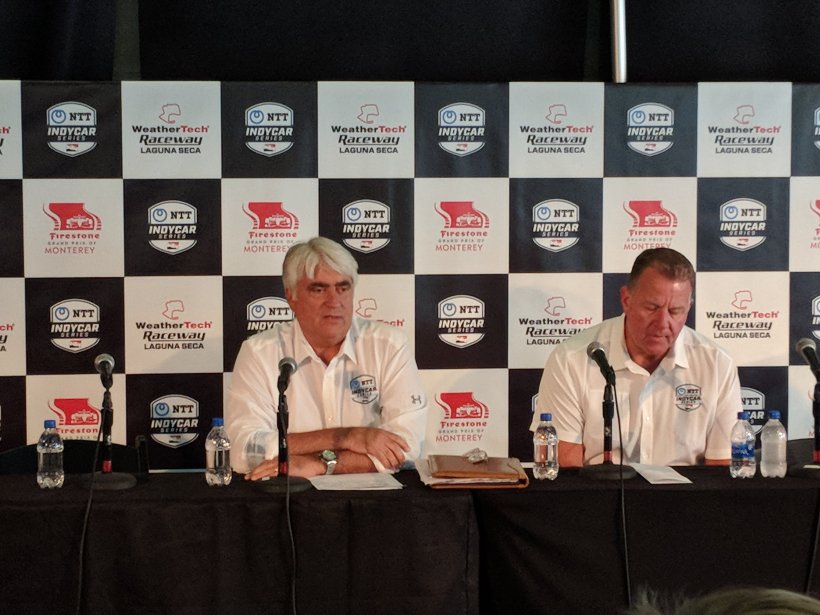
“In almost every metric our marketing, promotional, and commercial initiatives are growing the sport and hopefully gaining more fans,” Mark Miles,  president of Hiulman and Company,  began the state of the NTT Indycar Series media availability this morning at Weather Tech Raceway Laguna Seca.

Miles noted the solid, consistent car count and the growth of entries for the Indianapolis 500 and race attendance.   Eight races have shown a year over year increase and four events set weekend records More than 1,5 million fans have attended the first 16 races this season.

Miles said that 97%  of sponsors in place for 2020.  He expects to add another meaningful sponsorship  before the end of the year.

On the television side,  1.129 million viewers have watched  through the first 15 races. Eleven races have experienced growth.

Miles does not see an Indycar/ NASCAR doubleheader before 2022. He believes it would work best at a track where both series race. He is still looking to add two races outside the United States in February. Nothing is imminent, however.

Jay  Frye, Indycar president, said the aeroscreen tests scheduled for October are the final sign off. He doesn’t believe there will be any issues on track.  The tests are October 2  at IMS, October 7 at   Barber, and  October 15  at Richmond.

Frye said there are 10 Requests for Proposals out for the hybrid component expected to debut in 2022. He is excited about the cars being able to restart themselves and the added horsepower the unit will help produce.

Back after today’s second practice


A Look at the Aeroscreen

The new aeroscreen for 2020 was introduced on Carb Day by Jay Frye, President of Indycar, accompanied by Andy Damerum, and Ed Collings of Red Bull Racing.  The device will replace the AFP, which debuted at the Indycar Grand Prix.

My first impression was that it is too tall, it looks like an enclosed halo, and if the open area is covered, we have a single seat Daytona Prototype.  here are some other views.


The driver appears to be sit much lower in the cockpit, but that may just be an illusion. I like seeing the drivers turn the steering wheel. I don’t think this design will allow for that.

One question that wasn’t asked was what happens on a road or street course when it rains?  Frye said if the screen gets covered in oil, the car would have to pit to remove a tearoff.  Removing a tearoff will not help in the rain. Are we about to see wipers on Indycars?

Part of the aesthetic issue is that the screen is being retrofit onto  existing bodywork. When the new car goes into service, the aeroscreen (they’re still working on a better name) will be better integrated into the design. That may help lower the profile.

I liked the look of the windscreen that was tested last year better.  I understand there were problems with it as far as heat in the cockpit and distortion. Red Bull and Dallara are working on a cockpit cooling system as well as a defogging unit.

I’m all for making the cars as safe as they can. I’m not sure I like the look of the car with this new attachment. However, like the original screen and the AFP, , I would like to view it in person on a car.  I’m sure there will be modifications as they go through the on track testing.

Coming up tomorrow  I have a look at the Victory Banquet. Watch for my Detroit preview on Wildfire Sports Friday.

Indycar Moves Up AFP Debut to Indycar GP

Indycar announced that the Advanced Frontal Protection device, which made its first appearance on cars during Wednesday’s test at the Indianapolis Motor Speedway, will now be on the cars for the Indycar Grand Prix May 11. The device was to debut for the 103rd running of the Indianapolis 500 May 26.

Indycar President Jay Frye said Indycar is satisfied the unit is ready for use. The device will be on all cars for the remainder of the season.

“Thanks to a phenomenal effort by Dallara and all of the Indycar teams,we are ahead of schedule in making this happen,” Frye said.

The titanium piece weighs 2.8 pounds and the mounting piece is an additional 2.1 pounds. Driver reaction to the device was mixed after Wednesday’s test session. The main concerns were a change in airflow which resulted in helmet buffeting and obscured vision.

This “Phase 1 of our solution,” according to Frye.  The next phase will be announced next month.

I think this move makes sense. It seemed strange to me that they would run with it during the test, remove it for one race, then re-install the device for the 500. It is one of those things we hope never has to be tested in a race.

Look for a post this weekend about an addition to the start/finish line and a report on Driving for Dyslexia.  For $20 you can come to Sarah Fisher’s place tonight and watch me make a fool of myself.  Or you can just read my blog for free.


The Next Step in Driver Protection

The Advanced Frontal Protection device  received a formal introduction today before the open test at the Indianapolis Motor Speedway.  Jay Frye explained the concept and  explained why the NTT Indycar Series chose this system. The device will be used on the cars the rest of the season.

Some facts courtesy of the NTT Indycar Series:

Today is the first time the AFP will be used on track.

The device is made of titanium and manufactured by Dallara.

Versions of the AFP have been explored since 2012.

Dallara introduced the device to Indycar in January.

The AFP has been subjected to and passed the same loads as the roll hoop.

The AFP weighs 2.8 pounds with bolts. Reinforcements to the monocoque weigh 2.1 pounds.

Frye said this is the first phase of cockpit protection.

“Sometime in May we will announce the next phase, ” Frye said.

The next phase is for 2020.  Frye explained the reason for the length of the process.

“You can’t just put something on a car without vetting it all the way out,” he said.

The AFP cost $5,000.  Titanium is more expensive than steel, but its lighter weight was the reason titanium was chosen.

As far as the view from the cockpit, this should be a minimal distraction.

IMG_5823

Track Update

After about 20 minutes of running, the track was closed because of rain. An update will be given n about an hour. Ed Carpenter had the fastest lap at 220.817. I hope to get some photos during the rain delay of som.e of the newer liveries.

I will keep you posted through The Pit Window on Twitter and The Pit Window’s Facebook page.


Indycar Introduces New Safety Device- Some Thoughts

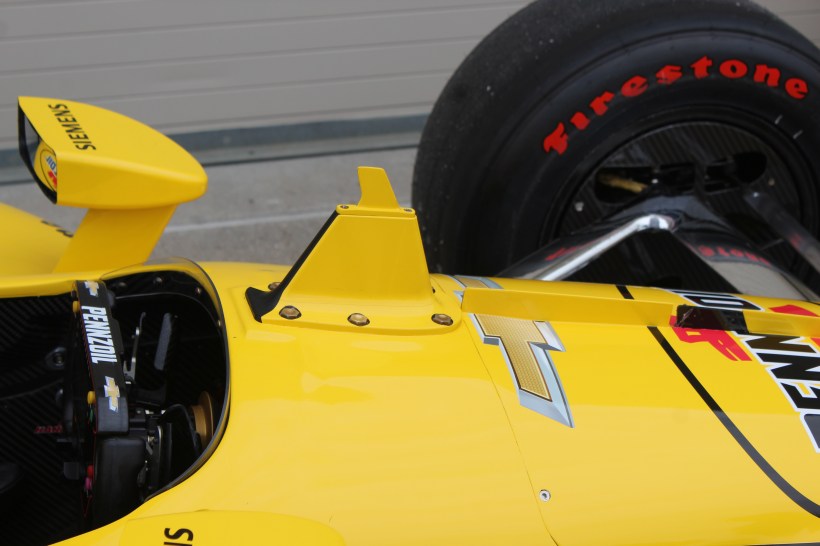
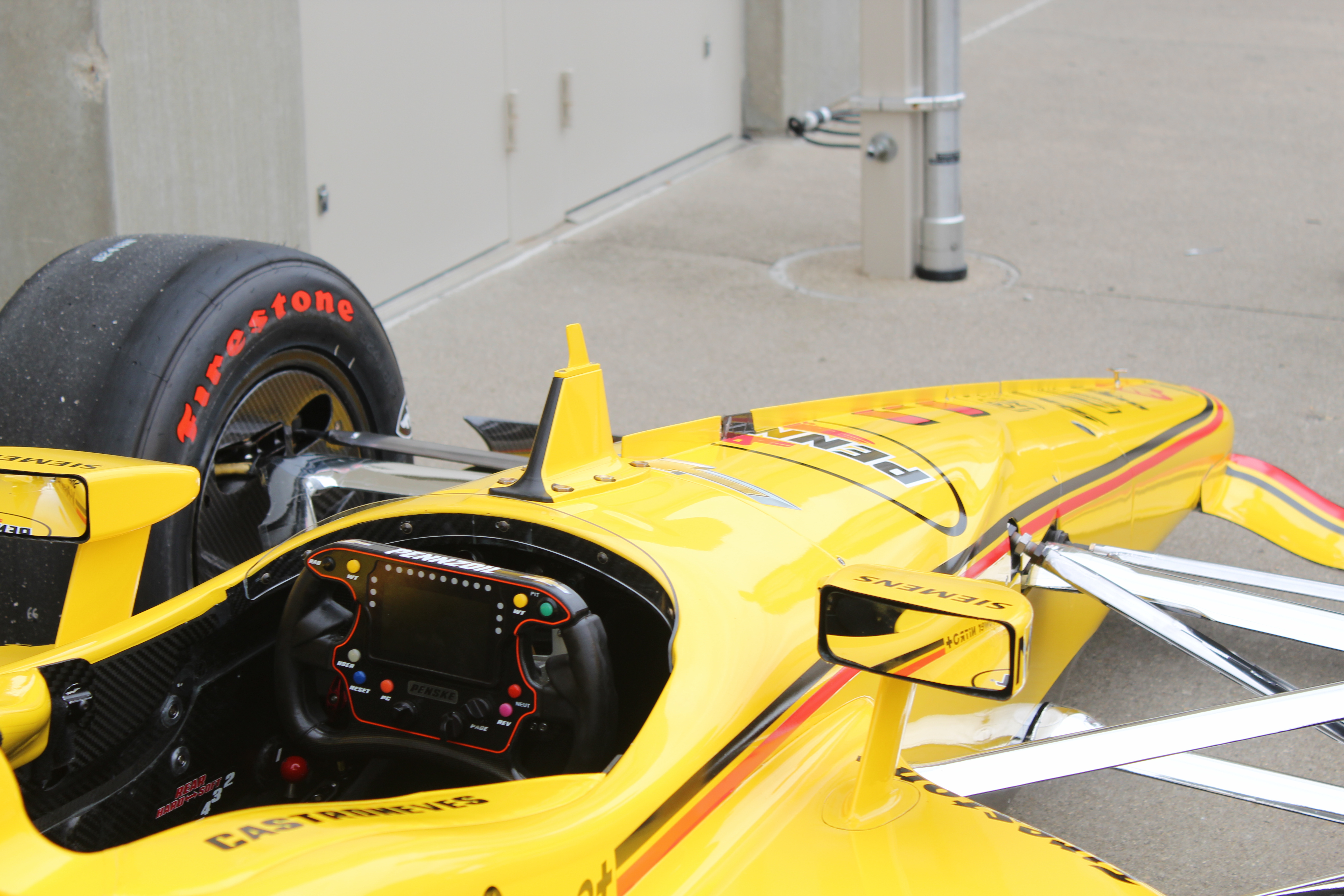
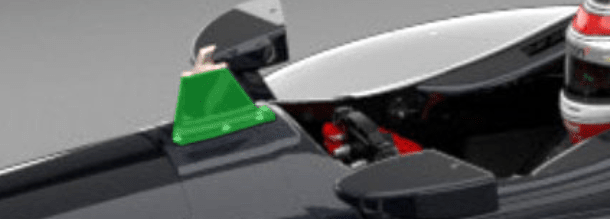
Yesterday Indycar introduced a new safety device which will debut at the Indianapolis 500. It is a small deflector in front of the cockpit between the rearview mirrors. The device, called the Advanced Frontal Protection Device (AFP),  is supposed to deflect low flying small debris.   The three inch high, 0.75 inch wide titanium piece is built b Dallara. The windscreen still needs more development, which is continuing. It might surprise you, but probably doesn’t , that I have some thoughts about this device.

In fairness, the AFP has not appeared out of the blue. It has bee discussed and studied for a few years. I’m positive the series would not put something on the car that has not been researched.

First, I have to trust Jay Frye and his team on this one. The never ending quest to make the cars safer is always at the front of his mind. I applaud his effort to implement some sort of safety deflector as an alternative to the windscreen. The screen had some issues. It added heat to the cockpits. Drivers who tested it complained of distortion and limited vision. I like that they are still working on it. The AFP does not appear to affect the driver’s sightline.

“Safety is a never-ending pursuit, and this is INDYCAR’s latest step in the evolution,” IndyCar president Jay Frye said. “There are more details to come about the phases to follow.”

I’m glad that the NTT Indycar Seeries is not proceeding with the windscreen because they don’t feel it is ready.

My concern is the AFP appears to be limited in what it can prevent from entering the cockpit and striking the driver. I’m not an engineer, but it appears that debris must come at a specific angle on a low trajectory for it to be effective.  The device seems designed to stop smaller objects.

Before commenting further, I would like to see a view of this from the front of the car.

I hope this is a stopgap feature leading to the windscreen. The AFP looks like it is a transitional device which will give way to a more comprehensive cockpit protector.

While the 500 will be the first race for the cars to use the AFP, it will be on all cars for the April 24 test at the  Indianapolis Motor Speedway. Like many safety devices, I hope it is never tested in a race. Sadly, needing it is the only to know if it works as intended.

A close-up of the deflector highlighted in green:

wp-15506263205104841224816522310609.png

Image by Indycar

Again, I need to see this in person and learn more about what it is designed to do before I pass a definite judgment.


You can read the complete release at Indycar.com


Frye Named Indycar President

This afternoon Jay Frye was named President of Indycar in a reshuffling of positions within Hulman and Company. The changes are a positive step, NASCAR had been pursuing Frye for awhile. It can only be a good thing that he remains with Indycar. He will continue to be Director of Competiton. The fukk statement from Indycar:

INDIANAPOLIS (Monday, Dec. 17, 2018) – Jay Frye will become President of INDYCAR as part of Hulman & Company organizational changes announced today by Mark Miles, President and CEO of the parent company.

Frye, who has led INDYCAR’s Competition and Operations departments since November 2015, will add Marketing and Communications to his responsibilities, effective Jan. 1. Miles will continue as CEO of INDYCAR.

Frye joined Hulman & Company, which owns INDYCAR and Indianapolis Motor Speedway, in 2013 as Chief Revenue Officer, leading the combined team of INDYCAR and IMS in sponsorship sales, licensing and account services. In 2014, the team secured a title sponsorship agreement with Verizon as well as the addition and expansion of several other corporate partners, including TAG Heuer and Panasonic.

Mark Sibla, INDYCAR Chief of Staff, Competition and Operations, will similarly expand his role with the Indianapolis-based sanctioning body, becoming Chief of Staff of all INDYCAR departments.

The reorganization is a result of C.J. O’Donnell’s resignation at year’s end. O’Donnell has been Chief Marketing Officer at INDYCAR and IMS since November 2013.

Curt Cavin, INDYCAR Vice President, Communications, and a new role to be filled of INDYCAR Vice President, Marketing, will report to Frye.

Additional organizational changes have been made at IMS, including:
• Jarrod Krisiloff will have his responsibilities expanded at IMS, becoming Vice President, Facilities and Events. He has been Executive Director, Events, for the past two years.
• Dan Skiver will become Director, Operations, and responsible for the many functions related to IMS events. Pat Garlock will be promoted to Assistant Manager, Facilities and Events.
• Alex Damron will be promoted to Senior Director, Communications, for IMS and Hulman & Company, and corporate communications will be added to his responsibilities.