October is a Lovely Time for an Auto Race

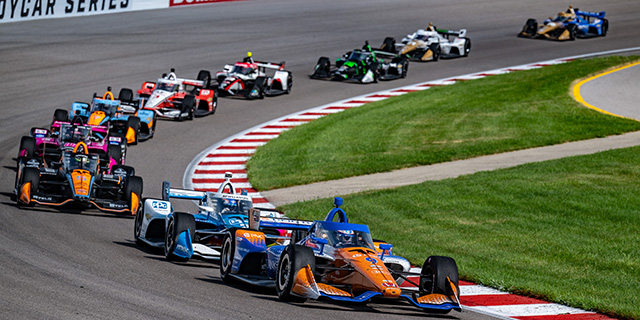
IndyCar ends its season next weekend, with at least four weeks of decent weather remining in the year in most of the country. In 2025, the season ends even earlier- on Labor Day weekend. As the calendar would have it, the season finale next year is on August 31. Why? Because IndyCar doesn’t want football to kill its ratings.

I have said this before- don’t be afraid of football, work around it. My good friend George Phiilips of Oilpressure is a big NFL and University of Tennessee fan. He prioritizes IndyCar until football season starts, then IndyCar goes on the back burner. I get that. Unlike George and a lot of other people, I don’t care for football. I probably cannot name 10 NFL quarterbacks; the only player I really know of is Taylor Swift’s boyfriend.

While I still have F1 continuing until November to get my open wheel fix it’s not the same. IndyCar is out of the public eye for six months. The series does not have a lot of post season awards tat they can give out a week at a time post season like the stick and ball sports. The checkered flag falls on the last race of the season, then we don’t hear much about IndyCar nationally until it’s time for St. Pete.

Going later in the year and accepting a ratings hit could avoid the four events in five week stretches which lead to long gaps between races during the current schedule.

The United Staes Grand Prix was in October at Watkins Glen was in October in the late 70s and early 80s.

How to work around football? Saturday afternoon races in the fall would avoid the NFL. True, there is college football on Saturday, but many games are lopsided. Would you rather watch an IndyCar race or the University of Georgia scoring 100 points against Nebraska Institute of Meteorology in September?

Everyone has their sports preference. In the racing postseason I prefer to watch college basketball and hockey, but neither starts until late October.

A mid-September race at Road America would be beautiful with the leaves turning color, and an October event in Phoenix could give Midwestern fans who attend a last taste of warm weather before settling in for the winter.

All may not be lost for fans like me. Mark Miles talked about putting together a postseason international series in an Indy Star article by Nathan Brown this morning. I would be fine with that, especially if it is shown opposite a football game.
Iconic Blue Envelopes Containing Indy 500 Tickets Mailed to Fans across Globe

One of the three best days of the year!

From IMS:

  INDIANAPOLIS (Tuesday, March 12, 2024) – Indianapolis 500 fans will watch their mailboxes after the highly anticipated blue envelopes featuring Race Day tickets were mailed Tuesday, March 12 from the Indianapolis Motor Speedway Ticket Office.
AJ Foyt Racing’s Sting Ray Robb and Meyer Shank Racing’s Felix Rosenqvist (photo, left, right, with IMS President J. Douglas Boles) were on hand to assist with the initial mailing, which included shipments to all 50 U.S. states, the District of Columbia and 36 countries around the world as race fans eagerly await the 108th Running of the Indianapolis 500 presented by Gainbridge on Sunday, May 26.
“This is really cool,” Robb said. “It’s the start of what we dream about during our offseason, and it feels like it’s becoming real as we approach the Month of May.
“It’s really cool to see physical tickets still going out to the fans because you see people who have been coming to the track for 50, 60, 70 years for the ‘500,’ and they probably still have some of those tickets laying around. We’re continuing that history here today.”
Rosenqvist and Robb also took time to write notes and signatures on a few envelopes, with Rosenqvist’s special messages going to ticket buyers from his native Sweden.
“It’s cool to give a little message to some select fans back home,” Rosenqvist said. “It gives you a perspective of what we are doing. It’s so cool that people are coming from all around the world to watch this race. It means so much to me. I actually live here in Indy now, and the Indy 500 is both the greatest race in the world and my home race, but the fact that people are coming from my home country to watch, it gives you an idea how big it is.”
It takes approximately nine weeks to package all pre-ordered tickets for mailing, from orders the day after the previous year’s race up to current orders. Hard work from employees in the Ticket Office and other Penske Entertainment Corp. departments ensures the ticketing process runs smoothly and on schedule
.A few facts and figures about this year’s initial ticket mailing:
Number of tickets sent: More than 190,000 items (includes 160,000 Indy 500 Race Day tickets, parking, qualification and practice tickets, concert tickets, etc.)
Number of blue envelopes sent: More than 26,000
Number of U.S. Postal Service trays to accommodate envelopes: More than 580
Weight of all ticket envelopes and trays in first mailing: More than 5,300 pounds
Hours needed to fill envelopes by hand: More than 800 person-hours.
Number of working days to package envelopes: 48
Number of Penske Entertainment employees who fill envelopes: 48
Number of states distributed: 50
Number of countries distributed: 36 (including United States)Federal postal inspectors came to IMS with a large truck for the first mailing.
Robb and Rosenqvist joined several IMS employees in helping to load the trucks.
Receiving an eagerly awaited blue envelope in the mail is a rite of spring for thousands of fans of “The Greatest Spectacle in Racing.” But why are the envelopes blue?
In the 1970s, Indianapolis 500 tickets were mailed in brown envelopes with the IMS return address in the upper left corner. In the 1980s, a heavier-stock, gray-colored envelope was introduced to mail the tickets, with just the IMS Post Office box number in the upper left corner. A computerized printer also was used for the first time in the 1980s to print ticket customers’ name and address on each envelope.
When the NASCAR Cup Series was added to the IMS schedule in 1994, the Ticket Office needed a way to distinguish between the envelopes containing tickets for the Indianapolis 500 and the annual NASCAR race, especially if the Postal Service returned the envelope as non-deliverable.
So, the IMS Ticket Office decided to color-code the ticket envelopes for each event. Indianapolis 500 ticket envelopes became blue, Brickyard Weekend envelopes became purple, GMR Grand Prix envelopes became green, and ticket envelopes for other IMS events use a variety of colors, including red, cream, gray and yellow.
Tickets for the 108th Running of the Indianapolis 500 presented by Gainbridge on Sunday, May 26, the Sonsio Grand Prix on Saturday, May 11 and all other Month of May events are available at IMS.com/Tickets or via the IMS Ticket Office at 317-492-6700. 

Flinn Lazier to Make Indy Lights Debut in September

Indy Lights announced that the son of 1996 Indianapolis 500 winner Buddy Lazier will drive for Abel Motorsports in the final three races of the year at Portland and Weather Tech Raceway Laguna Seca.

The news release from Indy Lights:

Third-generation race driver Flinn Lazier will make his Indy Lights Presented by Cooper Tires debut with Abel Motorsports on Sept. 4 at Portland International Raceway.

Lazier also will drive the No. 15 Abel entry in the season-ending doubleheader Sept. 10-11 at WeatherTech Raceway Laguna Seca. Lazier, 23, is the son of 1996 Indianapolis 500 winner and 2000 INDYCAR SERIES champion Buddy Lazier and the grandson of 1981 CART Rookie of the Year and Indianapolis 500 veteran Bob Lazier.

“I’m really excited to get this opportunity to make my Indy Lights debut with Abel Motorsports,” Lazier said. “I’ve been working for this for a long time, and I am incredibly grateful to Abel Motorsports for giving me the opportunity to get my feet wet in the series. I can’t wait to get to Portland and begin working with the team and seeing what we can accomplish together.”

Colorado native Lazier is no stranger to open-wheel racing. He has won two races this season in the Formula Atlantic series and was the 2019 Formula Atlantic champion.

Lazier also made four starts in the Indy Pro 2000 Championship Presented by Cooper Tires in 2021 and also has extensive experience in Sports Car Club of America racing.

Al Unser, Jr. Battles Drivers and Demons

There are two Al Unsers, Jr. The great Indycar driver, who won two Indianapolis 500s and two national championships, and the addicted Al, who spent much of his off track time with drugs and alcohol. Al Unser, Jr. discusses both men in his autobiography, Al Unser, Jr. : A Checkered Past, as told to Jade Gurss. Gurss is the author of Beast, the story of the 1994 Mercedes -Ilmor engine that dominated the 1994 Indianapolis 500 which Unser won.

Unser, Jr. is brutally frank as he tells his story, using raw language at times. He does not rationalize his behavior in any way. He honestly talks about his triumphs on the track and his failures off of it.

Unser begins his racing career in karts with the help of his father, Al Unser, Sr. As a member of one of racing’s royal families, he feels the weight of continuing the legacy established by his dad and uncle Bobby. Unser is able to figure out the racing line quickly and starts winning races.

Al Unser, Jr. after winning the 1992 Indianapolis 500

Unser enters Indycar with the help of Rick Galles, an Albuquerque car dealer. Galles is willing to spend whatever it takes to produce a winning team. Unser chronicles his Indycar career, from the disappointment of losing his 500 duel with Emerson Fittipaldi in 1989 to his two victories in 1992 and 1994. His 1992 win over Gordon Johncock is still the closest finish in race history.

Unser starts his career as an aggressive driver in the style of Bobby Unser. An incident with Mario Andretti at Long Beach in 1989 and a talk with Andretti before the race at Nazareth causes him to get his aggressiveness under control.

While Unser enjoys success on the track, his life off the track is a time of drug consumption and family strife. In the chapter “Two Al Juniors” Unser talks about his infidelities, his arguments with his wife, Shelley, and his drug use. He admits to being fortunate that he raced in an era before the Indycar series had a stringent drug testing program.

Throughout the story, Unser recounts his failed tries at rehab facilities and his never ending battle with marijuana and alcohol. He is frank in discussing in detail the night he contemplated suicide

Unser is a good friend of Tony George. He understands his reason for starting the IRL, but he is unhappy with the way he implements it. The fear of a total CART boycott of the 500 leads George to add the NASCAR Brickyard 400 to the IMS schedule. Unser cites George’s plan not to invite the CART teams to Indy as the big error.

Unser says, “That’s where he went awry. That’s where he went sideways…he should have still invited the top teams. It was a self-inflicted wound, and no one was bold enough to tell him not to do it.”

The autobiography concludes as Unser finds Jesus and seeks redemption. he is free of the demons that once ruled his life. Unser is now a driver coach for Alliance racing, a Formula 4 team.

Al Unser, Jr. admits he is not a perfect person, on or off the track, but he has battled to improve himself after o many years of self loathing. The ending is inspiring and hopeful.

Al Unser, Jr. : A Checkered Past is available at Octane Press.

Pat Patrick, Car Owner, CART Founder, Dies at 91

Pat Patrick, who began his involvement in Indycar as a team sponsor and became one of the founders of CART, died Tuesday, January 5, at the age of 91 in His home in Phoenix. Patrick’s team won the Indianapolis 500 three times in his twenty seven years of ownership.

In 1967 Patrick’s oil company became a sponsor for Walt Michener’s team. In 1970 he became the co-owner of the team,with Johnny Rutherford driving. Rutherford just missed the pole of the 500 that year by0.01 second to Al Unser. Patrick owned the Indianapolis winning cars of Gordon Johncock in 1973 and 1982, and Emerson Fittipaldi’s victorious machine in 1989. The Wildcat chassis that Johncock put in Victory Lane in 1982 was the last American made car to win the 500. A Patrick car entered the 500 every year from 1970-1995. Patrick’s last entry At IMS was in 1994 with Al Unser, Jr. driving.

In 1979, Patrick and Roger Penske formed Championship Auto Racing Teams (CART) and by 1982 the organization sanctioned all Indycar races except for Indianapolis.

Patrick invested in what is now Indy Lights, and he was instrumental in Firestone’s continued involvement in the series.

John Paul, Jr., 1960-2020, Won in Two Eras

John Paul, Jr. began winning at 19 years old when he made the SCCA Runoffs, then immediately took IMSA by storm. He won the Daytona 24 Hours and Sebring in 1982 on his way to the IMSA GT championship. In 1983 Paul won the CART Michigan 500, passing Rick Mears on the final lap. I’m hard pressed to find someone else who won a race that way. He raced in two eras of Indycar, and also tried stock cars.

The Muncie, Indiana native had all the makings of a rising star. His career came to an abrupt halt in 1986 when he was convicted on a drug trafficking charge. Paul spent 2 and a half years in prison. When his racing career resumed, the bigger teams and sponsors shied away from him.

He drove in seven Indianapolis 500s, scattered over a period 16 years. Paul’s rookie year, 1985, ended with a lap 164 accident. His best finish was his final 500 when he was seventh in 1998.

Paul won the IRL race at Texas in 1998 driving for Team Pelfrey. He also had a brief foray into NASCAR in 1991.

Paul retired in 2002 after contracting Huntington’s disease.

The Greatest 33 Non-Winners: Final Grid- A Reader Request Post

Editor’s Note: This is the first reader request; originally published May 9, 2017

What a fun project this turned out to be! It was fascinating seeing how much those who submitted grids both agreed and disagreed. Some drivers got just one mention, while others appeared on every ballot.  There was near unanimous placement for some drivers, and some drivers were near the front on some grids and near the back on others. The driver nearly everyone agreed should be on the pole is Michael Andretti (pictured above, from 1992).

I  noticed the rankings were along age lines. Older fans close to my age seemed to have near identical grids,  and younger fans as a group submitted similar lineups.  Many drivers from long ago in general fared better on the lists from the older group. I was surprised how well the current drivers stacked up against the racers of the past. Another interesting detail is that all 50 driver finalists had at least one mention. I didn’t expect that.

To rank the drivers, I assigned points to the drivers corresponding to their spot on each person’s grid. A driver on pole got 1 point, the last driver got 33. If a driver was listed on pole on five grids, his total was 5. The lowest total won the pole. If a driver did not appear on someone’s grid, he/she was given 34 points. To my shock, there were only two ties. I resolved placement by averaged each driver’s highest and lowest rank of all the grades, with the lowest average getting the higher spot. One of the ties was for 32nd and 33rd. It was just like qualifying for the 1963 500.

The front row- Michael Andretti, Rex Mays, and Ted Horn, is strong. These drivers were in the top 10 on everyone’s grid. Andretti led 431 laps, the most by any non-winning driver. he started on the front row three times and had 5 top 5 finishes.  Rex Mays, in the middle of the front row is the only other driver to lead more than 200 laps and not win. Mays was on the pole four times. Ted Horn, on the outside of the front row, finished in the top five 9 times in 10 starts.

So here they are, the Greatest 33 Non-Winners of the Indianapolis 500:

Row 1

Michael Andretti

Rex Mays

Ted Horn

Row 2

Harry Hartz

Marco Andretti

Lloyd Ruby

Row 3

Gary Bettenhausen

Ralph Hepburn

Roberto Guerrero

Row 4

Scott Goodyear

Carlos Munoz

Robby Gordon

Row 5

Eddie Sachs

Tony Stewart

Jack McGrath

Row 6

Wally Dallenbach

Tomas Sheckter

Will Power

Row 7

Danica Patrick

Tony Bettenhausen

Joe Leonard

Row 8

Jimmy Snyder

Ed Carpenter

Danny Ongais

Row 9

Pancho Carter

Mel Kenyon

Kevin Cogan

Row 10

Vitor Meira

Russ Snowberger

Paul Russo

Row 11

Tom Alley

Johnny Thomson

George Snider

it’s kind of fitting that Snider is last on the grid. his trademark was jumping into a car on Bump Day and getting into the field starting near the back. Thanks to everyone who submitted a grid. I really enjoyed reading your thoughts and reasoning as to how yo put your grids together.

I will be back tomorrow with some 500 news and a report on my visit to the A. J. Foyt exhibit at the Speedway Museum. The cars were great to see, but the memorabilia was even more amazing to me. Thursday I will have my Indianapolis Grand Prix preview with my normally inaccurate winner’s prediction.


Sebring 2019 – A Two World Show

It’s called Super Sebring. The 67th running of the oldest sportscar race in the United States will also feature a 1,000 mile race featuring the World Endurance Championship series. The WEC cars look similar to the IMSA machines with a similar class structure. Most of the drivers who ran at the Rolex 24 will participate this weekend, although some will be in different cars.

The prime example of a driver switching to not only a different car, but the other series, is Fernando Alonso. Alonso was part of the winning Wayne Taylor Racing entry at Daytona. This weekend he drives for Toyota Gazoo in the WEC, his regular job. Toyota Gazoo is the top team in the WEC.

Indycar newcomer Ben Hanley’s Dragonspeed car will race in the WEC series Friday. Teams are not allowed to participate in both races. Jordan King, who drove the road course schedule for Ed Carpenter Racing in 2018 and will enter the 500 with Rahal Letterman Lanigan Racing, will also drive the WEC event in LMP2 car 37.

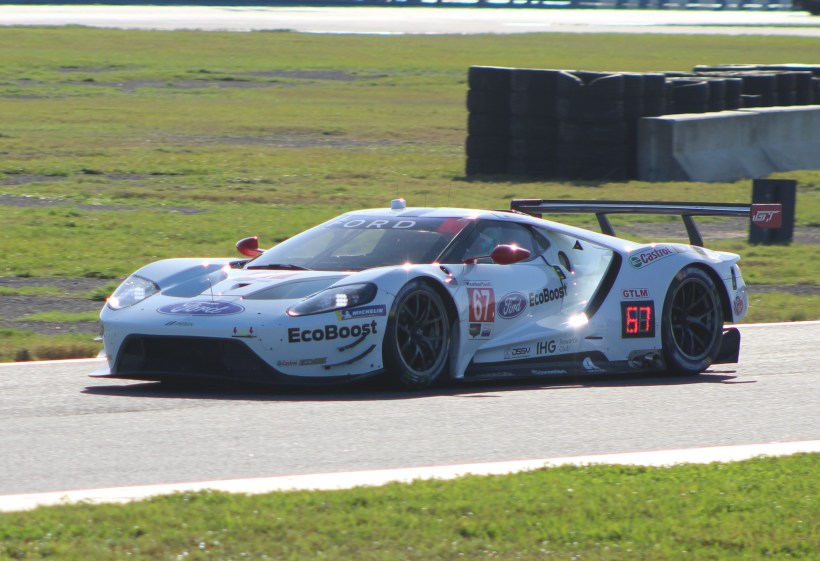
Chip Ganassi’s LMGTE Ford entry for Friday has two driver slots listed TBA. There is speculation Ford may leave the GT program at the end of this season.

Indycar Drivers Return to Rolex Teams

Five Indycar regulars who drove in the Rolex 24 return to the same teams for the 67th 12 hours of Sebring. Alexander Rossi will drive car 7 and Simon Pagenaud car 6 for Roger Penske’s Acura team.

Sebastien Bourdais in car 66 and Scott Dixon in 67 again join Chip Ganassi Racing’s Ford GTLM squad.

Colton Herta will again co drive car 25 for the Rahal BMW team.

Kyle Kaiser again drives for Juncos in car 50.

The Meyer Shank car 57 continues its all female lineup with Katherine Legge, Christina Neilsen, and Ana Beatriz. The team was disappointed this week to learn they did not receive an invitation to Le Mans.

The Disappearing Class

There are just two LMP2 entrants for the 12 hour. The class had just four cars at Daytona. As I wondered then, why does this class exist as a separate group? They qualify with the DPi cars and receive little recognition during the race. IMSA very much wants four classes, but they need to have a plan in place to develop the fourth class.

I am eager to see how this double header weekend works out. It will be interesting to compare the cars of the two series. I expect the WEC cars to be faster, but the IMSA racing to be better.

Watch for Updates Here

I will be posting updates all weekend, beginning with WEC qualifying tomorrow. Some will be quite brief.  I will have my Quick Thoughts column after each race. The WEC race ends at midnight, so look for that column Saturday morning (not early).

On Monday my full weekend wrap-u will be on Wildfire Sports.

1976: New Buildings, a Very Short Race, and an End to a Rainy Era

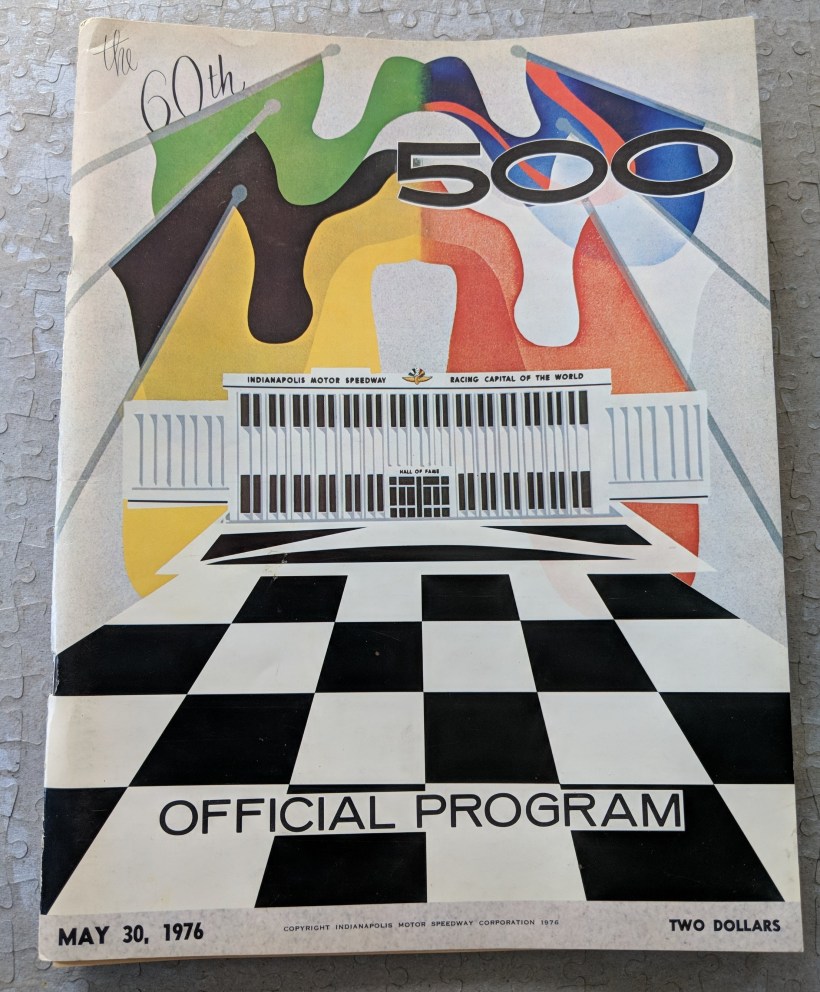
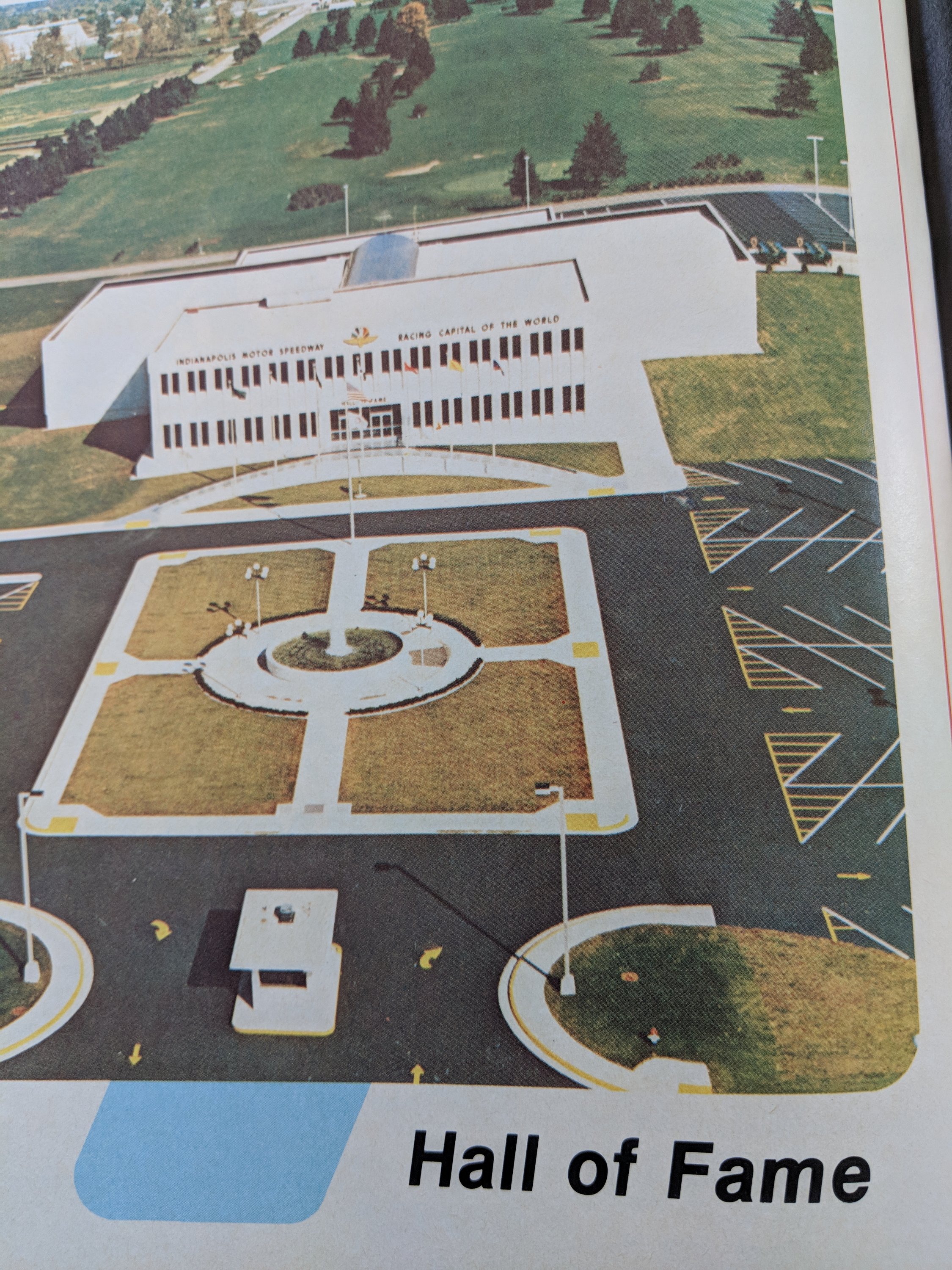
The modern face of the Indianapolis Motor Speedway began to take shape in America’s Bicentennial year. The current IMS Museum building opened, allowing for more old cars to be displayed. The building at the corner of 16th and Georgetown would become office space for IMS administration. The Speedway honored the new building with a rendition on the cover of the program.  A photo (below) in the program shows a much different space than we see now.

wp-15510553945525167816063197217686.jpg

Also new in the infield just west of the new Museum is the Louis Chevrolet memorial. The project had an estimated cost of $40,000. It would cost at least five times that today.

I believe this program was one of the last to have a memorial page, honoring drivers and others associated with the track and the race who had died since the last race. Three former winners grace the page, two who died early. Rene Thomas, winner of the 1914 500, died the previous September and at age 89. Other winners on the page are  1966 champion Graham Hill, killed in a plane crash in November 1975; and 1972 winner Mark Donohue, who died of injuries suffered in a testing crash in Austria.

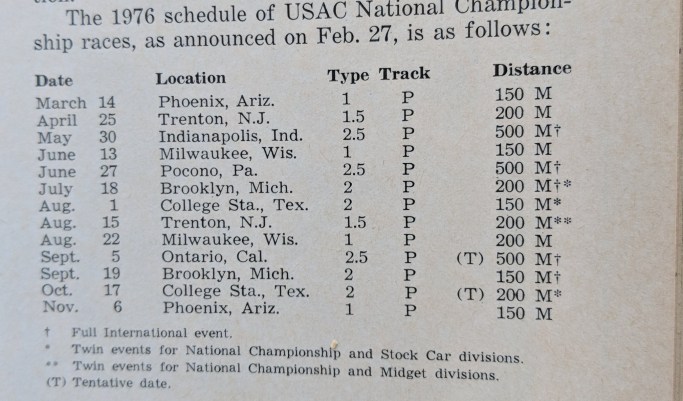
USAC has what seems like a larger than usual presence in the program. There is an ad inviting fans to join the club and a feature by Donald Davidson recognizing the USAC’s 21st year. The article  includes the 1976 schedule:

wp-15510554131545127155326271206613.jpg

Other stories are a nice tribute to Mary “Mom” Unser, mother of Bobby, Al,  Louis, and Jerry, Jr., who died of a heart attack the previous December.  Mary was popular for her famous chili, which she cooked every May for the paddock.

I always enjoy looking through the old programs for the ads for products no longer in use. Champion spark plugs, Monroe shock absorbers, CAM2 racing oil, and Standard oil are immortalized in print.

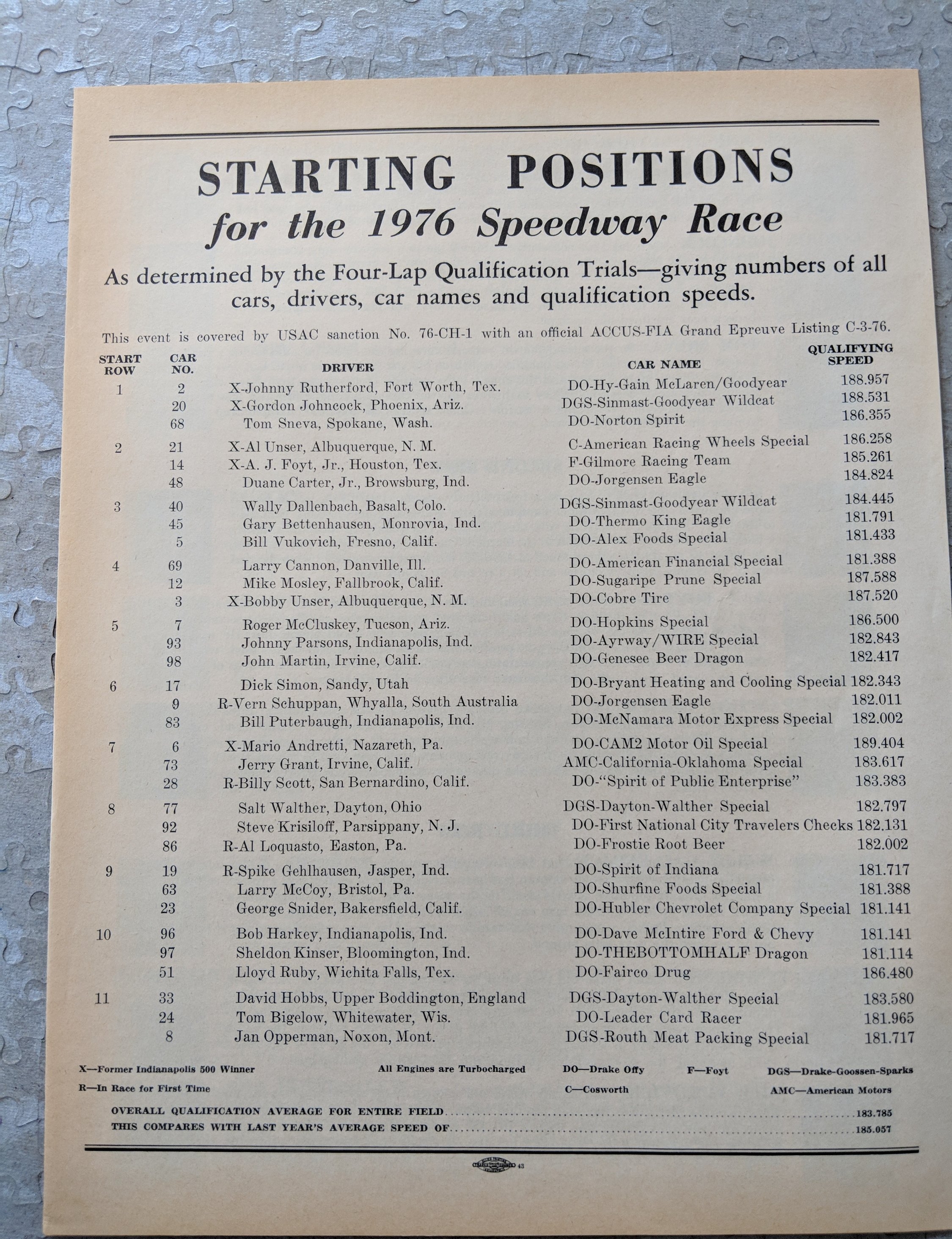
The score sheet insert is one I had never seen before. It is a pamphlet which includes thumbnail biographies of the drivers, a brief history of IMS, and the current USAC Championship point standings, plus a brief explanation of the points system. Going into Memorial Day, Gordon Johncock led the standings with 530 points. Johnny Rutherford was second with 400 points.

The winner of the 500 received 1,000 points and the 12th place finisher took home 50. Points were not awarded outside the top 12.


wp-15510554270039079659877841013571.jpg

The race itself turned out to be the shortest in history. Rain stopped the event after 102 laps, 255 miles. The field completed just one lap more than the required distance to make it an official race. Johnny Rutherford won from the pole, leading 48 laps. It was Rutherford’s second win in three years. It was the last race won by a four cylinder engine.

1976 was the third rain shortened race in a four year period. The 1973 race was postponed two days and ran only 133 laps, and in 1975, rain halted the race after 174 circuits.  An odd statistic- the back to back rain curtailments  gave each winner- Bobby Unser won in 1975-  their second 500 title. There have been just two rain shortened races since then, in 2004 and 2007.

Some races have had starts delayed because of weather and then run to completion the same day.   Others have had postponements of a day or two. The longest postponement was in 1986, when the race ran the Saturday following its original Sunday date.

Later this week, my season previews will be on Wildfire Sports. The Pit Window will share news and commentary on the week’s Indycar happenings as well.